Where Harvest Meets Hospitality: The Quiet Rise of the Working Farm Stay
From apiary tours in Tennessee to wool-spinning workshops in Portugal, a new breed of luxury properties invites travelers into the rhythms of agricultural life.
The Land as the Amenity
There is a particular quality of morning light at Wildflower Farms in New York's Hudson Valley, the kind that filters through a stand of birch trees and settles on dewy grass in a way that feels almost engineered for contemplation. Guests who rise early enough might find themselves walking the property's forest trails with a basket, foraging for ramps, or standing at the edge of the chicken coop, collecting eggs still warm to the touch. The 140-acre site, once a dairy farm and tree nursery, has been reimagined as something between a nature preserve and a luxury resort, where the working farm supplies ingredients not only for the kitchen but for the spa treatments as well.
This is not farm-to-table as marketing language. It is farm-to-table as physical experience, as daily encounter, as a reorientation of what a hotel might offer when it stops thinking of the land as backdrop and starts treating it as the central attraction.
Across continents, a quiet shift is underway in how certain properties conceive of luxury. The emphasis is no longer solely on thread count or Michelin stars, though those remain, but on proximity to process, to the cycles of planting and harvest, to the animals and the people who tend them. It is a form of travel that asks guests to slow down, to participate, to get their hands dirty if they wish, or simply to witness the work that sustains a place.
Immersion Over Observation
At Southall Farm & Inn in Tennessee, the 325-acre property operates as a self-contained world. Cars are left behind upon arrival; movement happens on foot, by bicycle, or via golf cart. The effect is deliberate, a way of encouraging guests to experience the land at a pace that allows for noticing. There are apiary tours, farm suppers, a Sunday farmers market. The architecture is elegant but unshowy, the details carefully considered: custom wallpaper, glazed clay plates, flowers cut fresh each morning.
The appeal lies not in spectacle but in the texture of daily life on a working farm. Guests are invited to participate in that life or to observe it, depending on temperament. Either way, the farm does not perform for visitors; it continues its work, and visitors are simply welcome to join.
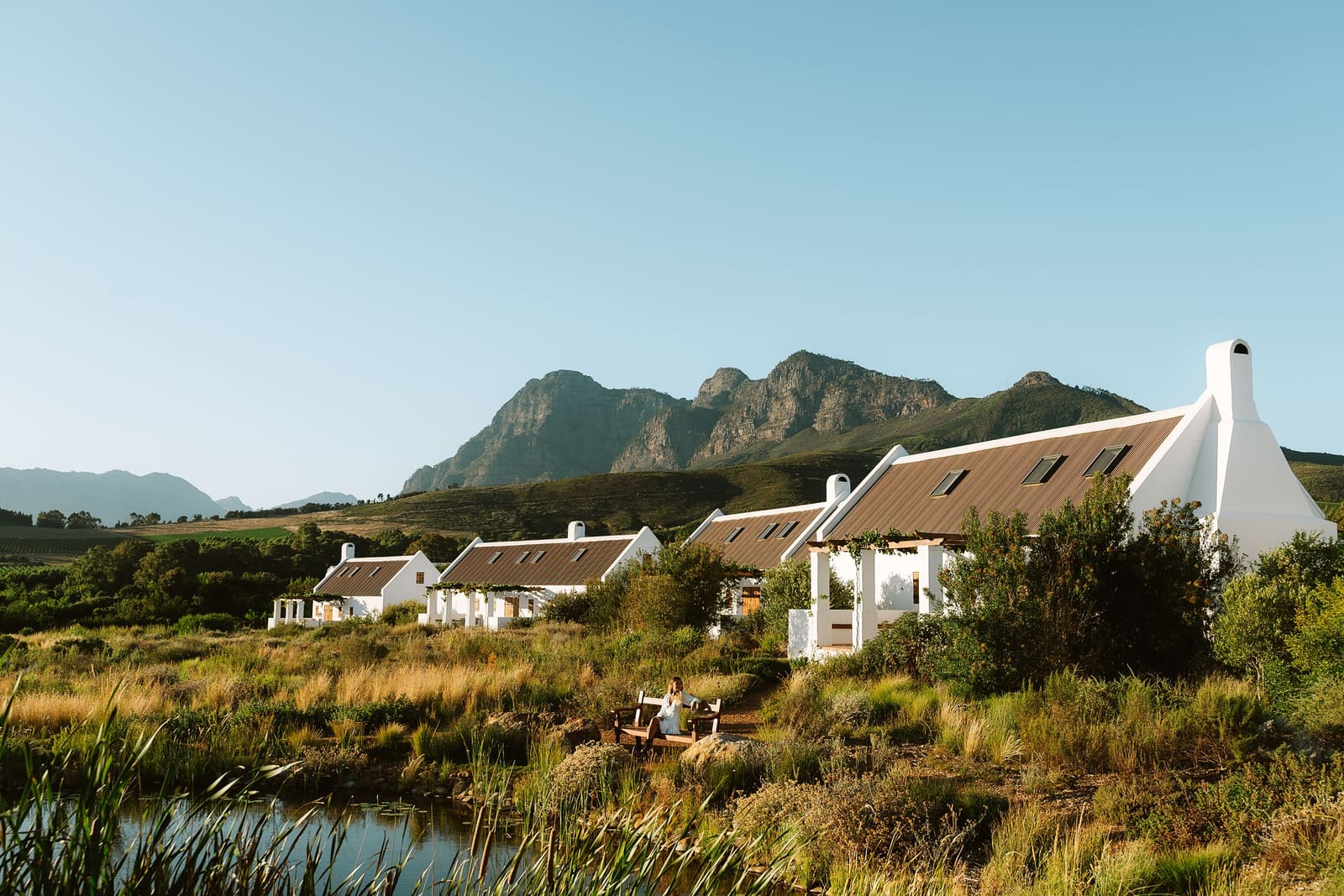
In South Africa, Babylonstoren sprawls across 2,600 acres in the Cape Winelands, a place where the line between hotel, garden, and agricultural estate blurs entirely. The property includes edible gardens, cheese rooms, wine cellars, and Soetmelksvlei, a refurbished 1890s farmstead where guests can milk cows, churn butter, and interact with craftspeople going about their tasks. The experience is immersive without being didactic, a chance to see how things are made without the pressure to master the craft oneself.
Daily garden tours wind through beds of vegetables and herbs, past fruit trees and beehives. The biodiversity is striking, and the kitchen draws from it liberally. This is luxury defined not by distance from the source but by intimacy with it.
The Architecture of Connection
At The Newt in Somerset, England, the Georgian mansion of Hadspen House anchors a property that includes former outbuildings converted into guest rooms, each quirky and individual. Some rooms overlook the ancient tree avenue; others, housed in the old stables, feature four-poster beds set into the original stalls. The surrounding woods, orchards, and deer park are open for guests to explore.
The Botanical Rooms restaurant combines the brightness of a Victorian greenhouse with the warmth of a gentleman's club, serving tasting menus that highlight produce from the estate. Cider tastings are held in the cellar, composting workshops in the garden. The property operates as a kind of living curriculum, where guests can choose their own level of engagement.
In Portugal's Alentejo region, São Lourenço do Barrocal occupies 2,000 acres of montado landscape, where cork oaks and olive trees punctuate wildflower meadows. Lusitano wild horses graze alongside cattle. The medieval town of Monsaraz rises in the distance, and granite dolmens hint at the region's ancient past.
The 40-room hotel is both elegant and unpretentious, housed in whitewashed farm buildings arranged around a geranium-lined courtyard. Guest activities include beekeeping lessons, ethnobotanical walks, and wool-to-yarn workshops. During olive harvest season, guests are invited to join in the picking. The estate has been producing wine for two centuries, and the cellars offer tastings of robust native varietals that pair with polished takes on traditional Alentejan dishes.
The Rusticity of Refinement
On Menorca, Son Vell presents a different aesthetic. The 18th-century Italianate villa, surrounded by olive and fig trees, holm oaks, and formal gardens, feels almost incongruous in the gently undulating agricultural fields of the island's western edge. The architecture is grand, the interiors pale and luscious, the 34 bedrooms distributed between the main house and five bungalows.
Yet the property remains a working farm, its organic gardens supplying the kitchen, its stables offering horseback rides through the surrounding countryside. The elegance does not negate the agricultural function; it simply coexists with it, a reminder that luxury and utility need not be at odds.
In New Zealand, Rosewood Cape Kidnappers occupies 6,000 acres of coastal hills in Te Awanga. While many guests come for the Tom Doak-designed golf course, the property is equally notable for Cape Sanctuary, a privately funded conservation project dedicated to habitat restoration and species reintroduction. Thanks to a predator fence and ongoing pest control, the sanctuary has become one of the best places on mainland New Zealand to observe native birds, including kiwis.
Shepherding experiences and garden workshops are available, but so is the option to simply walk the property and take in the wildlife. The farm operates in service of conservation as much as agriculture, a model that expands the definition of what a working farm might be.
Why Now, Why This
The turn toward farm stays reflects a broader cultural reckoning with distance. For decades, luxury travel emphasized removal, the idea that a great hotel should lift you out of the everyday and into a realm of seamless service and curated beauty. That model has not disappeared, but it is no longer the only one.
Travelers increasingly seek not escape but connection, not removal but rootedness. They want to understand where their food comes from, how a landscape is maintained, what it takes to sustain a place. The farm stay offers a way to engage with those questions without requiring a complete abandonment of comfort.
These properties succeed because they do not pretend to transform guests into farmers. The work remains the work of the staff, the farmers, the chefs. But the invitation to witness, to participate at the margins, to understand the labor and care involved, that invitation is real. And it changes the nature of the stay.
There is something deeply satisfying about eating a meal made from ingredients you watched being harvested, or walking past the beehives that produced the honey in your tea, or knowing that the flowers on your bedside table were cut from the garden you toured that morning. It is a kind of coherence, a sense that the place you are staying is not a stage set but a living system, and you are, however briefly, part of it.
The Craft of Participation
At Wildflower Farms, guests who collect eggs from the chicken coop can choose to take them home or pass them to the kitchen staff, who will prepare them for breakfast. It is a small gesture, but it encapsulates the ethos of these properties: you are invited in, but you are not required to perform. The farm does not need you to function, but it welcomes your interest.
At The Newt, harvest suppers are held outdoors, long tables set among the orchards, the meal punctuated by toasts and storytelling. At Southall, the Sunday farmers market brings together produce, baked goods, and preserves made on-site, a chance for guests to take a piece of the farm home with them.
These rituals matter. They create a sense of occasion without spectacle, a way of marking time that feels tied to the land rather than imposed upon it. The result is a kind of travel that feels less like consumption and more like participation, less like observation and more like collaboration.
The Quiet Luxury of Work
There is a paradox at the heart of the farm stay: it offers luxury through proximity to labor. The rooms are beautiful, the linens exquisite, the service impeccable. But the real draw is the work itself, the daily tasks that keep the farm running, the rhythms of planting and harvest, the care required to maintain a landscape.
This is not poverty tourism or performative rusticity. The properties are unequivocally luxurious, designed with an attention to detail that rivals any five-star hotel. But they locate that luxury in a different place, not in distance from the everyday but in a deeper engagement with it.
At São Lourenço do Barrocal, the evening might end around a firepit, guests wrapped in blankets, the stars overhead unusually bright in the Dark Sky Reserve. At Babylonstoren, it might end in the cheese room, tasting fresh ricotta and discussing the differences between cow's milk and sheep's milk with the cheesemaker.
These are not the kinds of experiences that can be manufactured. They require a property to be what it claims to be: a working farm, a living landscape, a place where the work of sustaining life continues regardless of who is watching. The fact that guests are invited to witness and occasionally participate in that work is the hospitality, not a distraction from it.
The farm stay, at its best, offers a way of traveling that feels less like escape and more like return. Not to a specific place, but to a way of being in the world that is attentive, engaged, and grounded in the rhythms of the land. It is luxury redefined, not as removal but as presence, not as distance but as intimacy. And in an age of increasing disconnection, that may be the most valuable offering of all.