Inside Eéso, Where Stone and Shadow Redefine the Cretan Suite
OmniView carves an adults-only enclave on Nema's grounds, trading resort brightness for geological intimacy and double-height drama.
A Hotel Folded Into Itself
Stand at the threshold of Eéso and the first thing you notice is not the pool or the planting but the quiet. The newest addition to Nema Design Hotel & Spa in Analipsi feels less like an extension than a withdrawal, a deliberate retreat into shadow and mass. Alexandros Kapetanakis commissioned Athens practice OmniView to design what architect Dimitris Tsigos calls an "introverted" complex. The word is not metaphorical. Privacy here is structural, built into the plan rather than layered on afterward with hedges or lattice.
Eéso takes its name from the ancient Greek for "within," and that preposition does the heavy lifting. This is a resort nested inside another resort, a second address that operates under its own spatial logic. Where Nema's original buildings engage the beach with ease and lightness, Eéso turns inward. Its vocabulary is one of enclosure: thick walls, deep reveals, rooms that climb two stories or sprawl horizontally across generous footprints. The palette has shifted too, from the crisp neutrals of a beachfront hotel to something darker, more mineral, closer to the island's geological memory.
Four Types, One Logic
The accommodation is organized into four categories. Atrium, Sanctum, Pavilion, Penthouse: each name signals a different spatial strategy. Some suites extend laterally, pulling gardens and private pools into their orbit. Others rise through double-height volumes, their walls climbing past sleeping platforms and seating areas to meet high openings that slice daylight into narrow bands. Verandas act as transitional zones, mediating between the conditioned interior and the Cretan afternoon.
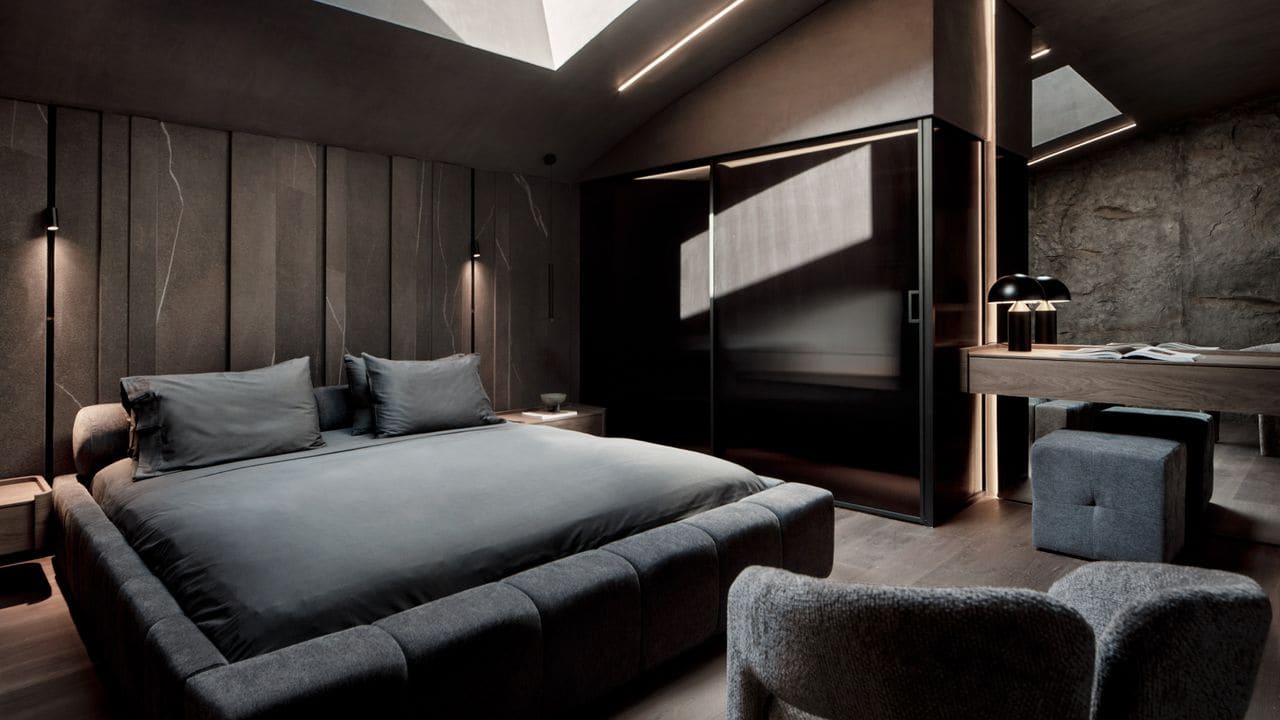
Tsigos explains that the brief demanded suites that felt generous and unexpected. OmniView answered by treating each unit as a distinct architectural proposition rather than a standardized room type. Floor-to-ceiling glass reveals the scale. In the taller suites, stone-textured walls rise uninterrupted, their surfaces broken only by apertures placed high enough to admit light without compromising seclusion. The horizontal suites work differently, using long glazed elevations to connect living and sleeping zones with their outdoor counterparts.
The result is accommodation that reads as carved rather than assembled. Built-in ledges, recessed niches, and substantial wall sections give the interiors a tactile, almost geological presence. There is a sense that the rooms have been excavated from the landscape rather than imposed upon it.
Material as Regional Anchor
The palette is earthy and dense. Charcoal, mineral grey, earthen brown: these are not the colors of a typical Mediterranean resort. Rough, stone-like surfaces meet glass, metal, and reflective finishes, their contrasts heightened by the strong coastal light. OmniView describes the interiors as a conversation between raw reference and architectural precision. The stone and tactile surfaces carry a connection to the landscape; the geometry supplies the discipline.
Cultural identity is embedded in the substance of the building rather than applied as decoration. There are no scenic arches, no nautical flourishes, no decorative nods to antiquity. Instead, the connection to Crete is material and procedural. OmniView sourced locally where possible, beginning in nearby Heraklion and working with suppliers and craftspeople across mainland Greece when an appropriate island-based solution was unavailable. The result ties Eéso to the region through workmanship and substance.
This approach aligns with a broader shift in luxury hospitality, where authenticity is increasingly understood as a matter of production rather than pastiche. The materials here are not meant to evoke Crete; they are of Crete, their origins traceable to quarries, workshops, and fabricators within the region.
Water as Inhabited Territory
At the center of the enclave, a shared pool complicates the usual relationship between water and lounging. OmniView has positioned pergola-topped seating structures inside the pool itself, turning sections of the water's surface into inhabitable rooms. Each structure is equipped with its own seating and shade, forming a private retreat within a shared aquatic landscape.
Water here functions as a spatial divider, separating the structures in place of solid partitions. The pergolas edit the sunlight, casting sharp shadows that shift throughout the day. Their geometric outlines repeat and distort in the reflections below, creating a layered visual field that changes with every ripple.
The strategy is unusual. Most resort pools treat water as a backdrop or a recreational amenity, something to be looked at or swum in. OmniView treats it as architecture, a medium that can be inhabited and subdivided. The result is a pool that feels less like a communal amenity and more like a series of private rooms connected by a liquid corridor.
A Complete Precinct
Eéso includes its own dining venue, Ná Le Ma, an à la carte restaurant reserved for guests of the enclave. Together with the pool, suites, and gardens, it allows Eéso to function as a complete resort precinct within Nema. Guests can remain entirely within the enclave if they choose, or they can move between Eéso and the original hotel, depending on their preference for intimacy or openness.
This model of a hotel-within-a-hotel is not new, but it remains relatively rare in Greece. It allows operators to segment their offering without building an entirely separate property, and it gives guests the option to pay for a different kind of experience: more private, more curated, more architecturally distinct. For Nema, Eéso represents a second identity, one that retains the original hotel's design vocabulary while translating it into a different scale and mood.
Geometry Meets Geology
The architectural language of Eéso is spare but sensuous. The interiors avoid ornament, relying instead on proportion, light, and material to create atmosphere. The double-height suites feel monumental without being cold, their scale softened by the warmth of the stone-like surfaces and the controlled admission of daylight. The horizontal suites feel expansive without being exposed, their long glazed walls framing views of private gardens and pools.
There is a deliberate tension between the building's geometric precision and its earthy materiality. The lines are sharp, the volumes clearly defined, but the surfaces carry texture and variation. This balance between rawness and refinement is what gives Eéso its character. It is neither rustic nor minimalist, but something in between: a built landscape that feels both ancient and contemporary, rooted and refined.
The Case for Introversion
In an era when many luxury hotels compete to offer the most expansive views, the most open-plan interiors, the most seamless connection between inside and outside, Eéso makes a case for enclosure. Its suites are designed to contain and protect, to create a sense of refuge rather than exposure. The thick walls, deep reveals, and high openings are not defensive but deliberate, a response to the intensity of the Cretan climate and the desire for a different kind of luxury.
This introversion is not a rejection of the landscape but a different way of engaging with it. Instead of dissolving boundaries, Eéso frames them, creating thresholds that heighten the experience of moving between interior and exterior. The result is a hotel that feels less like a transparent pavilion and more like a series of inhabited caves, each one carved to admit just enough light and air to make the enclosure habitable.
For travelers seeking a retreat that prioritizes intimacy over spectacle, Eéso offers a compelling alternative. It is a place where luxury is measured not by square footage alone but by the quality of enclosure, the precision of proportion, and the tactile richness of materials. It is a hotel that asks its guests to look inward, to find beauty not in the panorama but in the detail, the shadow, the weight of stone against skin.