Behind the Sukajan Curtain: A Hidden Hi-Fi Lounge in the Heart of Abu Dhabi
Saikindō disguises itself as a fashion atelier before revealing a world of vintage audio, yakitori smoke, and cocktails tuned to the rhythm of vinyl.
A Door That Shouldn't Be There
The lobby of the Four Seasons on Al Maryah Island ends in what looks like a small fashion studio. Embroidered bomber jackets hang along the walls, each one stitched with the kind of imagery that flooded Japan in the 1980s: stylized tigers, flames, kanji. Accessories catch the light. And then a wall opens.
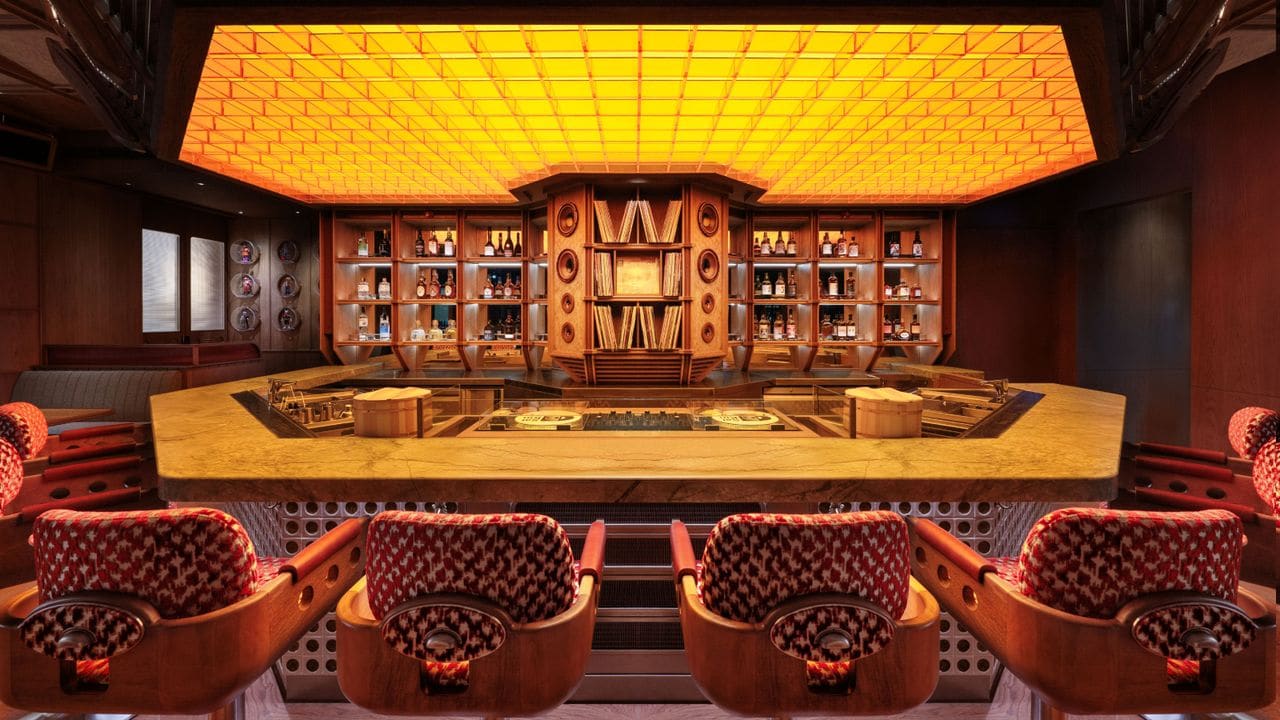
What lies beyond is not a stockroom. It is a bar called Saikindō, and it has been designed to feel like stepping into the interior of a vintage speaker cabinet lined with oak and wired for warmth. The name, in Japanese, translates loosely to "How have you been?" a phrase that carries the easy familiarity of a regular haunt. That tone, casual but considered, runs through every element of the space.
At Global Chic Voyage, we have spent years watching hospitality concepts lean harder into narrative. But Saikindō does something different. It does not announce itself. It misdirects, then reveals. The fashion atelier is not decoration. It is threshold.
Metabolism, Vinyl, and a Borrowed Swagger
The design language here draws on three distinct references, each one feeding into the atmosphere without overtaking it. The first is Japan's Metabolism movement of the 1960s, an architectural philosophy that treated buildings as living organisms, modular and adaptable. The second is the material craft of mid-century audio equipment, the kind built from timber and metal and meant to last. The third is harder to pin down: a fictional collision of James Bond and Bōsōzoku biker gangs, trading tailored suits for embroidered jackets and trading martinis for something smokier.
The entrance corridor makes the Metabolism reference explicit. Circles and squares repeat across the walls in carved relief, backlit to suggest both radio static and the geometric grids of Kisho Kurokawa's capsule towers. The effect is cinematic without being theatrical.
Inside the main lounge, shallow speaker forms climb the walls in staggered rows. The materials are oak, jade velvet, and polished metal, all of them chosen to echo the warmth of analogue sound systems from the 1970s. The central DJ booth anchors the layout, flanked by shelves of vinyl and two diagonal mixing stations. The bar counter sits flush with the floor, placing bartenders and guests at the same eye line, a small gesture that shifts the usual power dynamic.
Elsewhere, a private room called Kūkan hides its own DJ booth behind embroidered panels of flaming tigers. Outside, a woven mural reimagines Ultraman, King Kong, and Godzilla as decorative motifs, their pop-culture menace translated into craft.
Cocktails Structured Like a Record
The beverage program, led by Marco Corallo and Ann Pinsuda, takes its structure from the format of a vinyl LP. The menu, titled Aji No Hibiki or "Resonance of Flavour," contains twelve cocktails split between Side One and Side Two. Each drink is named after a song, and each song informed its flavor profile through rhythm, tempo, and melody.
Big Poppa, for example, combines sotol with Campari, wasabi, tomato dashi, and vanilla, a drink that reads savory and slightly off-kilter. Like Sugar pairs vodka with black sesame, banana, tonic, and blueberry balsamic, leaning into sweetness without tipping into dessert territory. Several drinks are also available as zero-proof serves, a detail that feels more pragmatic than performative.
The approach is not new, exactly. We have seen cocktail menus structured around albums, around playlists, around the supposed moods of different decades. What makes this one work is restraint. The songs are not explained. The bassline is not annotated. The drink simply exists, and if you know the track, the connection lands. If you don't, the cocktail still holds up.
Charcoal, Wagyu, and the Robata Room
Food comes from the Robata Room, an 18-seat enclave where chef Slamet Wahyudi works a charcoal grill. The menu is short and precise. A5 wagyu tartare arrives with smoky mustard and a charcoal bun, the kind of dish that feels indulgent without requiring ceremony. Lobster negima is grilled with yuzu kosho butter, the citrus cutting through the richness. Kobe sirloin skewers come with yolk tare and torched spring onion, each element contributing texture and char.
The cooking here is not fusion. It is grounded in Japanese technique, particularly the kind practiced in yakitori-ya and izakaya, where the grill does most of the work and the ingredients are allowed to speak. The wagyu is Australian, the lobster likely Gulf-sourced, but the treatment is unambiguously Japanese.
What strikes us is the lack of overreach. The menu does not try to be comprehensive. It does not offer sushi or ramen or tempura. It stays within the logic of the grill, and that focus gives the food clarity.
A Bar for the After-Work Island
Al Maryah Island is a business district, home to the Abu Dhabi Global Market and a cluster of high-rise offices. It is not a neighborhood in the traditional sense. It is a zone, purpose-built, and the people who spend their days there are often looking for somewhere to decompress before heading home.
Saikindō positions itself for that moment. The music is analogue but not precious. The lighting is low but not moody. The dress code, implied by the sukajan jackets at the entrance, leans casual. The question the bar seems to ask is not "How sophisticated are you?" but "How have you been?" The difference matters.
In a city where luxury often manifests as spectacle, Saikindō opts for something quieter. The misdirection at the entrance is playful, but once inside, the space settles into a rhythm that feels lived-in rather than curated. The vinyl spins. The yakitori smoke drifts. The bartenders work at eye level. It is a bar that knows what it is.
The Limits of Borrowed Aesthetics
There is a risk, of course, in building a concept around borrowed cultural signifiers. Bōsōzoku gangs, Metabolism architecture, vintage hi-fi, 1980s Japan as a kind of neon-soaked dreamscape: these are all potent images, and they have been mined extensively by designers looking to inject edge into hospitality projects. The line between homage and pastiche is thin.
Saikindō walks that line carefully. The sukajan jackets are not costumes. The Metabolism references are not applied as decoration. The vinyl is not for show. Each element is integrated into the spatial experience, and the bar does not ask guests to perform a version of Japaneseness. You can arrive in a suit. You can arrive in sneakers. The space accommodates both.
What makes it work, ultimately, is restraint. The design is dense but not cluttered. The menu is conceptual but not overwrought. The music is present but not dominating. The bar knows when to reveal and when to hold back.
A New Kind of Hideaway
We have watched Abu Dhabi's hospitality landscape evolve over the past decade, from the early wave of international luxury brands to the more recent crop of chef-driven restaurants and concept bars. Saikindō belongs to the latter category, but it brings something different to the table. It is not trying to be the best Japanese bar in the city. It is not competing on authenticity. It is building a world that borrows from Japan, from mid-century audio culture, from 1960s architecture, and from the swagger of biker gangs, and it is doing so with enough confidence to make those borrowings feel coherent.
The question it raises, for us, is whether this kind of layered, narrative-driven design will become more common in Gulf cities, or whether it remains an outlier. Abu Dhabi has the infrastructure for it. The audience is there. The appetite for something beyond the standard luxury playbook is evident. But the execution requires a light touch, and that is not always easy to find.
For now, Saikindō offers a glimpse of what happens when a bar treats its concept seriously without taking itself too seriously. The door is hidden. The world inside is deliberate. And the question it asks, in Japanese, is simple: How have you been?