Where Arctic Darkness Meets the Dinner Table
In Norway's remote Lofoten archipelago, a culinary retreat inside restored fishing cabins turns storm-battered mountains and fjord waters into the season's tasting menu.
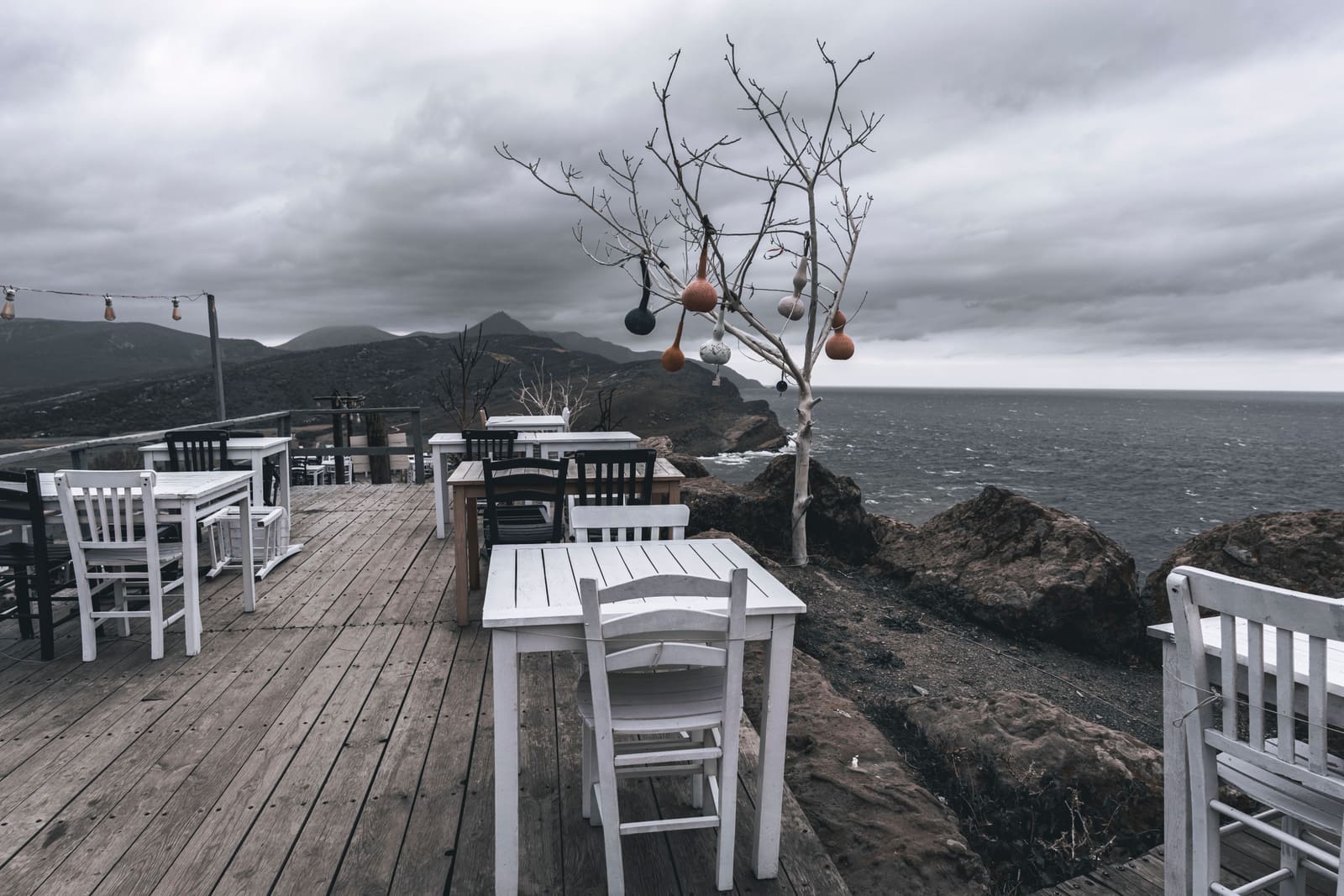
The Weight of Clouds
Moss underfoot turns to liquid when rain arrives sideways. At nearly six hundred metres above the Norwegian Sea, stone loses its grip, birch branches whip across your palms, and the promised vista of glacial valleys dissolves into fog. This is Lofoten in late September, when summer's endless daylight has retreated and the archipelago's true character surfaces: elemental, unforgiving, older than the dinosaurs.
The reindeer-meat sandwich tastes better for the climb. Sheltered beneath a granite overhang, the group chews on dried fish and Norwegian chocolate wafers while the storm presses against the mountain's eastern flank. Below, somewhere in the white-out, lie the freshwater lakes and painted villages that fill the brochures. Up here, sixty-eight degrees north of the Arctic Circle, visibility ends at your outstretched hand.
Yet it is precisely this harshness that draws close to a million visitors annually to these spiky islands, and it is this same severity that defines what grows, swims, and eventually appears on the plate. In Lofoten, the menu is written by the Gulf Stream, the Barents Sea, and the brief, intense growing season that sends wildflowers into a photosynthetic frenzy. To eat here is to taste geology, climate, and a thousand years of coastal survival.
Stilts Above the Tide
In Sørvågen, a village clinging to the archipelago's southwestern edge, a row of corrugated-roof cabins painted the colour of mustard seed juts into the water on wooden stilts. These are rorbuer, the traditional fishing shelters that once housed cod workers during the winter harvest. Grass insulation tops some roofs; weathered planks connect the structures via narrow walkways that creak in the wind.
Holmen Lofoten occupies this cluster of restored buildings, its guest rooms framed by picture windows that fill with surf and stone. The interiors are spare: local wood, hand-hewn furniture, none of the gilt or marble that signals luxury elsewhere. Here, extravagance is the view, the silence, and the knowledge that the nearest city lies two flights and several fjords away.
Ingunn Rasmussen took over the property in October 2001. A fisherman's daughter, she spent her childhood near this site; one cabin still bears her sister's pencil marks on the wall. After years abroad, she returned with a vision to restore the rorbuer without erasing their history. Her son, Håvar Holmen, now runs the property alongside her. The project was meticulous: preserve the original frames, add only what honours the vernacular, and ensure that every material speaks to place.
In 2018, Ingunn launched Kitchen on the Edge of the World, a quarterly culinary event that invites acclaimed chefs to cook within these walls. The thirtieth edition would be led by Matt Orlando, a California-born chef whose CV includes The Fat Duck and Per Se, and whose Copenhagen restaurant Esse earned a Michelin star within months of opening. But pedigree matters less here than philosophy. Ingunn selects chefs who understand land stewardship, who forage with care, and who recognise that the people and wildlife of Lofoten are not backdrop but co-authors of every dish.
Infusions and Icebreakers
The first evening begins in the living room above the kitchen. Exposed beams, foraged branches, taxidermy, and sculptural driftwood echo the landscape beyond the glass. The interiors are deliberately raw, as though the outdoors has been invited in and asked to stay.
Trays circulate with shrimp croustades and drinks that resemble Negronis but tell a different story. The vermouth has been infused with foraged blackcurrant leaves; the bitter component steeped with dried berries and yarrow flowers. The non-alcoholic option is equally layered: elderflower tonic with syrup made from wild hops picked nearby. Each sip carries the hillside's autumn palette, the rust and gold that blankets the slopes in late September.
Holmen's kitchen team, drawn from as far as Sicily and Brazil's Piauí region, prepared this opening feast. The meal is designed to break the ice, and Ingunn promises that by the fourth day, the group will feel like old friends. The guests are varied: a geologist from Brunei, an adventurer from Dubai, a Melbourne retiree who travels solely for intimate food events. Conversations spill onto the deck, where dessert arrives as ice cream flavoured with black currant leaves and lovage, topped with mascarpone made from Lofoten cream and finished with meringue charred over Japanese binchotan. The Northern Lights tracking app suggests the aurora is close, and Holmen keeps watch on the skies.
Mia Hjorth Hansen, co-owner of Gedulgt, a cocktail bar in Aarhus, Denmark, works at a corner station surrounded by glass jars filled with cornflower, dandelion, and fireweed. This is her twelfth Kitchen on the Edge. While visiting chefs rarely return, Hansen is an exception, her elixirs now a fixture of the experience. She speaks of the chefs who have passed through: Ana Roš of Slovenia's three-Michelin-starred Hiša Franko, Simon Rogan of the UK's farm-to-table movement. Each shares a commitment to the land, a refusal to extract without giving back.
The Morning After the Storm
The next morning, Orlando and his sous chef, Tom Siebeler, are already at work when the first guests wander into the kitchen. Holmen encourages this: the kitchen is the heart of the property, and visitors are welcome to pull up a stool at any hour.
Orlando stands beside the wood-fired oven, working through a pile of reindeer ribs sourced from a sustainable farm run by Sámi herders north of the archipelago. He had expected chops and is now improvising garnishes to suit the ribs. Reindeer is one of many ingredients Holmen sources locally, alongside cheeses, Lofotlam (a Geographical Indication-protected lamb), and vegetables grown in the brief, intense summer.
The tableware is equally considered. Local ceramicist Gunvor Tangrand creates the plates and bowls, their organic forms and textured surfaces incorporating old fishing yarn, a quiet nod to the rorbuer's original purpose.
Orlando arrived in Lofoten with a case full of building blocks: barley, Danish yellow peas, several kinds of miso. But his excitement centres on what he can find here. He invites a guest to step outside and forage for the evening's menu. They return with chickweed, corn shoots, and sheep sorrel. "Thinking on the fly and exploring the potential in things you've never worked with is where the coolest ideas come from," he says.
Orlando's background informs his approach. He opened Amass, a circular restaurant in Copenhagen's industrial Refshaleøen neighbourhood, where a low-waste tasting menu was paired with a harborside produce garden. Amass has since closed, but Esse, which opened last year in a restored Nordhavn warehouse, carries forward the same environmental philosophy. Signature dishes, including fermented potato bread, made the move. At Holmen, that philosophy finds a natural home.
Fishbone Noodles and Harvest Moon
That night, the communal tables are adorned with wildflowers and candlelight. The fermented potato bread arrives first, served with allium butter, and the table erupts in quiet delight. Then come the fishbone noodles, a creation made by pressure-cooking fish bones until they can be puréed smooth. The collagen-rich mixture gives the noodles their slippery texture, which Orlando complements with smoked chili, sunflower-seed miso, and fermented chili cream.
The meal is served family-style, messy and convivial. Utensils are set aside for the main course: reindeer, eaten with hands. The pescatarian option is hedgehog mushrooms grilled with chili-strawberry barbecue sauce and served with Lofoten chimichurri. Outside, the harvest moon hangs above the fjord.
Four Seasons in an Hour
Weather in the North moves quickly. Calm gives way to chaos, then back again. The phrase "four seasons in an hour" is repeated often, and it is this volatility that makes Lofoten so productive. The Gulf Stream's warmth meets Arctic cold, creating conditions that support marine life. Long hours of summer sunlight send plants into overdrive. Sea spray nourishes the pastures where lambs graze.
Ingunn leads foraging walks, returning with fireweed flowers for immune-boosting tea, cloudberries for jam, lovage for savoury butter. She speaks of the land and sea as family, as something that has nourished generations. This is not metaphor. In Lofoten, survival has always depended on reading the landscape, on knowing when the skrei will arrive and when the berries will ripen.
Skrei, or Arctic cod, is the archipelago's most enduring food source. The tepee-style wooden drying racks known as hjeller are as much a part of the visual landscape as the mountains themselves. These frames have stood for more than a thousand years. In late September, they are empty. Come January, they will be stacked with skrei caught at the end of their annual migration from the Barents Sea to Lofoten's milder spawning waters. Transformed into tørrfisk, or wind-dried stockfish, this seasonal bounty has sustained the local economy for centuries.
The racks are a reminder that in Lofoten, food is never merely sustenance. It is calendar, economy, identity. To eat here is to participate in a system older than the rorbuer, older than the villages, older than the names given to the mountains.
The Long View
On the final morning, the fog lifts. The view that was promised on the first day finally reveals itself: spiky peaks, freshwater lakes, the Norwegian Sea stretching towards the horizon. The group gathers one last time in the living room, quieter now, reluctant to leave.
Holmen Lofoten does not offer escape. It offers immersion, a chance to eat what the land and sea provide, to forage what grows in the brief window of warmth, to taste the Gulf Stream's gift and the Arctic's severity in equal measure. The chefs who pass through understand this. They arrive with technique and vision, but they leave having been shaped by the place.
Orlando packs his knives, his case of miso and barley now half-empty. He speaks of the fishbone noodles, the improvised garnishes, the sorrel pulled from the hillside. "Cooking in remote places forces you to see potential everywhere," he says. "That's the gift."
As the guests depart, Ingunn is already preparing for the next edition. The rorbuer will stand through winter, battered by storms, dusted with snow. The hjeller will fill with cod. The Northern Lights will return. And in a few months, another chef will arrive, another group will gather, and the cycle will begin again.
In Lofoten, the table is always set. The menu is written by the wind, the tide, and the memory of a thousand winters. To dine here is to accept that you are not the centre, that the meal exists because the land permits it, and that the greatest luxury is not comfort but connection to something older, harder, and infinitely more generous than yourself.