
The Pacific Northwest City That Finally Stepped Out of Seattle's Shadow
Bellevue has quietly assembled a culinary scene, park system, and waterfront identity that no longer needs an introduction - or an apology.
ML
6 Jul 2026 · 5 MIN READ · UPDATED 17 AUG 2026
A City That Stopped Apologizing
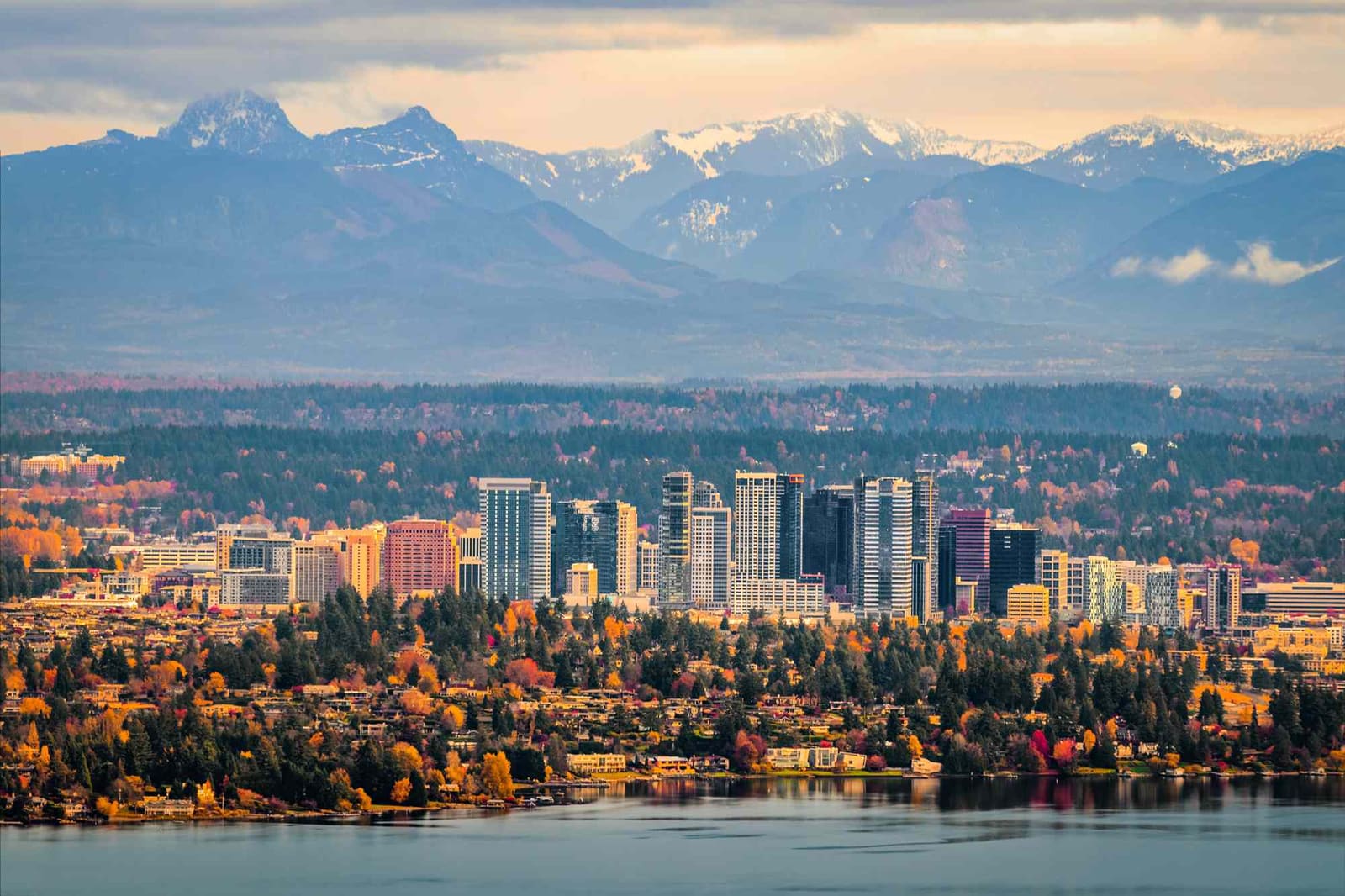
There is a particular kind of light that arrives in the Pacific Northwest each summer, when the clouds finally part and Lake Washington becomes a mirror for the Cascade foothills beyond. We've noticed it most acutely, lately, from the eastern shore - the one that belongs to Bellevue, a city that has spent the better part of its modern history being introduced as "just across the lake from Seattle." At Global Chic Voyage, we've watched that introduction grow shorter, and less necessary, with each return visit.
Bellevue has always possessed the infrastructure of ambition: glass towers, wide boulevards, a downtown core that hums with tech-economy prosperity. What it lacked, for a long time, was the texture that makes a place feel lived-in rather than merely occupied. That has changed. The dining scene alone - a patchwork of regional American kitchens, pan-Asian fine dining, and chef-driven neighborhood spots - has matured into something worth crossing state lines for, not just the lake. The parks, more than a hundred of them, thread through the city like a circulatory system, each one a small argument for staying outdoors a little longer. And the lake views, those sweeping westward panoramas that catch the Olympic Mountains on clear evenings, have always been here. We're simply paying attention now.
The Dining Culture That Arrived Without Fanfare
Bellevue's culinary evolution did not announce itself with a single landmark opening or a celebrity chef decampment. Instead, it accumulated quietly, restaurant by restaurant, until the aggregate became undeniable. The city's proximity to both Puget Sound and the agricultural valleys of Eastern Washington gives it access to the same seasonal bounty that has made Seattle a dining destination, but without the same degree of competition for real estate or attention.
We've returned, over the past two years, to a handful of kitchens that feel emblematic of this shift. There are Japanese izakayas where the yakitori is grilled over binchotan and the sake list runs to thirty bottles. There are Vietnamese pho houses that have been family-run for two decades, their broths still simmered overnight, their herbs still cut to order. There are new American bistros where the chef might serve Dungeness crab with fermented chili and buttermilk, or lamb shoulder with preserved lemon and farro, dishes that reflect the region's ingredients without feeling tethered to any single tradition.
What strikes us most is the lack of self-consciousness. These are not restaurants trying to prove Bellevue belongs in the conversation. They are simply cooking well, for an audience that has learned to expect it.
A Park System That Functions Like a Public Living Room
The statistic - more than a hundred parks within city limits - risks sounding bureaucratic until you spend a few days moving through them. Bellevue's park system is not an ornament. It is infrastructure, designed with the same seriousness as its transit grid or fiber-optic network, and it has become one of the city's most persuasive arguments for livability.
The Downtown Park, a twenty-one-acre expanse that anchors the city center, is perhaps the most visible. It features a circular promenade, a canal with a waterfall, and enough open lawn to accommodate both yoga classes and impromptu picnics. But it is the smaller, neighborhood parks - Chesterfield, Wilburton, Meydenbauer Bay - that reveal the city's commitment to green space as a daily amenity rather than a weekend destination. Many are linked by trails, some paved, some gravel, that allow you to move through the city on foot or by bike without ever fully surrendering to the street grid.
Meydenbauer Bay Park, in particular, has become a touchstone for us. It sits on the lake's eastern shore, with a small beach, a fishing pier, and a lawn that slopes gently toward the water. On summer evenings, it fills with families, runners, paddle boarders, and people who have simply come to watch the light change over the Olympics. It is not a grand gesture. It is a place that works, quietly and well, which is a different kind of achievement.
Lake Washington as Both View and Venue
The lake itself is Bellevue's most enduring asset, a body of water large enough to feel like a geography rather than a feature. At twenty-two miles long and up to two and a half miles wide, Lake Washington separates Bellevue from Seattle with a finality that has shaped both cities' identities. For Bellevue, the lake has historically been both a moat and a mirror - a reminder of what lay on the other side, and a surface on which to project its own ambitions.
We've come to appreciate the lake not just as a view, though the views are considerable, but as a venue. The city's waterfront parks - Meydenbauer, Chesterfield, Newcastle Beach - offer kayak launches, paddleboard rentals, and swimming beaches that are remarkably accessible for a city of this size. The lake's eastern shore is quieter than the western, less trafficked by seaplanes and tour boats, and that quietness has its own appeal. It is a place to watch the city across the water without feeling the need to be in it.
On clear days, the vista extends beyond Seattle to the Olympic range, a serrated line of peaks that catches the last light long after the city has fallen into shadow. It is the kind of view that benefits from repetition, from being seen at different hours and in different weather, until it becomes less a postcard and more a presence.
The Architecture of Ambition and Restraint
Bellevue's built environment is a study in contrasts, a city that has embraced high-rise density in its core while preserving low-slung residential neighborhoods just blocks away. The downtown skyline, anchored by glass towers that house tech firms, luxury condominiums, and corporate headquarters, projects a confidence that can read as sterile to visitors expecting the grit and texture of older cities. But there is a clarity to Bellevue's urbanism, a legibility that makes it easy to navigate and, increasingly, pleasant to inhabit.
The Bellevue Arts Museum, a geometric structure clad in red steel, stands as a counterpoint to the glass-and-concrete surroundings. Designed by Steven Holl and opened in 2001, it was conceived as a celebration of craft and design, with galleries devoted to everything from studio glass to contemporary fiber art. The building itself - angular, light-filled, unapologetically modern - makes an argument for architecture as civic statement, a reminder that Bellevue has invested in culture as well as commerce.
More recently, the city has turned its attention to the pedestrian experience. The Grand Connection, a planned two-mile corridor that will link the waterfront to the Wilburton neighborhood, is designed to prioritize foot traffic, with wide sidewalks, public art, and green spaces woven into the route. It is an ambitious project, one that reflects a city no longer content to be experienced primarily from behind a windshield.
Why Bellevue Matters Now
The transformation of Bellevue is not a story of reinvention so much as maturation. The bones - the parks, the lake, the infrastructure - were always there. What has emerged, over the past decade, is the texture: the restaurants that have found their voice, the public spaces that have been activated, the cultural institutions that have deepened their programming. It is a city that has stopped defining itself in relation to Seattle and started defining itself on its own terms.
For travelers, particularly those drawn to the Pacific Northwest for its landscape and culinary culture, Bellevue offers an alternative entry point. It is less congested, more navigable, and increasingly capable of holding your attention for more than an afternoon. The lake views alone justify the visit, but it is the accumulation of smaller pleasures - a well-executed meal, a park that invites lingering, a waterfront that feels genuinely public - that makes the case for a longer stay.
At Global Chic Voyage, we've noticed a shift in how we talk about Bellevue. It is no longer the city across the lake. It is simply the city, one that has earned its place in the regional conversation without raising its voice.
Photo: mandritoiu / Adobe Stock
Spot something wrong? Email editors@globalchicvoyage.com. We log every correction publicly.
RELATED
SEE ALL →
21 Jul 2026 / 5 min
20 Jul 2026 / 5 min
17 Jul 2026 / 5 min
10 Jul 2026 / 5 min