
Why One Corner of Northern Spain Holds More Magic Than the Rest
Beyond the well-trodden paths of Andalucía and Catalonia lies a region where mountain air meets Atlantic salt - and where authenticity hasn't yet been polished away.
SI
21 Jul 2026 · 5 MIN READ · UPDATED 17 AUG 2026
The Pull of a Place That Refuses to Perform
There is a particular quality to arriving in Asturias that other corners of Spain no longer seem to hold. Perhaps it is the way the Picos de Europa rise abruptly from green valleys, their limestone faces catching late afternoon light in a manner that feels almost Scandinavian. Or perhaps it is simpler than that: this is a region that has never learned to perform for visitors, and in that refusal lies its greatest appeal.
At Global Chic Voyage, we've watched Spain's coastal stretches transform over the past two decades - watched as authenticity gave way to infrastructure, as fishing villages learned the language of tourism. Asturias has largely sidestepped that trajectory, not through conscious resistance but through geography and temperament. The Atlantic crashes against cliffs here with a force that discourages the sort of beach-resort development that has reshaped the Mediterranean. The mountains form a natural barrier to the kind of access that brings crowds. What remains is a region that still belongs, first and foremost, to the people who have always lived here.
A Cuisine Rooted in Necessity and Place
The food culture of Asturias emerged from isolation and abundance in equal measure. Protected from Moorish influence by the Cantabrian range during the medieval period, the region developed culinary traditions that owe more to Celtic and northern European sensibilities than to the olive-and-saffron palette of southern Spain. Dairy thrives in these cool, wet highlands. The ocean provides a steady supply of shellfish, anchovies, and hake. Apple orchards - planted centuries ago - yield the fruit for sidra, the still cider that is poured from height in a ritual designed to aerate rather than impress.
In the stone-walled sidrerías of Oviedo and Gijón, meals unfold with a rhythm dictated by the pour. A server lifts the bottle overhead, tilts the glass low, and releases a thin stream that strikes glass with practiced precision. You drink what lands - usually no more than a finger's width - toss the remainder, and wait for the next pour. It is communal, wasteful by design, and entirely without pretense.
The region's most famous dish, fabada asturiana, is a white bean stew enriched with chorizo, morcilla, and pork shoulder. It is peasant food elevated by quality of ingredient rather than technique - the kind of dish that makes sense only in a place where winters are long and the land yields what it yields. In village restaurants tucked into the Picos or perched above the coast, fabada appears on menus alongside grilled octopus, Cabrales cheese so pungent it must be aged in limestone caves, and rice pudding dusted with burnt sugar. There is no molecular gastronomy here, no foam or tweezers. Just an unshakeable confidence in the ingredients themselves.
Villages That Time Hasn't Gentrified
The mountain settlements of Asturias - Bulnes, Sotres, Poncebos - exist in a state of functional preservation. These are not museum villages maintained for the benefit of day-trippers. People still farm here, still keep livestock, still speak Asturian among themselves. The architecture is pragmatic: stone walls thick enough to hold back winter wind, slate roofs that shed rain, wooden balconies for drying crops.
Bulnes, accessible only by funicular or a steep footpath, sits in a glacial valley beneath peaks that remain snow-capped well into spring. There are no cars, no souvenir shops selling miniature bottles of sidra. What you find instead are a handful of guesthouses, a small church, and the kind of silence that feels almost confrontational to anyone accustomed to the hum of connectivity. Mobile reception is patchy. Meals are served when the kitchen is ready. The rhythm is dictated by daylight and weather, not by schedule.
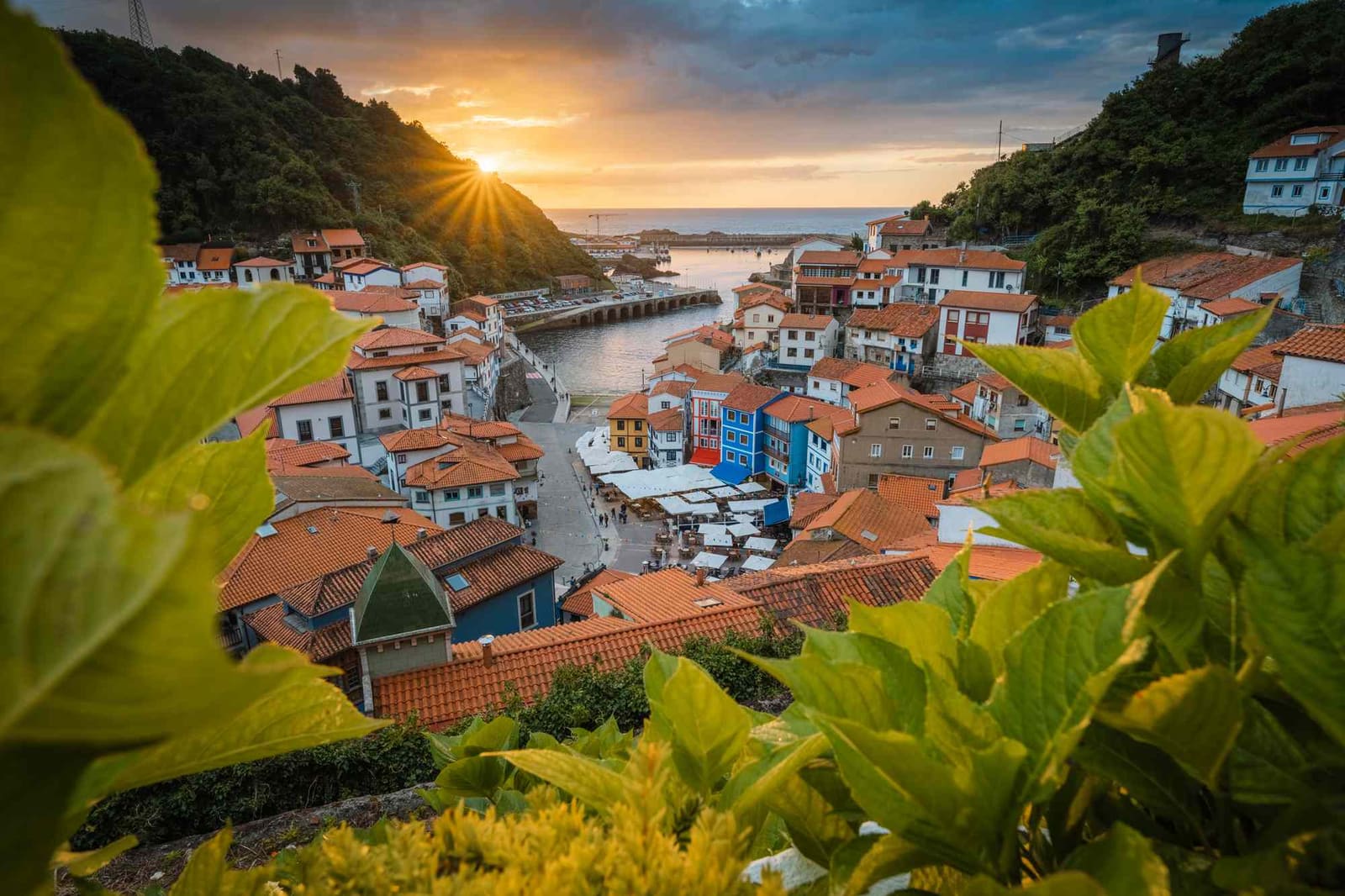
Further east, the village of Cudillero clings to a steep ravine that opens onto a small fishing harbor. Houses painted in ochre, rose, and faded blue stack vertically, their facades weathered by salt air. Fishing boats still depart before dawn. The morning catch - sardines, sea bream, spider crab - is sold from stalls along the waterfront, then appears on lunch menus in the taverns that line the harbor. It is a working town that happens to be beautiful, rather than a beautiful town that has ceased to work.
Wild Coastline That Resists Domestication
The Asturian coast stretches for more than three hundred kilometers, a procession of cliffs, coves, and beaches that remain largely undeveloped. Playa de Gulpiyuri, a small inland beach fed by seawater through underground channels, sits in a meadow a hundred meters from the ocean - a geological curiosity that has somehow escaped commercialization. Playa de Torimbia, framed by headlands and accessible via a dirt track, attracts naturists and surfers but little else. There are no beach clubs here, no rows of loungers, no amplified music.
The wildness is not incidental. Much of the coastline falls within protected designations: the Costa Verde, a stretch of cliffs and estuaries where development is tightly controlled; the Somiedo Natural Park, a UNESCO Biosphere Reserve where brown bears still roam. These protections reflect a regional identity that has long prioritized landscape over profit - a stance that feels increasingly anachronistic in a country where coastal real estate has become a primary economic engine.
Walking the coastal path from Llanes to Ribadesella, you pass through a landscape that shifts between pastoral and dramatic. Meadows give way to sea cliffs. Stone barns dot hillsides. The path dips into fishing hamlets where the smell of grilled sardines drifts from open doorways. It is the kind of walking that requires no destination, where the route itself is sufficient.
The Architecture of Persistence
Asturias is home to some of the oldest standing structures in Spain - pre-Romanesque churches built in the ninth and tenth centuries, during the reign of the Kingdom of Asturias. Santa María del Naranco, perched on a hillside above Oviedo, was originally constructed as a royal hall before being consecrated as a church. Its lines are spare, almost austere: barrel vaults, blind arcades, narrow windows that frame views of the valley below. There is no Gothic excess here, no Baroque flourish. Just stone and light and the weight of continuity.
These buildings were erected at a time when much of the Iberian Peninsula was under Muslim rule, and they represent a distinct architectural lineage - one that connects more closely to Visigothic and Carolingian traditions than to the Mudéjar styles that would later define Spanish ecclesiastical architecture. To stand inside Santa María del Naranco is to occupy a space that has remained fundamentally unchanged for more than a millennium, a rare experience in a continent where layers of renovation typically obscure original intent.
In the villages, a different kind of architectural persistence is evident: hórreos, elevated granaries built from wood or stone, their roofs thatched or tiled, their supports topped with flat discs designed to keep rodents at bay. These structures date back centuries and are still in use, a testament to design that solves a problem so effectively that there is no reason to abandon it. They line roadsides and farmyards, weathered and functional, monuments to pragmatism.
Why Asturias Endures
There is a tendency, in travel writing, to frame authenticity as something fragile - a quality that must be experienced before it disappears. Asturias suggests a different model. This is not a region clinging to tradition out of nostalgia or marketing strategy. It is simply a place where the old ways continue to make sense: where the climate favors dairy and apples, where the mountains limit access, where the ocean is too rough for the kind of tourism that demands calm water and guaranteed sunshine.
The hotels we've returned to here are small, often family-run, their owners more interested in maintaining a certain standard than in scaling up. The restaurants source locally not because it is trendy but because it is logical. The trails are well-marked but not over-engineered. There is an absence of the infrastructure that usually signals a region's readiness to receive visitors in large numbers - and that absence, paradoxically, is what makes Asturias so ready to receive the kind of traveler who doesn't require that infrastructure.
In an era when so much of travel has become a curated performance - when cities optimize themselves for Instagram, when beaches are engineered for maximum throughput - Asturias offers something increasingly rare: a place that remains, stubbornly and beautifully, itself. The mountains will continue to rise, the cider will continue to be poured from height, the fishermen will continue to depart before dawn. And for those willing to meet the region on its own terms, that continuity is more valuable than any amenity.
Photo: Marco Bottigelli / Getty Images
Spot something wrong? Email editors@globalchicvoyage.com. We log every correction publicly.
RELATED
SEE ALL →
10 Jul 2026 / 5 min
24 Jul 2026 / 5 min
20 Jul 2026 / 5 min
17 Jul 2026 / 5 min