
Where Finland's 120 Blue Lakes Hold More Than Just Water
In the Saimaa region, archipelagos and quiet kitchens are rewriting the story of European travel.
SI
17 Jul 2026 · 5 MIN READ · UPDATED 17 AUG 2026
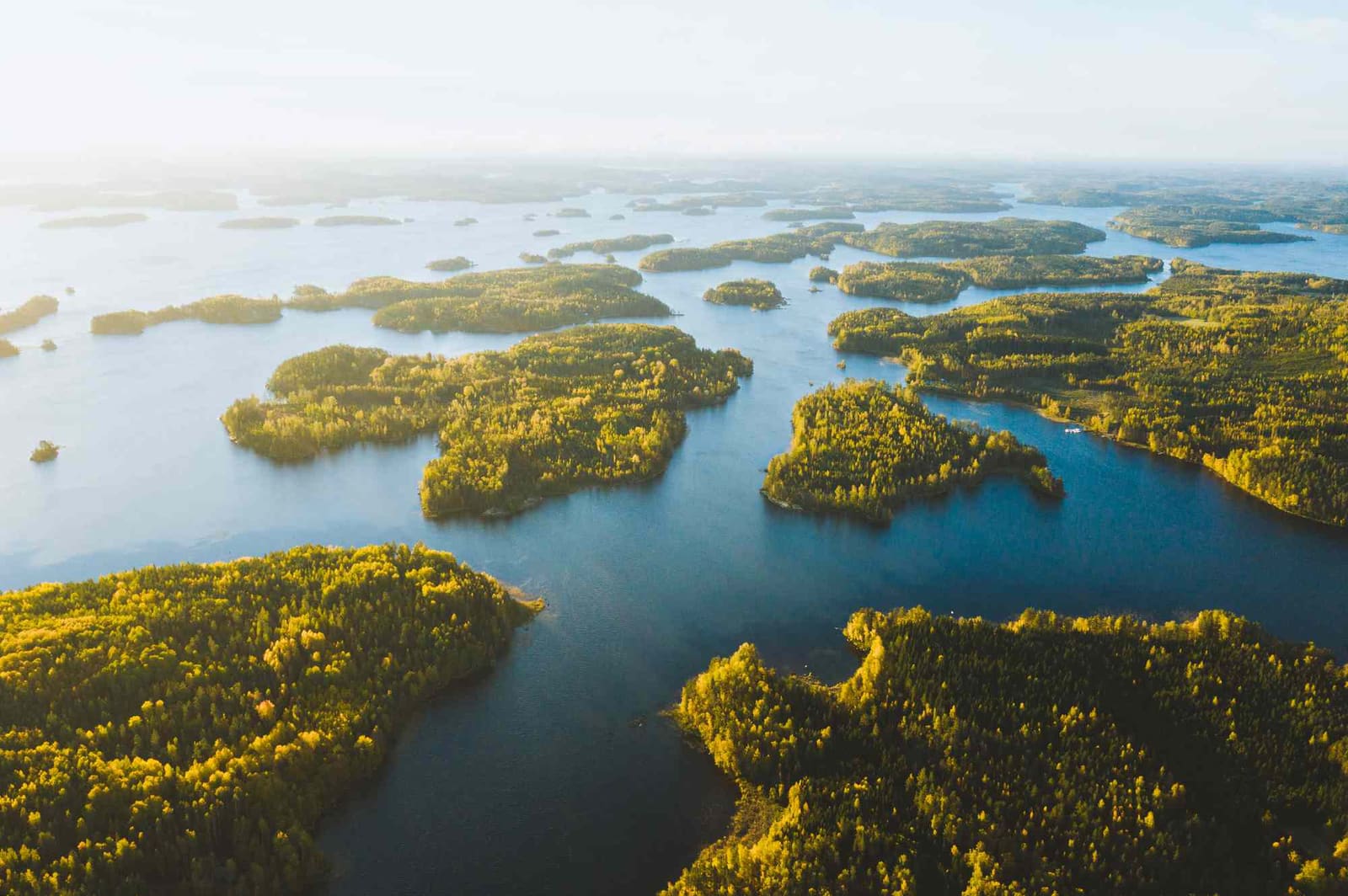
A Geography That Refuses to Simplify
There is a moment, halfway across the ferry from Savonlinna to one of the smaller islands, when the horizon fractures into a hundred different blues. Water meets sky, shoreline meets forest, and the eye loses count. Finland's Lake Saimaa region is not a single lake at all but a sprawling constellation of more than 120 interconnected bodies of water, threaded with roughly 14,000 islands. It is Europe's fourth-largest lake system, yet it remains curiously absent from the crowded itineraries that funnel travelers toward more famous coasts and capitals.
At Global Chic Voyage, we have watched travelers seek ever more remote corners of the continent, places where solitude and authenticity are not marketing terms but geographical realities. Saimaa offers both. The region's labyrinthine waterways stretch across southeastern Finland, carving through pine forests and granite outcrops with a kind of patient insistence. The landscape here does not announce itself; it unfolds slowly, rewarding those willing to linger.
The Archipelago as Archive
The islands themselves are a study in microclimates and micro-histories. Some are large enough to support small farms and summer cottages, their wooden docks weathered silver by decades of freeze and thaw. Others are little more than moss-covered boulders, temporary perches for migrating birds. The sheer number of islands creates a shifting sense of scale, where a short boat ride can feel like a crossing to another world.
This fragmentation has preserved a certain way of life. Fishing traditions persist here not as heritage theater but as living practice. Small-scale fisheries still pull vendace and perch from the cold waters, their catches destined for local markets and family tables rather than export channels. The rhythm of the seasons governs movement, as ice roads in winter give way to boat routes in summer, a natural calendar that resists the flattening pressures of year-round tourism.
A Culinary Scene Emerging from Quiet
What surprises many visitors, however, is not the landscape but what grows and simmers within it. The Saimaa region has cultivated a culinary identity that remains largely unknown beyond Finland's borders. This is not the high-concept Nordic cuisine of Copenhagen or Stockholm, with its Michelin ambitions and plating philosophies. Instead, it is rooted in proximity: what the lake yields, what the forest offers, what the short growing season permits.
Restaurants and small producers across the region have begun to articulate a food culture that draws on hyper-local ingredients without the usual fanfare. Smoked fish, foraged mushrooms, wild berries, and lake vegetables appear on menus with minimal adornment, their quality assumed rather than announced. There is a confidence in simplicity here, a refusal to over-explain or over-manipulate.
We have noticed this approach gaining traction among travelers who have grown weary of the performative dining scenes that dominate much of luxury travel. In Saimaa, a meal is less likely to be an Instagram moment than a quiet conversation with the person who caught your fish or grew your greens. The food scene here is under-the-radar not because it lacks quality, but because it has not yet been subjected to the branding and amplification that often precede authenticity's slow erosion.
The Architecture of Stillness
The built environment in Saimaa reflects the same restraint. Summer cottages, many passed down through generations, sit lightly on the land. They are functional rather than ostentatious, their interiors warmed by wood-burning saunas and their windows framed by birch and spruce. Even newer accommodations tend toward understatement, favoring clean lines and natural materials over the kind of rustic excess that has become shorthand for "wilderness luxury" elsewhere.
This architectural modesty mirrors a broader cultural sensibility. Finland's relationship with nature is not one of conquest or spectacle but of coexistence. The right to roam, enshrined in Finnish law as everyman's right, allows for responsible public access to private land, a legal framework that assumes trust and mutual respect. In Saimaa, this translates to trails that meander without signage, campsites that appear and disappear with the seasons, and a general absence of the transactional infrastructure that can make popular destinations feel like theme parks.
Timing and Accessibility
Reaching Saimaa requires intention. The region is accessible by train and car from Helsinki, roughly a three-to-four-hour journey depending on your destination within the lake system. Savonlinna, with its medieval Olavinlinna Castle, serves as a natural gateway, though smaller towns like Mikkeli and Lappeenranta offer their own entry points. Domestic flights connect some of the larger towns, but the experience is fundamentally one of surface travel, of watching the landscape shift from urban to forested to aquatic.
The best months to visit are June through September, when daylight stretches long and the water is navigable. Winter brings its own appeal for those drawn to ice fishing and cross-country skiing, though the culinary scene quiets considerably as many seasonal establishments close. Spring and autumn are transitional, beautiful in their starkness but less accommodating to visitors seeking the full range of local experiences.
Why This Matters Now
Saimaa represents a model of tourism that many regions aspire to but few achieve: abundant natural beauty without overcrowding, cultural specificity without commercialization, accessibility without homogenization. As more of Europe becomes overrun with short-term rentals and algorithmic itineraries, places like Saimaa offer a counterpoint. They suggest that travel can still involve discovery rather than confirmation, that a destination's value need not be measured by its Instagram density.
For travelers willing to exchange convenience for depth, the Saimaa region delivers something increasingly rare: the sense that you have arrived somewhere that does not yet belong to the travel industrial complex. The 120 lakes and 14,000 islands are not a marketing slogan but a geographic fact, a reminder that Europe still contains pockets of genuine remoteness, places where the landscape dictates the terms and the visitor is asked, politely but firmly, to adjust accordingly.
Credit: Visit Lake Saimaa
Spot something wrong? Email editors@globalchicvoyage.com. We log every correction publicly.
RELATED
SEE ALL →
8 Aug 2026 / 5 min
9 Jul 2026 / 5 min
21 Jul 2026 / 5 min
20 Jul 2026 / 5 min