Beyond the Expected: How Alsace Rewrites the Wine-Country Playbook
A winding drive through France's lesser-known wine region reveals a landscape richer and more layered than its most famous export.
SI
3 Jul 2026 · 5 MIN READ · UPDATED 17 AUG 2026
The Route That Refuses to Be Pinned Down
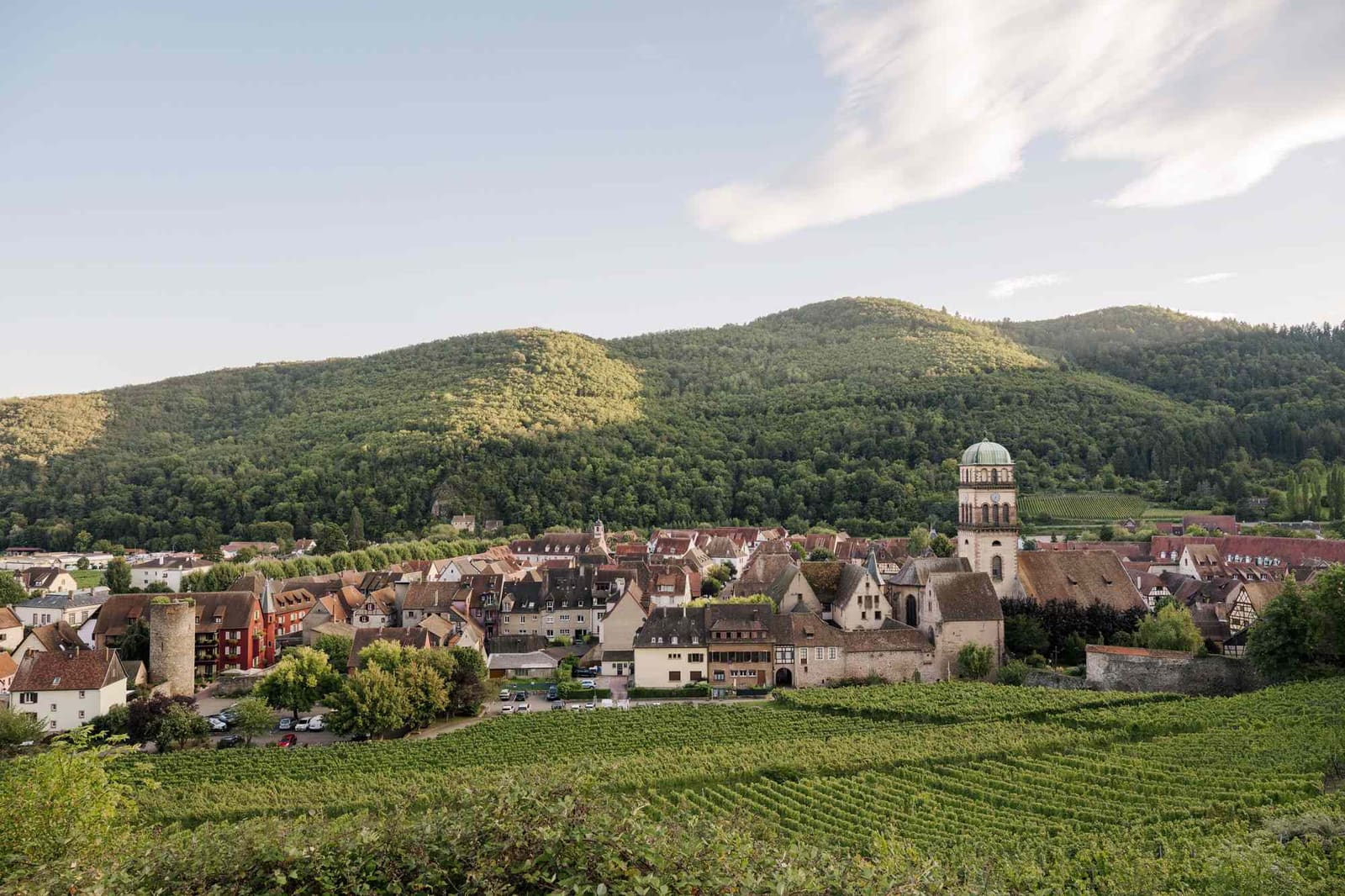
The half-timbered houses appear first, their facades painted in shades of ochre and rose that seem lifted from a medieval manuscript. Then come the vineyards, terraced up hillsides in geometric precision, their rows catching the late-afternoon light like brushstrokes. Somewhere between the third village and the fourth, you realize that Alsace does not reveal itself all at once. It unfolds slowly, insistently, in a way that makes you reconsider what you thought you knew before you arrived.
At Global Chic Voyage, we've watched travelers plan entire itineraries around a single bottle, a specific vintage, a grape variety that has taken on mythic proportions in their imaginations. Alsace invites that kind of devotion. Its Wine Route stretches more than a hundred miles through rolling countryside, connecting villages that look as though they've been preserved under glass. But the region's winemakers have grown weary of being reduced to a single varietal, no matter how celebrated. They are quietly, persistently, expanding the conversation.
A Landscape Built on Complexity
Alsace sits tucked against the Vosges Mountains, a natural barrier that shields the vineyards from the Atlantic's moisture and creates one of France's driest climates. The result is a patchwork of microclimates and soil types, each imparting something distinct to the wines grown there. Granite, limestone, clay, sandstone, volcanic rock: the geological diversity reads like a primer in terroir, and the winemakers here speak of their plots with the specificity of cartographers.
This is not a region that lends itself to generalizations. The same village might produce a bone-dry Riesling on one slope and a lush, late-harvest Gewurztraminer on another. The Wine Route itself meanders without hurry, dipping into towns where the streets are so narrow that two cars cannot pass, where fountain squares double as outdoor tasting rooms, where the architecture feels borrowed from both France and Germany in equal measure.
The cultural duality is not ornamental. Alsace has changed hands between the two countries multiple times over the centuries, and that history is written into the food, the language, the way locals approach winemaking. There is a precision here, a reverence for craft, that feels Germanic. But there is also a playfulness, a willingness to experiment, that is unmistakably French.
The Winemakers Who Push Back
In a cellar just outside Riquewihr, a winemaker pours a glass of Pinot Gris and watches for a reaction. It is not the sweet, honeyed version that many expect. Instead, it is mineral-driven, almost austere, with a finish that lingers like the memory of stone. "People come here thinking they know what Alsace tastes like," she says. "We spend a lot of time showing them otherwise."
This sentiment echoes across the region. Winemakers here are increasingly focused on expressing site rather than style, on letting the land speak louder than expectation. Some are turning to organic and biodynamic practices, reducing intervention in both vineyard and cellar. Others are reviving nearly forgotten grape varieties, planting parcels of Savagnin Blanc or Klevener de Heiligenstein, grapes that tell a more complete story of the region's viticultural past.
The shift is subtle but unmistakable. At boutique estates tucked into hillside villages, tastings unfold less like sales pitches and more like seminars in geology and history. Winemakers pull out maps, trace the contours of their parcels, explain how a difference of fifty meters in elevation can alter acidity, how a shift in soil composition can transform aromatic profile. The wines themselves are offered as evidence, each glass a small argument for complexity over simplicity.
Michelin Stars and Market Tables
The food in Alsace carries the same dual identity as its wines. In Colmar, a Michelin-starred chef plates tarte flambée with razor-thin slices of truffle and a drizzle of hazelnut oil, elevating a peasant dish into something approaching art. A few streets over, a market stall sells the same dish, wood-fired and served on paper, for a fraction of the price. Both are excellent. Both belong here.
Choucroute garnie, the region's signature dish of sauerkraut braised with pork and sausages, appears on nearly every menu, but no two versions are identical. Some chefs add juniper berries or caraway, others finish the dish with a splash of Riesling or Sylvaner. The meal is always generous, always rich, and always best accompanied by something crisp and dry from a nearby vineyard.
The dining culture here rewards curiosity. Small winstubs, traditional wine taverns, serve regional specialties alongside bottles from local producers, many of whom supply only a handful of restaurants. The wine lists read like insider guides, heavy on names that never make it beyond the region's borders. This is not a place for chasing labels. It is a place for discovering what has been quietly excellent all along.
The Road Ahead
Alsace has begun to reckon with its own identity in ways both practical and philosophical. Climate change is shifting harvest dates earlier, nudging alcohol levels upward, forcing winemakers to rethink techniques that have been in place for generations. At the same time, a younger cohort of vignerons is arriving with fresh ideas, less tethered to tradition, more willing to question inherited wisdom.
The region's classification system, which designates certain vineyards as Grand Cru sites, remains a point of debate. Some producers embrace the distinctions, bottling single-vineyard wines that command premium prices. Others reject the hierarchy entirely, preferring to blend parcels or bottle under regional appellations. The conversations around these choices are animated, sometimes contentious, always rooted in a deeper question: what does it mean to make wine here, now, in a world that is changing faster than the vines can adapt?
What remains constant is the landscape itself. The villages still glow in the evening light, their window boxes overflowing with geraniums. The vineyards still climb the hillsides in patient rows. And the winemakers still pour their wines with a quiet confidence, knowing that the best way to understand Alsace is not to arrive with assumptions but to let the region dismantle them, glass by glass, mile by mile.
A Region That Resists Definition
We left Alsace with more questions than we brought, which is perhaps the highest compliment one can pay a place. The Riesling was exceptional, yes, but so were the Pinot Blancs, the Muscats, the experimental cuvées that defied easy categorization. The Michelin-starred meals were memorable, but so were the impromptu picnics in vineyard parking lots, bread and cheese and a bottle pulled from a trunk.
Alsace does not ask to be understood quickly. It asks to be experienced slowly, with patience, with a willingness to be surprised. The Wine Route is less a destination than a series of detours, each one leading somewhere unexpected. And the winemakers, for all their precision and craft, are storytellers first, eager to share not just what they make but why, and how, and for whom.
In an era when travel often feels like a checklist, when experiences are curated and packaged and optimized for maximum efficiency, Alsace offers something increasingly rare: the pleasure of not knowing exactly what comes next. The road winds. The villages appear. The wines pour. And somewhere along the way, the trip you planned becomes the trip you needed.
Photo: Clara Tuma / Travel + Leisure
Spot something wrong? Email editors@globalchicvoyage.com. We log every correction publicly.
RELATED
SEE ALL →
20 Jul 2026 / 5 min
15 Jul 2026 / 5 min
21 Jul 2026 / 5 min
17 Jul 2026 / 5 min