Where Land Meets Sea: A Woven Sanctuary on the Sagami Coast
In the quiet coastal town of Hayama, Patricia Urquiola and Tomorrowland have spun a hotel from threads of craft, memory, and the meeting of two shores.
A Threshold Between Two Worlds
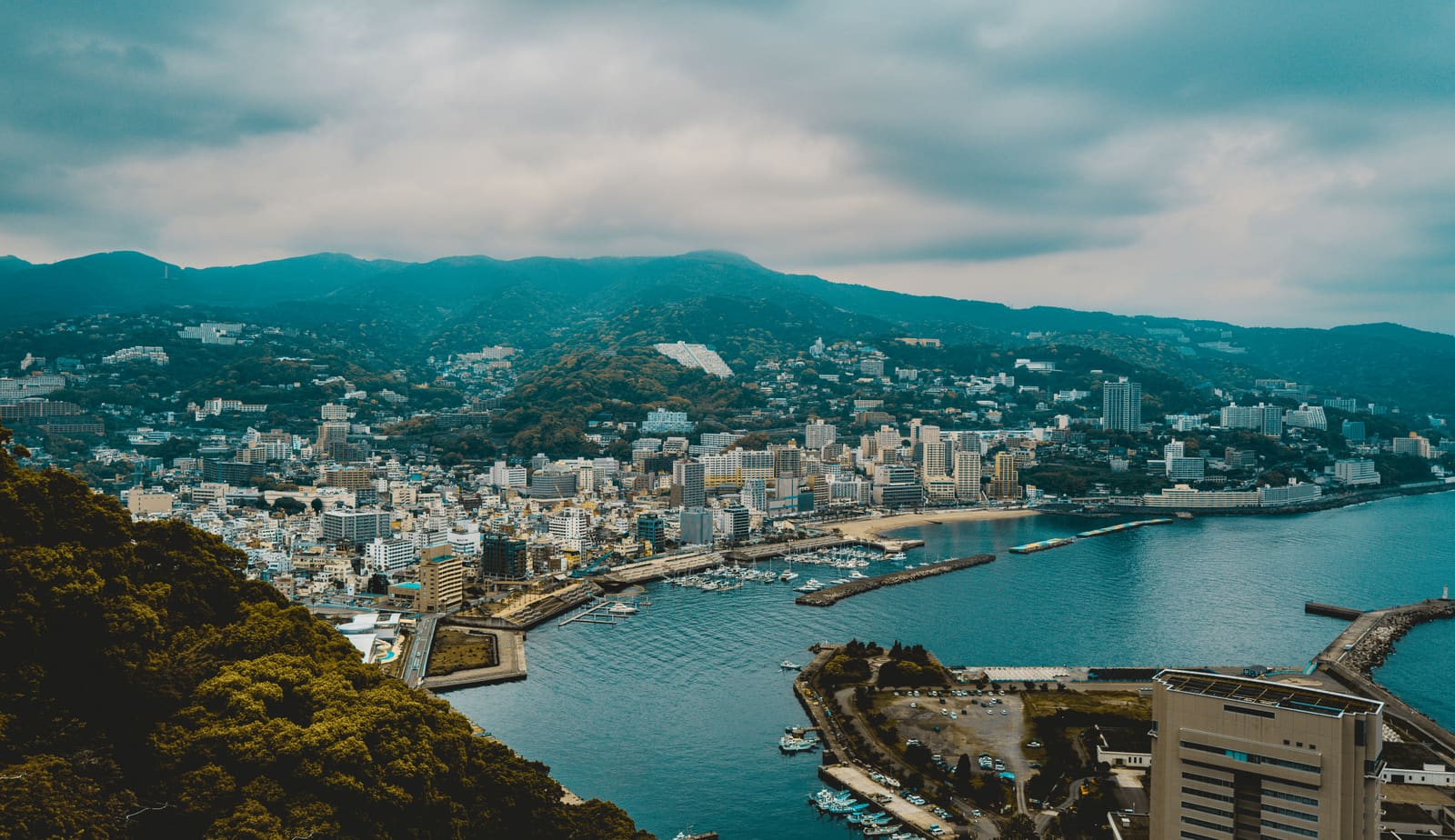
The entrance sits at the edge of a residential street in Hayama, unremarkable until you step through and the Sagami Bay unfolds before you. Mount Fuji rises in the distance, pale against the sky. The shore below is neither crowded resort nor postcard cliché; it holds the quietness of Hiroshi Sugimoto's seascapes, where horizon and water dissolve into meditation. Sailboats drift. The occasional figure walks the sand. The hotel behind you, Casa Caban Hayama, is built from the meeting of those two elements: the stillness of land, the restlessness of tide.
This is the first standalone hotel venture from Tomorrowland, the Japanese fashion and lifestyle company founded in 1978, and it bears the mark of a decade-long friendship. Patricia Urquiola, the Spanish architect and creative director of Cassina, stood on this site ten years ago with Hiroyuki Sasaki, Tomorrowland's chairman. A café occupied the plot then. The conversation they began that day has since become a 14-room sanctuary where architecture, craft, and the coastal landscape are drawn together by a single organising principle: weaving.
The Grammar of Warp and Weft
Urquiola chose weaving not as ornament but as structure, a nod to Tomorrowland's origins in knitwear and to the interlaced logic of textiles. The idea surfaces everywhere, translated across materials and scales. The building's concrete façade is scored with vertical and horizontal lines, a grid carved into stone. Sections are clad in panels handwoven in Indonesia from recycled polyethene, their texture catching light like fabric stretched over a frame.
Inside, the lounge ceiling is wrapped in bamboo, reinterpreted by Kyoto artisans into an interlaced pattern that recalls traditional screens. The louvres in guest rooms and corridors abandon the expected horizontal slats for a composition that incorporates vertical elements, casting shadows in checkerboard rhythm across floors and walls. Even the swimming pool participates: its floor is tiled in blue and white squares, evoking the tenugui, the cotton towel found in every Japanese bathhouse.
The palette moves from earth to ocean. Terracotta, copper, warm grey; then lilac, sea blue, the pale green of coastal grasses. It is a colour story drawn from the meeting of sand and water, the gradient where one element becomes another.
Ink, Resin, and the Art of Surface
Suminagashi, the centuries-old Japanese technique of marbling ink on water, appears throughout the hotel in unexpected forms. In the entrance hall, wall pieces shaped like roof tiles are lined up in rows. They look ceramic but are moulded from lightweight resin, their surfaces swirled with ink patterns frozen mid-flow. The lounge columns are clad in actual ceramic, treated with the same technique, so that each vertical surface carries a unique, unrepeatable composition.
Urquiola designed much of the furniture and commissioned pieces from makers she has long collaborated with: Flos for lighting, Moroso and Cassina for seating, Kettal for outdoor pieces, cc-tapis for rugs and wall hangings. Many items are customised versions of existing designs, recalibrated for this specific place. In the entrance hall, a geometric lightbox invites decoding; those familiar with Urquiola's work for Moroso may recognise an echo of her Loveseat design, abstracted into light and shadow.
The wall hangings, conceived by Urquiola and handmade by cc-tapis, interpret forms found in coastal nature: the curve of a shell, the spiral of a wave, the radial symmetry of a sea urchin. Ceramic objects, personally selected by the designer, punctuate shelves and niches. The effect is cumulative, a layering of detail that rewards slow looking.
Rooms as Instruments of Stillness
The Caban Suite, at 173 square metres, is the hotel's signature offering. Two rooftop terraces extend the interior into open sky. Inside, Cassina's Mon Cloud sofa curves across the living area, paired with a marguerite-inspired rug from cc-tapis. The Cimento dining table echoes those soft lines in stone. A secondary lounge is floored in rectangular and square ceramic tiles that return, once again, to the weaving motif, this time rendered in terracotta.
The Hayama Suite, smaller at 89 square metres, takes a more eclectic approach. Cassina's chunky Dudet chairs bring sculptural weight; a Flos pendant adds playful geometry. Lilac accents set against warm copper somehow evoke a Japanese sensibility without literalism. Urquiola's tapestries introduce an offbeat, funky note, a reminder that restraint need not mean austerity.
Every room faces the sea. Every room has its own terrace. The design assumes you will spend time here, that the room itself is not merely a place to sleep but a frame for slowness. There is no spa, no programme of treatments or classes. The retreat is the stay itself: the evening bath with Dead Sea salt, the botanical and marine skincare products, the bed linen and pyjamas cut from Egyptian Giza cotton, the Supima cotton towels. All designed by Tomorrowland Home, all calibrated for softness.
Tables Set with Local Tides
The main dining room serves Italian-inflected cuisine refined with Japanese precision. Pasta arrives with shirasu, the tiny anchovies pulled from local waters, or with sea urchin harvested off the Hayama coast. Hayama Ishii beef is grilled over charcoal. The cooking draws on seasonal produce from the Miura Peninsula, the narrow spit of land that stretches into the Pacific south of Tokyo.
On the lower level, Ashitaba offers a minimal counterpoint. It is the only space in the hotel not designed by Urquiola, and the restraint is deliberate. The traditional Japanese restaurant serves an omakase menu built around seafood from the surrounding waters. Both restaurants are open to outside guests, but the lounge bar is reserved for those staying overnight. The cocktail and mocktail menu changes daily; a recent special featured a piña colada mocktail topped with herbs from the hotel's garden.
Each guest room includes a small wine cellar stocked with a curated selection. The complimentary bottled water is sourced from the foothills of Mount Fuji, a detail that roots even hydration in place.
The Slow Unfolding of Far Niente
Casa Caban Hayama is conceived around the idea that the room and the pool are sufficient. There is no need to schedule wellness, to fill hours with activity. The Italian principle of far niente, the sweetness of doing nothing, governs the rhythm here. You might spend a morning on your terrace, watching the light shift across the bay. You might take an evening bath, following the Japanese custom, and slip into those long-staple cotton pyjamas. You might swim in the checkerboard pool, then return to your room with a drink.
The hotel sits within a ten-minute drive of Hayama Marina, where water sports and other seaside activities are available. Nearby Morito Daimyojin Shrine offers a brief excursion for those inclined. But these are optional footnotes. The design assumes you will stay close, that the view and the architecture and the quality of light on textured surfaces will hold your attention.
The Thread That Binds
For those who follow design, the hotel offers a rare chance to inhabit Patricia Urquiola's vision in totality. Her hand is evident in every surface, every object, every transition from room to corridor to terrace. On the lower level, the Caban store stocks footwear and bags she designed, extending the aesthetic into wearable form.
But the deeper story is about affinity. Casa Caban Hayama is the fruit of a friendship between Urquiola and Hiroyuki Sasaki, between a Spanish architect and a Japanese fashion company, between two practices that share a belief in craft, sustainability, and the slow accumulation of detail. Tomorrowland was among the first Japanese companies to blur the line between fashion and lifestyle; Urquiola has spent her career dissolving boundaries between architecture, furniture, and object.
The result is a hotel that feels less like a commission than a collaboration, a conversation carried out over years and across disciplines. The weaving motif is not mere decoration. It is structure and metaphor both: the interlacing of Spanish and Japanese sensibilities, of land and sea, of built form and natural landscape. You step through the entrance, and the threads pull tight. You step onto your terrace, and the horizon unspools before you, unbroken save for the silhouette of Mount Fuji, distant and serene.