Where Six Generations of Craft Meet the Mountain Mist
In a village known for lacquer and volcanic springs, one family has woven minimalist art and carpentry tradition into the fabric of ryokan hospitality.
A River Gorge and a Circle of Light
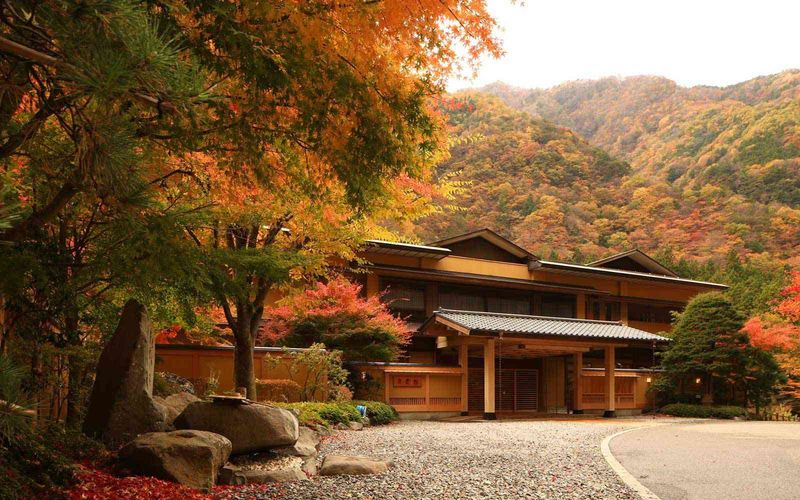
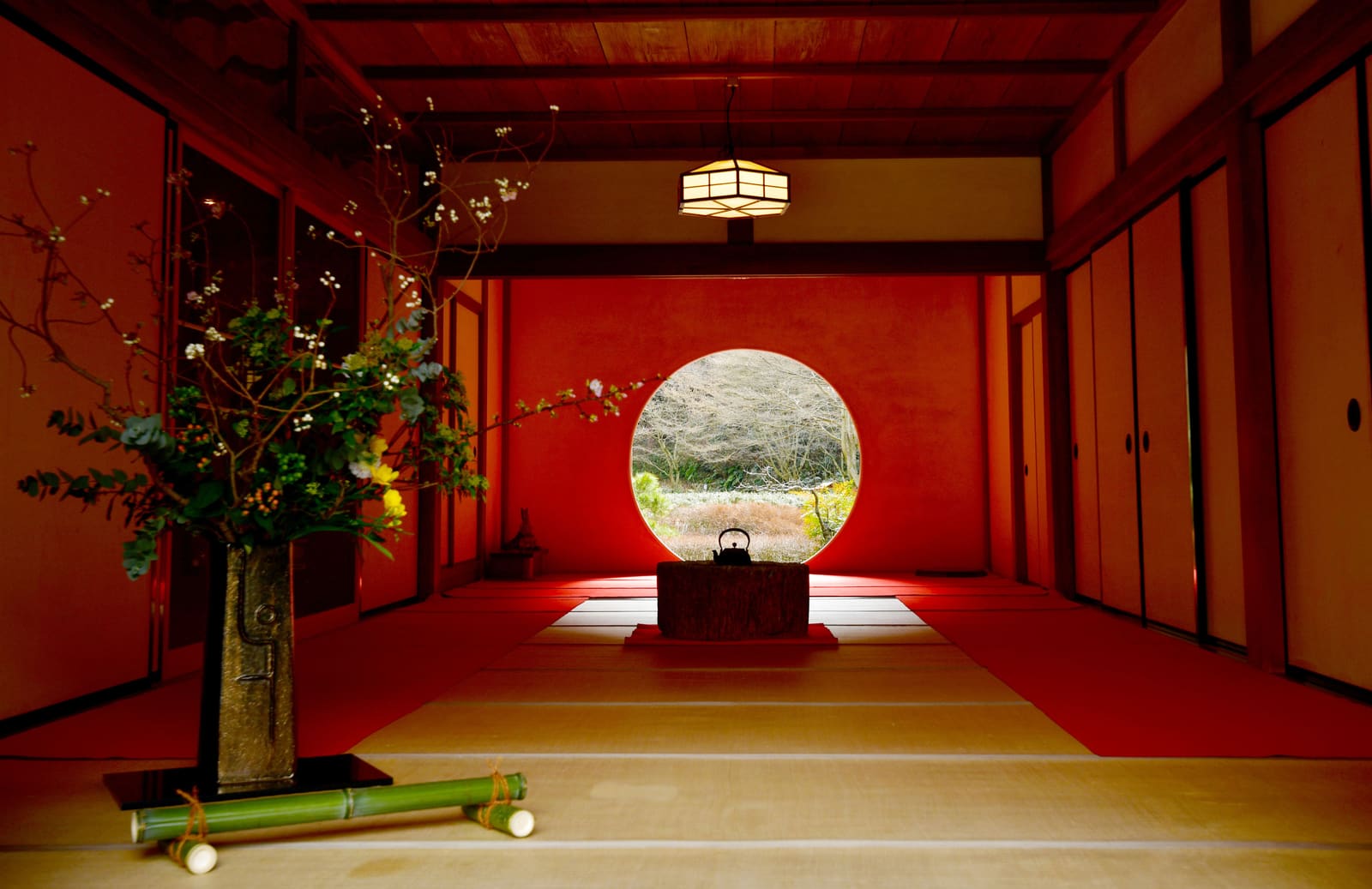
The white noren curtain parts in vertical slits, each one etched with the calligraphic simplicity of a Zen circle. Beyond lies a sweep of stone, walls the colour of fresh washi, and the scent of temple incense curling through the air. This is the threshold of Hanamurasaki, a ryokan perched above the Kakusenkei Gorge in Yamanaka Onsen, a village so small it feels like a secret kept by the mountains of Ishikawa Prefecture. For more than a millennium, travellers have come here to soak in volcanic waters; for 125 years, one family has offered them rest. Now, in the hands of Kohei Yamada and his wife Manami, the property is becoming something else entirely: a living gallery where traditional omotenashi hospitality converges with contemporary art, sculptural furniture, and the kind of quietude that feels deliberate rather than accidental.
Kohei, the sixth-generation steward, spent years in Singapore before returning home. Manami studied art and photography in San Francisco. Together, they have set about dismantling the notion that heritage must be static. Over the past four years, they have introduced art installations, opened a gallery in nearby Kanazawa, and commissioned a furniture collection designed to sit low and horizontal against tatami, its clean lines shaped by centuries-old carpentry methods. The work is ongoing. "In the past, onsen ryokan would often have artists-in-residence staying with them," Kohei has noted. "Artists would come and stay and leave an artwork. We are very inspired by this idea."
Mortar, Mesh, and the Language of Materials
The hotel's 25 rooms span a spectrum from traditional Japanese chambers to five suites designed by Simplicity, the Tokyo studio led by Shinichiro Ogata. These suites are exercises in restraint: low Western beds, stone onsen baths, walls of mortar imprinted with grid-like mesh, and soft white curves that feel more like sculpture than architecture. In the Modern Suite, mortar flows across floors and ceilings in smooth, unbroken swathes. A sunken table by lacquer artist Akihiko Sugeta anchors the space. The onsen bath is carved from stone, flanked by a sauna and framed views of green.
The Art Suite takes a different tack. Here, glowing glass panels by artist Rui Sasaki contain flowers and plants collected near the property, their forms suspended in light. Interior edges curve softly; bathrooms are clad in sharp black tile. A large round ceramic bath invites long soaks. Across both suites, the material palette is tactile and deliberate: washi, stone, mortar, lacquer. Nothing is merely decorative.
This autumn, the ryokan's traditional tatami rooms received their own intervention. Hanamurasaki introduced Suminobi, a bespoke furniture collection named after the architectural technique of lengthening temple eaves and roof corners. The pieces sit low, their horizontal lines designed to harmonise with tatami settings. Window-facing beds, monochrome sofas, and organic white textile forms hover on bases of darkened white ash. The effect is one of continuity rather than contrast, a conversation between old spatial grammar and new formal language.
Tea, Twig, and Tiered Trays
At the heart of the ground floor sits Sabo, a tea room designed by Simplicity. Light pours through walls of windows, illuminating hexagonal floor tiles, dark wood tables, and softly curved white surfaces. The space feels both expansive and intimate, a place where time slows to the pace of steeping leaves. Afternoon tea here is not a gesture but an event. Expertly curated selections, from Kaga Bocha twig tea to Ishikawa black tea, arrive in exquisite ceramics. Tiered trays carry creative compositions: turnip sushi, candied kumquat, yuzu jelly, lemon-simmered sweet potato. Matcha beer and sencha tea gin and tonic round out the menu.
The dining room, renovated two decades ago by Kohei's father, continues the material conversation. Dramatic washi wall abstractions by Kyoto artist Eriko Horiki divide the space into partitions, each one framing an intimate tableau. The omakase kaiseki menu shifts with Ishikawa's seasons, drawing from sea and mountain alike. From November through March, Snow Crab becomes the centrepiece, a local delicacy prepared with precision. Unusually for a ryokan, vegetarian kaiseki is also available. Breakfast is expansive: snow-white Koshihikari rice, sashimi, simmered tofu hot pots. Western options, omelettes and croissants, appear as quiet concessions to varied appetites.
Snowshoes, Bamboo, and the Revival of Kanjiki
Beyond the ritual of onsen soaking, Hanamurasaki has begun to offer activities that root guests in regional craft and landscape. A painting experience with ceramic artist Eijyu Yaguchi invites collaboration. In winter, locals Aria and Masa lead a snowshoe-making workshop, an effort to revive the dying tradition of hand-tying rope around curved bamboo to create kanjiki. Participants test their creations on a nearby snow-wrapped mountain, where tea is served in washi cups and the air feels sharp enough to cleanse.
These projects are not ancillary but central to the Yamadas' vision. Artist residencies are in the pipeline, as are collaborations with regional artisans. Retreats with local author and illustrator Hannah Kirshner are scheduled for next year. The aim is not to freeze the ryokan in time but to let it breathe, evolve, and respond to the creative currents that pass through.
A Living Inheritance
Hanamurasaki first opened in 1902 as Yamadaya, a hot spring retreat beloved by locals. In the 1980s, Kohei's father relocated the property to a newly built structure nearby and renamed it after the poetic phrase Sanshi Suimei, "purple mountains and clear waters." The current iteration is both a continuation and a departure. Kohei and Manami have tapped into the essence of Japanese hospitality while expressing it through a fresh lens: minimalist, modern, and deeply crafted.
The ryokan is accessible via the Hokuriku Shinkansen bullet train, which stops at Kagaonsen Station, up to three hours from Tokyo or 20 minutes from Kanazawa. From there, a shuttle or taxi covers the final 20 minutes to Yamanaka Onsen, a village known for more than 1,300 years of volcanic bathing and the beauty of its traditional lacquerware. The journey off the beaten tourist trail feels intentional, a gradual shedding of urban rhythms.
The Verdict
What Kohei and Manami have achieved at Hanamurasaki is a rare balance: respect for lineage without reverence for stasis, engagement with craft without nostalgia, and a willingness to let the property remain unfinished in the best sense. The lobby gallery showcases lacquer creations by Daigo Ohmura; a sculptural circle of light hangs in the monochrome space; wood and lacquerware abstractions by Eiko Tanaka punctuate the genkan entry. Each element contributes to a larger composition, one that will likely continue to shift as new artists arrive, new collaborations take shape, and future generations add their own layers.
The alkaline-rich onsen waters remain constant, as does the drama of the river gorge below. But Hanamurasaki is not a museum. It is a living, breathing work in progress, shaped by the hands of six generations and counting. The furniture sits low against the tatami. The tea steeps slowly in the light. The mountains remain purple; the waters, clear.