Where the Sky Becomes a Suite: Air Travel Reaches a New Altitude of Refinement
From double beds at 40,000 feet to bathrooms cleaned after every use, the world's leading airlines are redefining what luxury means in motion.
The Threshold of Excess
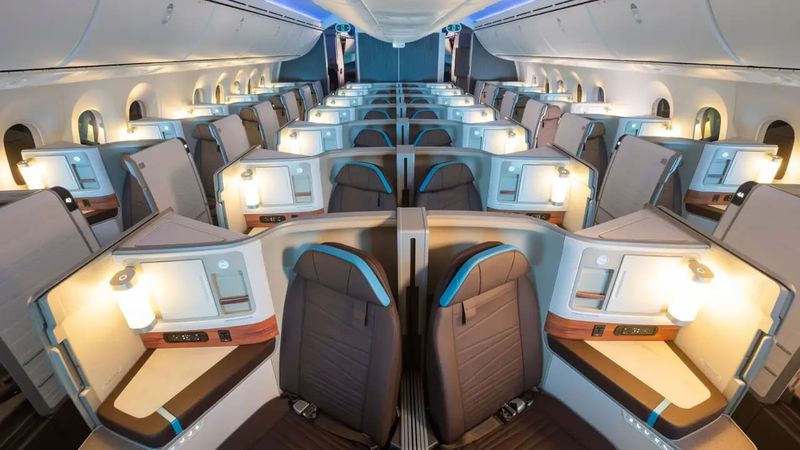
There is a moment, somewhere between the tarmac and the first sip of Champagne, when air travel ceases to be transport and becomes theatre. Perhaps it arrives when you settle into a seat designed with input from NASA engineers, upholstered in leather soft as a Mercedes-Benz interior. Or when you realise your suite contains five windows, an armchair, and a separate chaise longue that converts into a bed nearly two metres long. Or perhaps it is simpler still: the knowledge that someone will clean the bathroom after your every visit, a standard of care most of us do not maintain in our own homes.
The most seasoned travellers, those who measure their miles in hundreds of thousands and their passport stamps in continents, have rendered their judgement on what constitutes excellence at cruising altitude. Their conclusions, gathered from travel specialists who serve the world's most particular clientele, paint a picture of an industry in which the distance between good and transcendent is no longer measured in inches of legroom but in acts of anticipation, in materials chosen for their tactile pleasure, in the willingness to reimagine what a cabin can be.
The Domestic Standard-Bearer
Delta Air Lines has claimed the mantle of finest carrier within a single nation's borders, a recognition built on the unglamorous foundation of reliability. According to industry analyst Cirium, the Atlanta-based airline stands as the sole carrier from the United States to rank among the global top ten for punctuality. When delays do occur, the response distinguishes itself through attentiveness rather than apology.
The carrier's sliding-door suites have become a reference point against which others are measured. Yet the recognition arrived before Delta unveiled its next iteration of service, scheduled to debut in early 2027. The enhancement includes Wagyu beef preparations, premium American bourbon, and a dessert course featuring Champagne-infused sorbet. The tableware, designed with enough aesthetic confidence that passengers might be tempted to acquire it through unofficial channels, signals an airline willing to invest in details that most travellers notice only subconsciously.
Delta's partnership with PS private terminals extends the premium experience beyond the aircraft itself, addressing the friction points that occur before boarding. The logic is sound: a superior in-flight experience loses impact when preceded by queues and chaos.
The International Benchmark
Emirates emerged as the carrier most frequently cited for international routes, appearing in the top tier across half a dozen categories. The Dubai-based airline approaches luxury as a comprehensive philosophy rather than a checklist of amenities. Its first-class cabins allow passengers to adjust temperature and lighting individually, to summon meals through voice command, to view virtual window displays that transform the experience of an interior seat.
The involvement of aerospace engineers in seat design yields furniture that functions as both throne and bed, with electric recline extending even to premium economy. Service reaches a level that borders on the absurd: bathrooms maintained after each use, as though the aircraft were a five-star hotel rather than a vessel hurtling through the stratosphere at 900 kilometres per hour.
This commitment to excellence across all touchpoints, rather than singular innovations in isolated areas, distinguishes Emirates from competitors who may excel in one dimension whilst faltering in others. The consistency becomes the luxury.
The French Renaissance
Air France introduced its La Première service in 2025, and the offering has quietly ascended to the summit of first-class travel. The experience commences at the airport, where dedicated check-in and private security clearance eliminate the indignities of queuing. At Paris Charles de Gaulle and Los Angeles International, passengers access dining curated by Alain Ducasse and complimentary Sisley spa treatments before boarding. Ground transfers arrive via Porsche Cayenne.
Once aboard select Boeing 777-300ER aircraft fitted with four-suite cabins, each passenger commands 3.4 square metres of personal space. The suite unfolds in what Air France describes as a gradient of greys, a palette chosen for its calming properties. An armchair and chaise longue convert into a two-metre bed. Floor-to-ceiling privacy curtains create a cocoon. The allocation of space tells its own story: nearly five rows of economy seating compressed into accommodation for a single traveller.
Service adapts to individual preference rather than following a predetermined script. The flexibility extends from meal timing to the degree of interaction desired, acknowledging that some passengers seek conversation whilst others prize solitude.
The Three-Room Sky Apartment
When Etihad introduced The Residence on its Airbus A380 aircraft in 2014, the concept redefined possibility. A three-room suite containing a living area, a bedroom with double bed, and an ensuite shower transformed long-haul flying into something resembling a boutique hotel experience. Though the technology and furnishings have aged compared to more recent first-class redesigns, the fundamental offering remains unmatched.
The Residence now functions as an upgrade available to first-class ticket holders, accommodating two passengers on routes connecting Abu Dhabi with London Heathrow, Paris Charles de Gaulle, Singapore Changi, Toronto Pearson, and Tokyo Narita. The journey itself becomes the destination, a philosophy once reserved for ocean liners and transcontinental trains.
The suite's longevity speaks to the audacity of its original vision. Whilst competitors iterate on seat width and door height, Etihad created something that remains, more than a decade later, in a category of one.
Business Class That Rivals First
Qatar Airways has developed a business-class product so compelling that the Doha-based carrier briefly considered eliminating first class entirely. The Qsuite features 132-centimetre walls, a sliding privacy door, and fully flat beds that rival many airlines' premium offerings. The enclosed pod provides space that exceeds some micro-apartments and capsule hotels, a comparison that would have seemed absurd in an earlier era of aviation.
The airline's near-abandonment of first class reveals the extent to which business class has evolved. When the distinction between tiers becomes marginal, when business class delivers privacy, comfort, and space once reserved for the highest fare category, the traditional hierarchy loses meaning.
The Calculus of Altitude
These innovations arrive at a moment when luxury travel faces scrutiny over environmental impact and accessibility. The square metreage devoted to a single passenger, the resource intensity of maintaining such standards, the carbon cost of retrofitting aircraft with heavier furnishings - all invite questions about sustainability and equity.
Yet the travellers who select these services seek something beyond transport. They pursue the possibility of rest on a sixteen-hour flight, the dignity of privacy in a public space, the assurance that their journey will not begin with indignity or end with exhaustion. The question is not whether such luxury is necessary, but whether the industry can reconcile its pursuit of excellence with its responsibility to a warming planet.
The carriers recognised for their achievements have made substantial investments in fuel efficiency, fleet modernisation, and operational optimisation. Delta's punctuality reduces the carbon cost of delays and diversions. Emirates' newer aircraft consume less fuel per passenger-kilometre than their predecessors. Air France's partnership with Alain Ducasse emphasises seasonal and regional ingredients, reducing the environmental toll of long-distance food transport.
The Horizon Ahead
The elevation of in-flight experience reflects broader shifts in luxury consumption. Today's affluent travellers have seen the world's finest hotels, dined at its most celebrated restaurants, acquired objects of impeccable craftsmanship. They seek not mere comfort but curation, not simply space but the thoughtful use of it.
Airlines respond by borrowing strategies from hospitality rather than transport. They engage celebrated chefs, partner with luxury automotive brands, commission designers who work in residential architecture. They recognise that their competition is not solely other airlines but the entire ecosystem of premium experience.
The trajectory points towards further personalisation, greater integration of ground and air services, and continued blurring of boundaries between travel and destination. As aircraft become quieter, cabins more isolated, and service more anticipatory, the question shifts from whether one can sleep on a plane to whether one would choose to leave.
The sky, it seems, is no longer a place to endure but a place to inhabit, however briefly. And for those who can afford the ticket, that makes all the difference.