Alaska Airlines Brings Koa Wood and Champagne to the Skies
A West Coast carrier trades regional reputation for long-haul ambition with lie-flat suites, heritage bedding, and menus that change with the map.
A New Scale of Comfort
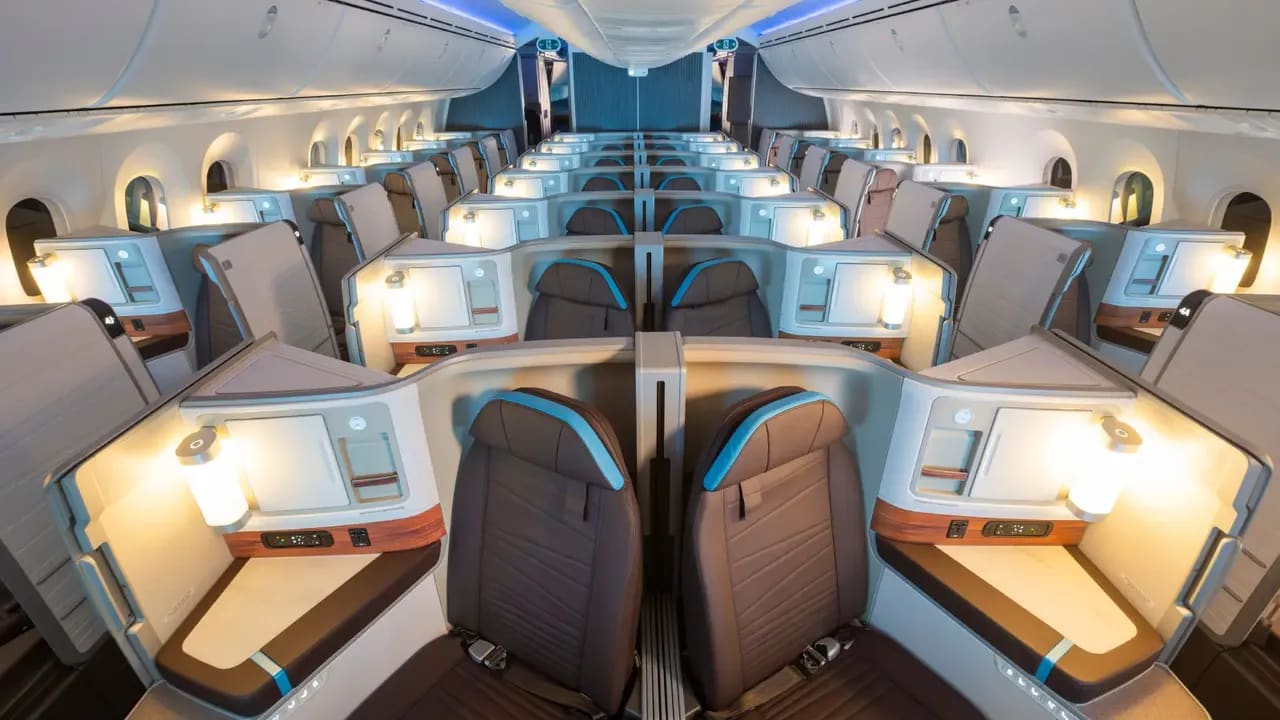
The window seat on a Seattle-to-Rome overnight feels different now. Not because the hours have shortened or the jet stream has shifted, but because a carrier once synonymous with Pacific Northwest hops has decided that long-haul need not feel borrowed. Alaska Airlines has introduced its first International Business Class cabin aboard the Boeing 787-9 Dreamliner, a suite-style configuration that shares design language with Hawaiian Airlines under their joint ownership by Alaska Air Group. The result is a cabin that leans into regional identity rather than away from it.
Thirty-four seats fill the forward section, each arranged in a 1-2-1 layout that grants every passenger direct aisle access. The suites convert to fully flat beds, a baseline expectation on routes to Europe and East Asia but a new offering for a carrier whose reputation was built on frequency rather than distance. Privacy doors close with the satisfying heft of a well-made drawer. Floors and panels echo koa wood, a nod to Hawaiian heritage that reads as warmth rather than pastiche. White marble surfaces house wireless charging pads and power outlets. An 18-inch high-definition screen anchors each suite, preloaded with more than 1,500 films and television programs.
The hardware comes from Adient Ascent, a collaboration between automotive seating specialist Adient and Boeing. The design prioritises lateral space over theatrical gestures, a choice that becomes apparent when the suite is reconfigured for sleep.
Bedding as Statement
Alaska Airlines turned to Filson, the Seattle-based heritage brand known for oilskin jackets and canvas bags, to develop its onboard soft goods. The collaboration yields a mattress pad, sleeping pillow, lumbar cushion, and oversized duvet finished in a beige check pattern that complements the cabin's teal accents. The aesthetic is Pacific Northwest lodge rather than anonymous luxury, a deliberate choice that reads as confidence in regional identity.
The amenity kit arrives in a collectable bag available in two colourways inspired by West Coast landscapes. Inside: Salt & Stone's aluminium-free skincare products, socks, an eye mask, and other essentials. Passengers also receive a reusable water bottle developed with PATH Water, a brand certified BPA-free. Noise-reducing headphones come from LSTN Sound Co, a company that channels proceeds toward hearing health initiatives.
The decision to partner with brands that carry geographic or ethical weight suggests a broader editorial stance. Alaska Airlines is not attempting to mimic the long-haul incumbents; it is building a cabin that reflects the values and aesthetics of its home market.
Menus That Move
Food on Alaska's International Business Class routes shifts with geography. London-bound flights feature a full English breakfast. Services to Seoul Incheon include gochujang chicken paired with traditional banchan. The approach is straightforward: acknowledge where the plane is going, and offer dishes that make sense in that context.
A standout is the Chef's Tray Table entrée, developed with Brady Ishiwata Williams, a Seattle chef whose restaurant work has earned regional acclaim. His signature short rib, sourced from Klingemann Farms in Washington, anchors the dish. The choice to feature a chef with deep local roots reinforces the carrier's strategy of leaning into its geographic identity rather than diluting it for a broader market.
Beverage service spans West Coast and European wines, including labels from California's Stag's Leap area, alongside Louis Roederer Champagne. Cocktails are made to order. Regional craft beers, mineral water, and Stumptown coffee round out the selection. The wine list does not attempt encyclopaedic breadth; it reflects the regions Alaska Airlines serves and the tastes of its core passengers.
Connectivity and the Long Game
Starlink's satellite service is scheduled to arrive on Alaska's 787-9 Dreamliners in the coming months, according to the airline. The system promises gate-to-gate connectivity for members of the Atmos Rewards programme, a feature that may prove more consequential than suite dimensions for passengers who measure productivity in hours aloft.
The timing of the new cabin aligns with Alaska Airlines' expanded international footprint. Since joining the Oneworld Alliance in 2021, the carrier has gained access to more than 900 global destinations. The inaugural non-stop service from Seattle to Rome marked the cabin's debut; routes to Seoul Incheon and Tokyo Narita are set to follow from the Pacific Northwest hub.
The decision to launch International Business Class now, rather than five years ago, reflects a carrier that has grown into its ambitions. Alaska Airlines spent decades building a reputation for operational reliability and customer service on short- and medium-haul routes. The 787-9 Dreamliner represents a different kind of wager: that passengers who have come to trust the carrier on flights to San Diego or Anchorage will extend that trust to overnight crossings.
What Regional Carriers Owe Themselves
The risk in launching a long-haul cabin is not the hardware, which can be leased or financed. It is the question of identity. A carrier that has built loyalty on one set of promises must decide whether to replicate the gestures of established competitors or to assert a different vocabulary. Alaska Airlines has chosen the latter, and the cabin reflects that choice.
Koa wood patterns and Filson bedding are not neutral design elements. They signal a willingness to foreground regional identity on routes where passengers might expect a more generic luxury. The Chef's Tray Table, with its Washington-sourced short rib, makes a similar argument. These are not details that will alter the economics of long-haul aviation, but they do suggest a carrier that believes its home market is an asset rather than a limitation.
Whether that belief translates into sustained demand remains to be seen. The Seattle-to-Rome route will test whether passengers are willing to choose a carrier with a strong regional reputation over incumbents with decades of transatlantic experience. The answer will shape not only Alaska's international ambitions but also the broader question of how regional carriers compete on routes where legacy airlines have long held the advantage.
For now, the cabin exists. The suites recline, the champagne pours, and the menus shift with the destination. What happens next depends on whether passengers see Alaska Airlines as a credible long-haul option or as a capable regional carrier stretching beyond its natural range. The distinction matters, and the market will render its verdict one booking at a time.