Where Limestone Farmsteads Meet the Adriatic
Inside the masserie and palazzi transforming Puglia's heel into Italy's most seductive escape
The Slow Pull of the South
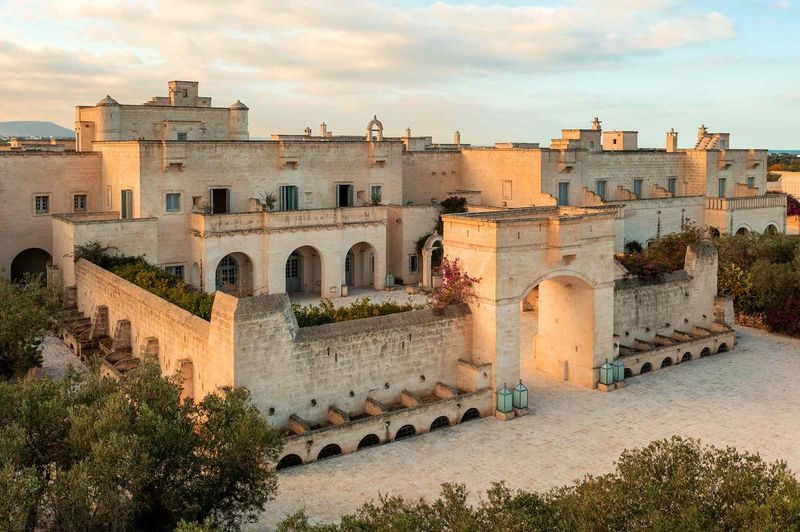
There's a particular quality to the light in Puglia that photographers chase and poets try to capture: the way it bleaches limestone façades until they glow like pearls, how it pools in the vaulted ceilings of ancient farmsteads, the golden hour that stretches impossibly long over olive groves that have stood for centuries. At Global Chic Voyage, we've watched this corner of Italy's heel evolve from a well-kept regional secret into one of Europe's most compelling luxury destinations, yet it has managed to retain something essential. The pace here refuses acceleration. The architecture speaks in whispers rather than shouts. And the hotels, many carved from structures that once housed agricultural laborers or noble families, understand that the greatest luxury is often restraint.
The region's hospitality landscape tells a story of adaptive reuse long before that phrase became design-world currency. Masserie, the fortified farmhouses that dot the countryside like sentries, have been reinvented as intimate retreats where contemporary comfort nestles within walls that have weathered centuries. Historic palazzi in hilltop towns now house boutique properties where original frescoes hang above modernist furniture. The Adriatic, Ionian, and Mediterranean seas converge here, their waters lapping against a coastline of sandy crescents, jagged promontories, and hidden coves that locals still guard jealously.
Architectural Memory, Modern Gesture
Vista Ostuni occupies a five-story palazzo at the foot of the "White City," where the old town cascades down the hillside in a tumble of whitewashed houses. The property resists easy categorization. It's neither a traditional masseria nor a conventional grand hotel, but something that draws from both lineages. Floor-to-ceiling windows frame views of ancient olive groves dissolving into the Adriatic's blue. No two rooms share a layout. Bathrooms are dressed in local Trani stone, its soft hue somewhere between cream and blush. Furnishings mix rattan with Dedar fabrics in ochre and teal. Grottaglie ceramics and handcrafted amphorae punctuate the interiors, grounding the contemporary gestures in regional craft traditions.
On the rooftop, classic Bambola armchairs cluster in conversational arrangements. This is where guests gather at dusk, drinks in hand, to watch Ostuni's tiered architecture catch the last light. The town earns its nickname honestly; the whiteness is almost aggressive in midday sun, softening only as evening approaches.
Further south, where Puglia narrows toward its tip, Castello di Ugento rises at the highest point of a small town that sees fewer tourists than its northern neighbors. The palazzo's renovation required eighteen months of sandblasting to reveal the original honey-colored pietra leccese beneath decades of neglect. The investment approached sixteen million dollars, a figure that speaks to both ambition and the challenges of restoring a structure whose bones date back centuries.
Three professional-grade kitchens were integrated into the design, built to accommodate culinary students learning traditional Italian techniques. The nine guest rooms marry original architectural elements with contemporary comfort. Star-vaulted ceilings arch overhead in some quarters; in others, rediscovered Norman-era vaults have been converted into rainfall showers. A museum wing hosts rotating contemporary art exhibitions against a backdrop of seventeenth-century frescoes. In the restaurant, a glass floor panel reveals excavated remnants of a Norman tower, offering diners a literal window into layers of history.
The Village Within the Estate
Borgo Egnazia operates at a scale unusual for the region. The property sprawls across three distinct zones: a 63-room masseria hotel at its heart, a collection of apartments arranged around lanes and piazzas that evoke a rural hamlet, and 29 private villas, each with its own pool. The complex can accommodate over three hundred guests during peak season, yet the design somehow absorbs crowds without feeling overwhelmed. Four swimming pools and an equal number of dining venues, from stone cellars to beachfront terraces, distribute guests across the property. A spa includes a screening room. Local advisors arrange excursions or simply indulge whims; there's a staff member dedicated solely to bicycle rentals.
The architecture nods to Puglia's vernacular without attempting slavish reproduction. Courtyards open to the sky. Archways frame views of the Adriatic. The color palette stays disciplined: whites, creams, the occasional terra-cotta accent. It's a riad sensibility translated to the Italian south, and it works because the design team understood that luxury here means space, silence, and the freedom to disappear into a private corner even when surrounded by other guests.
Where Water Defines the Experience
La Peschiera sits directly on the Monopoli coastline, occupying what was once a fishing reserve, a medieval aquaculture system where seawater was channeled into stone basins to keep catches fresh. The restoration preserved the property's relationship with the Adriatic, which remains the defining element. Guest rooms follow a restrained palette of whites and beiges, allowing the deep blue visible through every window to provide the only color accent needed. The suspended dining terrace hovers above the water, close enough that you can hear waves against stone between courses. Chef Vincenzo Montanaro's tasting menus lean heavily on seafood, as geography demands. A small private beach offers direct access to the sea, the kind of amenity that matters more than any spa treatment when temperatures climb.
In Fasano, within the Itria Valley's wild landscapes, Masseria Borgo Ritella represents a different approach. This is one of the few remaining masserie still operated by the family that originally farmed the land. After years teaching in Rome, Paola returned home and, working with interior designer Pino Brescia, transformed her grandfather's estate into a 17-room property. The restoration honored existing structures while introducing contemporary comfort. Neutral, earthy tones dominate the interiors. Cashmere throws dress the beds; draped canopy fabric softens the sleeping quarters. The luxury here is not about thread count or square footage but about waking to birdsong, about the scent of rosemary carried on morning breezes, about cuisine rooted in Apulian tradition: friselle, panzerotti, focaccia prepared as they've been prepared for generations.
The Agricultural Estate Reimagined
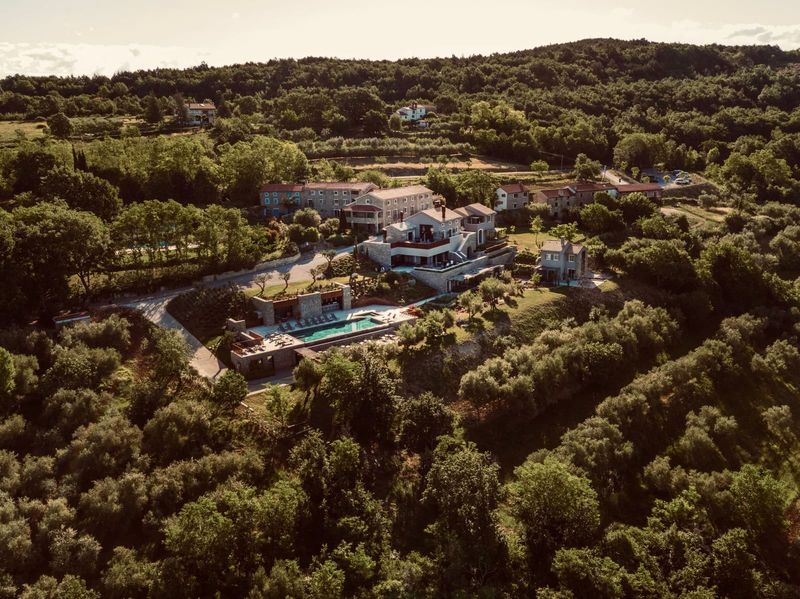
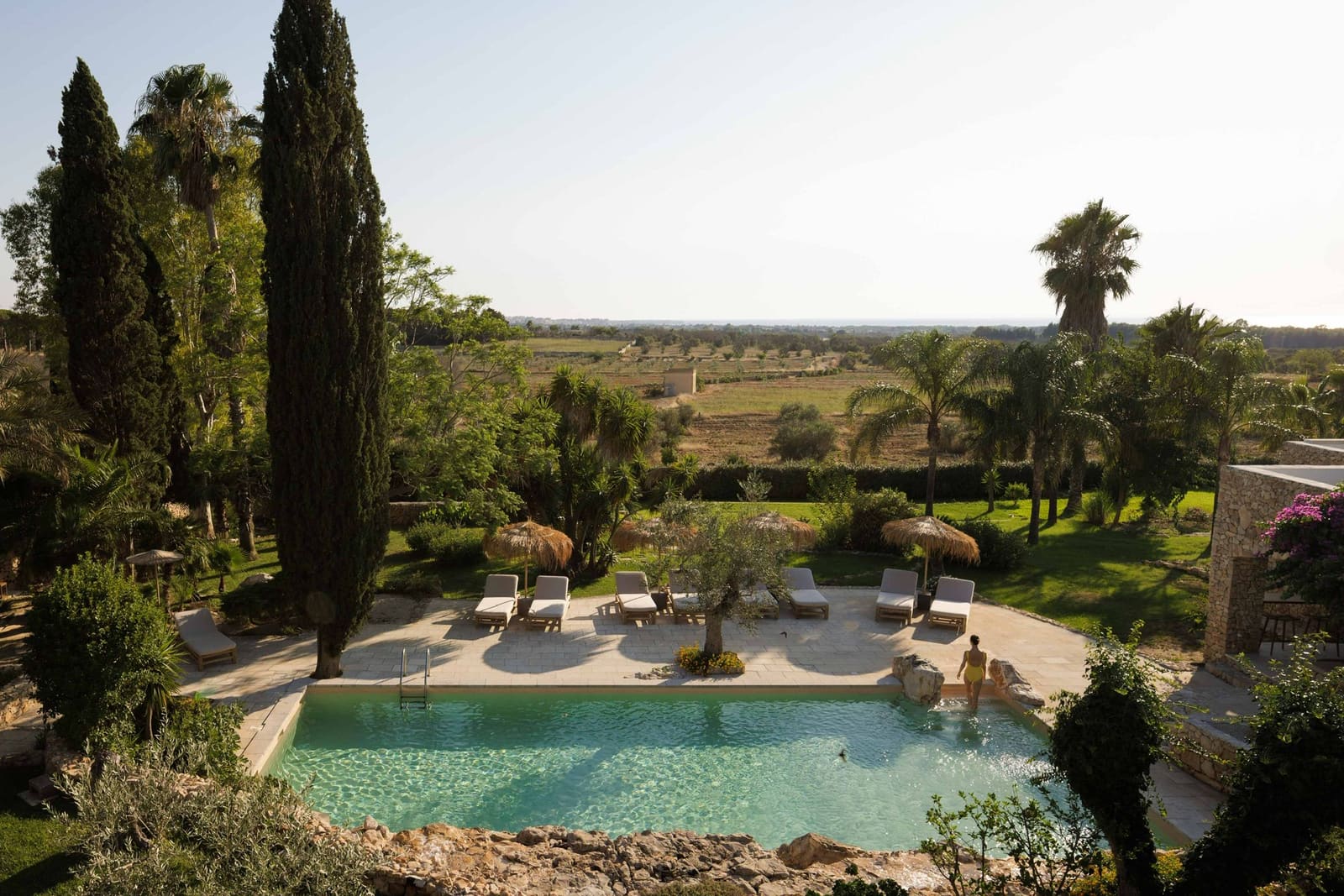
Borgo Valle Rita occupies 255 acres on the border between Puglia and Basilicata, a few miles inland from the Ionian Sea. The estate was acquired in 1972 and is now overseen by the founder's grandson and his wife, who have shifted its focus toward hospitality while maintaining agricultural operations. An ancient palm grove lines the Rita stream that gives the property its name. The rustic fourteenth-century manor was restored by Milan-based architect Anna Mazzucchelli, who prioritized local materials, including tufo Pugliese stone, and worked with regional artisans for furnishings. The 15 rooms, apartments, and villas each carry distinct design identities. The restaurant occupies a space beneath an elegant barrel-vaulted ceiling, serving a farm-to-table menu that draws from the estate's own production and nearby purveyors. A swimming pool overlooks the valley. Three hiking and mountain biking trails thread through the property, with both classic and electric bicycles available to guests.
Further south, near Gallipoli, Tenuta Negroamaro takes its name from the local grape variety and the red wine it produces. The estate sits embedded within olive groves, prickly pear stands, and almond orchards, an hour's drive from Brindisi Airport. Olga Ashby Interiors designed the 10-room property as a playful tribute to its surroundings, mixing earthy tones, natural materials, and textures that harmonize with Puglian vernacular design. Soft linen bedding, Aztec-inspired cushions, and jute rugs reinforce the laid-back atmosphere. Some rooms feature private plunge pools; others offer patios with outdoor showers. Mediterranean flavors anchor the menu, with produce from the estate's gardens paired with locally sourced seafood and regional specialties. The Cactus Bar, distinguished by a hand-painted mural, serves cocktails infused with prickly pear.
The Female Gaze
Masseria Montelauro, near Otranto, came into being through a collaboration among three women: Elisabetta Massaro and her daughters, Caterina and Mercedes. They acquired the run-down farmhouse and undertook a restoration that reflects a distinctly feminine sensibility. Sky-blue shutters punctuate the whitewashed façade. Large wooden cabinets display pastel-colored ceramics. Fresh flowers appear throughout the property, arrangements that change with the seasons. The 29 rooms honor tradition with vaulted ceilings and chianca stone floors, intricate wrought-iron bed frames, and lamps crafted by local artisans. The design avoids unnecessary ornamentation, allowing the architecture's bones to speak.
What unites these properties is not a single aesthetic or price point but a shared philosophy. They understand that Puglia's appeal lies not in reinvention but in careful amplification of what already exists. The region's beauty is in its bones: the limestone that glows at dusk, the olive groves that have fed families for generations, the sea that has shaped both cuisine and character. The hotels we've returned to this year are those that resist the urge to import foreign notions of luxury, choosing instead to work with the land's inherent qualities. They are spaces where the past is present not as museum artifact but as living context, where contemporary comfort enhances rather than erases regional identity.
The Rhythm That Resists
There's a particular rhythm to days spent in these properties, one that visitors from faster-paced cities often struggle to adjust to initially. Breakfast extends well into mid-morning. Lunch is followed by hours when the heat dictates stillness. Evenings unfold slowly, dinners that stretch across multiple courses and just as many hours. It's a cadence that feels almost radical in its refusal of efficiency, yet it's precisely this quality that guests find most transformative.
The region's culinary traditions, deeply tied to agricultural cycles and coastal bounty, reinforce this slower pace. Meals become events, opportunities to taste the specific terroir of southern Puglia: the peppery bite of local olive oil, the sweetness of sun-ripened tomatoes, the briny freshness of seafood pulled from the Adriatic that morning. Wine lists favor regional producers, the negroamaro and primitivo that thrive in this climate. Even coffee, that most routine of rituals, becomes something to linger over when taken on a terrace overlooking the sea.
The landscape itself resists hurry. Olive trees, some centuries old, stand as reminders that growth here has always been measured in generations rather than quarters. The trulli, those distinctive conical stone dwellings unique to the region, dot the countryside like prehistoric monuments. Villages perched on hilltops retain their medieval layouts, narrow streets designed for foot traffic and donkeys rather than automobiles. To move through Puglia is to move through layers of time, each era leaving its mark on the architecture, the cuisine, the very shape of the land.
Return and Recognition
At Global Chic Voyage, we measure a destination's pull not by first-time visitor numbers but by return rates. Puglia scores exceptionally high on this metric. Guests who discover the region often find themselves planning their next visit before the current one concludes. It's a phenomenon we've observed in other parts of the Mediterranean, but Puglia's version carries its own particular flavor. Perhaps it's the relative lack of mass tourism compared to Tuscany or the Amalfi Coast. Perhaps it's the authenticity that persists in villages where elderly women still gather in doorways to shell fava beans, where festivals honor patron saints with the same rituals followed for centuries.
The hotels profiled here understand their role as interpreters, translating the region's essence for visitors while protecting what makes it distinctive. They resist the homogenizing forces of global luxury branding, the tendency to replicate what works in other markets. Instead, they root themselves in specificity: the particular quality of Puglian limestone, the craft traditions of local artisans, the agricultural heritage that still shapes the landscape. This is not luxury as theater but luxury as context, comfort that emerges organically from place rather than being imposed upon it.
The Adriatic continues its patient work, waves reshaping coastlines grain by grain. Olive groves swell with fruit as they have for centuries. In kitchens across the region, hands shape orecchiette pasta with practiced efficiency, the same motion repeated thousands of times until it becomes muscle memory. And in masserie and palazzi transformed into intimate retreats, guests discover that the greatest luxury Puglia offers is not what's added but what's preserved: a way of living that refuses acceleration, a landscape that rewards attention, and a hospitality rooted in generations of knowing how to welcome strangers into the fold.