Where Ibiza's Clifftop Edges Meet Ceremony and Stillness
Nômade Temple Ibiza transforms a 1970s relic into a 182-room sanctuary where architecture bows to landscape and wellness becomes theatre.
A Northern Cove, Reimagined
The coast at Portinatx unfolds in three distinct crescents: S'Arenal Gros, S'Arenal Petit, and Es Port. Pine forests press against rocky headlands, and the Moscarter lighthouse, tallest in the Balearics, stands sentinel over the northern tip of Ibiza. This is not the island of neon-lit beach clubs or endless processions of DJ sets. Here, the rhythm slows. The light softens. And on the site of a former four-star all-inclusive built in the 1970s, a new kind of gathering place has taken root.
Nômade Temple Ibiza occupies 182 rooms, a sprawling terrain of terraces, arches, and pathways that descend toward the water. The property is the latest from Nômade People, the Mexican hospitality company behind retreats in Tulum, Holbox, and Madrid. But this is no simple expansion. The transformation, led by Oneness, the group's in-house architecture studio founded by Sebastián Sas and Bjarke Ingels, required dismantling the old resort's impositions and coaxing a new dialogue between building and landscape.
Guests enter through a compressed, almost monastic passage where a reflecting pool introduces the sound of water before the space opens. Reception sits beneath a large skylight, then the route pivots sharply, releasing the horizon in a single, calculated gesture. The architecture does not announce itself. It defers.
Arches, Terraces, and the Art of Disappearing
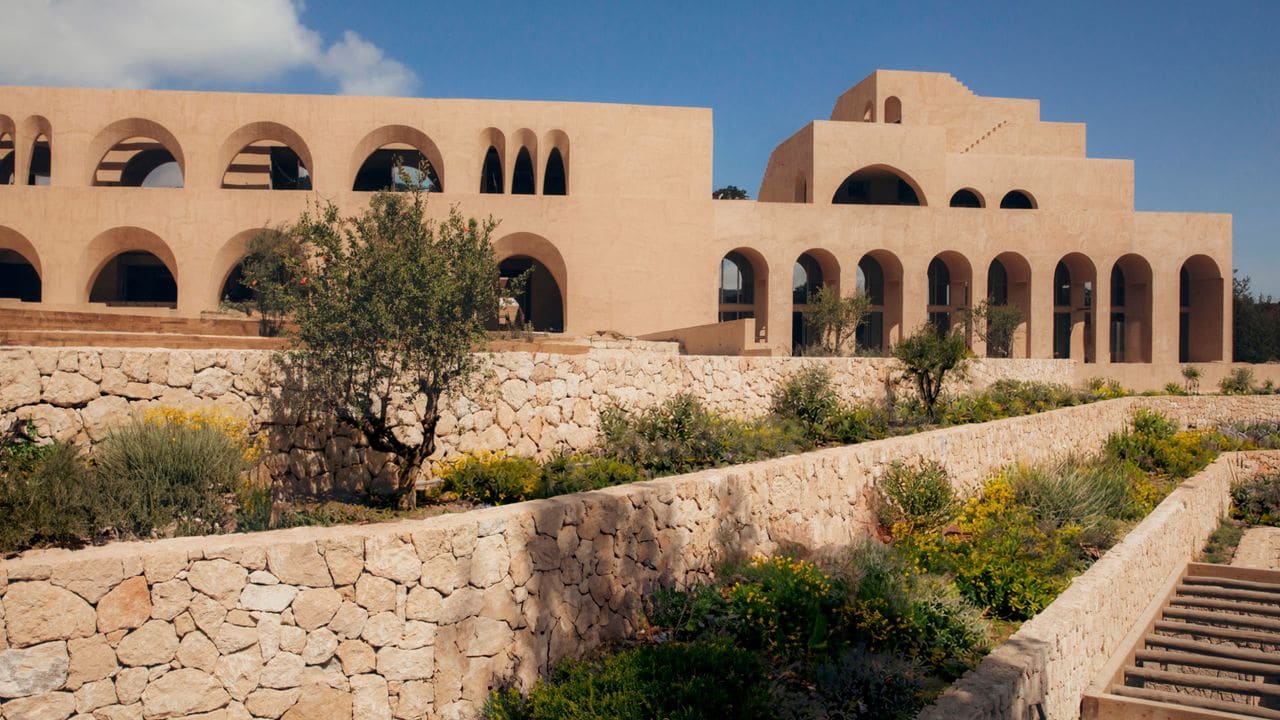
The original guestroom blocks were retained but reimagined. Larger openings now frame views of sky and sea. Environmental systems were upgraded. Interiors and exteriors blur through sliding thresholds and semi-covered balconies. New volumes step down the hillside so that one building overlooks another without compromising privacy. Arches and rounded corners echo the island's traditional payesa farmhouses, while deep walls and shaded terraces temper the Mediterranean summer.
The greatest architectural intervention centres on the main building, which once stood as a visual barrier between guests and the cove. Oneness transformed it into the social and structural heart of the property, housing the Portinatx Villa, restaurant spaces, lofts, and the forthcoming El Templo performance venue. Repeated arches soften its mass, framing glimpses of native planting and water as guests circulate.
Piedra blanca, sabina wood, terracotta, zellige, and rustic stone establish the material palette. Furniture was designed specifically for individual spaces, then layered with vintage pieces sourced internationally. The effect is cohesive but not uniform. Each room, each corridor, each dining space carries its own texture and mood.
According to Oneness, the intention was to craft the resort with the attention of a boutique property despite its scale. Natural materials, artisanal techniques, and locally sourced elements anchor the design in Ibiza's vernacular while allowing Nômade's nomadic, ceremony-driven ethos to take hold.
Rooms That Shift Between Solitude and Gathering
The Portinatx Villa, set within the main building, exemplifies the property's range. Three bedrooms, one with a private sauna, surround an expansive living area, full kitchen, and private pool. The villa can be rented whole or divided into separate rooms. Its central position offers sweeping views across the terraced resort and out toward the cove. Stone surfaces, saturated colour, tactile linens, and individually selected furniture create a domestic intimacy rare in properties of this size.
Beyond the villa, accommodations span compact solo rooms, oceanfront suites, double-height DJ Lofts, and cliffside villas designed for groups. Some prioritise seclusion, with private pools and outdoor bathing carved into the hillside. Others introduce shared kitchens and living rooms intended for creative residencies, extended families, or collaborative retreats. Locally sourced ceramics and handcrafted furniture recur throughout, but their combinations shift from room to room, resisting the homogeneity typical of large-scale resorts.
Oneness describes the approach as intentional: some rooms invite introspection and connection with the natural surroundings, while others, such as the DJ Lofts, foster companionship and creative energy. The architecture accommodates both impulses without favouring one over the other.
Fire, Omakase, and the Long Table
Tavla serves as the central all-day restaurant, built around seasonal Mediterranean produce, fire cooking, and communal dining. Restored wooden windows anchor the space, joined by stone floors laid piece by piece and handcrafted ceramics across the tables. The emphasis is on gathering, on meals that stretch across hours and blur the line between strangers and companions.
Café Libre handles mornings and the quiet hours between meals, offering speciality coffee from local roastery Meke alongside pastries and lighter fare. At the water's edge, 4fu3gos focuses on local seafood and open-fire techniques. Clay tiles wrap the kitchen, and traditional Mexican equipal chairs connect the island's vernacular to Nômade's origins in Tulum and Holbox.
Kuu Jū brings Japanese omakase discipline into contact with Mediterranean fish. Coloured glass evokes the aesthetic of the 1970s, according to Oneness, while a textured marble counter and an oversized straw pendant light suspended above define the space. Guests choose between a 13-course tasting and a bites menu that includes a soy-fuelled riff on the classic Spanish gilda and a tuna-belly katsu sando that deserves its own pilgrimage. After dinner, Dante's HiFi, inspired by Japanese audiophile bars, pairs vinyl with cocktails in a dimly lit corner that feels like a secret.
The Spa That Disappeared Into the Hill
The Gön House of Healing is Oneness's boldest spatial move. Faced with an 810-square-metre spa and a coastline already occupied by the inherited resort, the studio buried the wellness complex within the topography. The decision was both practical and philosophical: by submerging the structure, the cove remains the visual protagonist.
The subterranean interiors take cues from Ibiza's limestone caves. Travertine floors, textured walls, and sharp contrasts between light and shadow guide guests through hammams, saunas, cold plunges, flotation spaces, and the Wataflow Sanctuary. Treatments range from Augustinus Bader facials to the Waterness Journey, in which a practitioner guides the body through fluid movements in warm water. The Emotional Alchemy Ritual combines meditation with bodywork, while the broader programme extends into Pilates, astrology, hypnotherapy, and emotional freedom techniques.
A Journey Designer consultation at the start of each stay helps guests navigate the options. The role is part concierge, part spiritual guide, assembling a personalised route through rituals, treatments, and cultural events. A shaman-in-residence is available for energy cleansings. Telescope stargazing, beeswax jewellery workshops, and recode breathwork sessions fill the calendar.
The forthcoming El Templo, inspired by M.C. Escher's shifting geometry, will expand the programme beyond traditional wellness. Its stairways, changing perspectives, and theatrical use of light are designed to accommodate yoga, meditation, performances, and celebrations. The space is flexible by design, intended to hold whatever ceremony the moment requires.
A Logic of Its Own
Whether Ibiza's essence can be recovered is a question for historians and romantics. What Nômade has done is create a version of the island with its own spatial logic, soundtrack, and daily rhythms. Staying here means entering a worldview where wellness is not an amenity but a framework, where dining becomes ritual, and where architecture retreats so that landscape and ceremony can take centre stage.
With 182 rooms and a programme that spans everything from fire-cooked seafood to hypnotherapy, the property offers enough variety for each day to take a different shape. Guests can spend mornings in the subterranean spa, afternoons hiking the coastal trails, and evenings dancing beneath the arches. Or they can do none of it, letting the sound of water and the rhythm of the cove dictate the hours.
Nômade Temple Ibiza does not ask guests to choose between solitude and gathering, between introspection and celebration. It builds the architecture to hold both, then steps aside.