Where the Chalk Speaks: Rediscovering Champagne Beyond the Bubbles
From hidden grower cellars to hip-hop festivals in abbey ruins, France's most celebrated wine region has quietly become one of its most compelling overnight destinations.
The Underground City
Stand on the hill above Reims and you might not guess what lies beneath your feet. A labyrinth of former quarries, some with ceilings soaring nearly a hundred feet, stretches for miles under the surface. The crayères, as locals call these chalk cathedrals, have been temperature-stable sanctuaries since medieval times. Today they cradle tens of millions of bottles in near-total darkness, the still air thick with patience.
At Global Chic Voyage, we've watched Champagne shed its image as a quick excursion tacked onto a Paris itinerary. Since UNESCO inscribed the region's hillsides and cellars on its World Heritage roster a decade ago, overnight visitor numbers have climbed sixty percent, now exceeding 1.8 million annually. The shift is palpable. Where once you might have rushed through a single house tour before catching the afternoon train back to the capital, the region now rewards those who linger.
What changed? A constellation of factors. Plush hotels have opened in renovated mansions and former industrial buildings. Winemakers who once kept their doors firmly closed to outsiders now welcome visitors into private salons and working cellars. And a younger generation, both at historic houses and tiny grower estates, is experimenting with ways to connect wine culture to broader creative movements, from contemporary art installations to underground music festivals.
The Villages Hold the Story
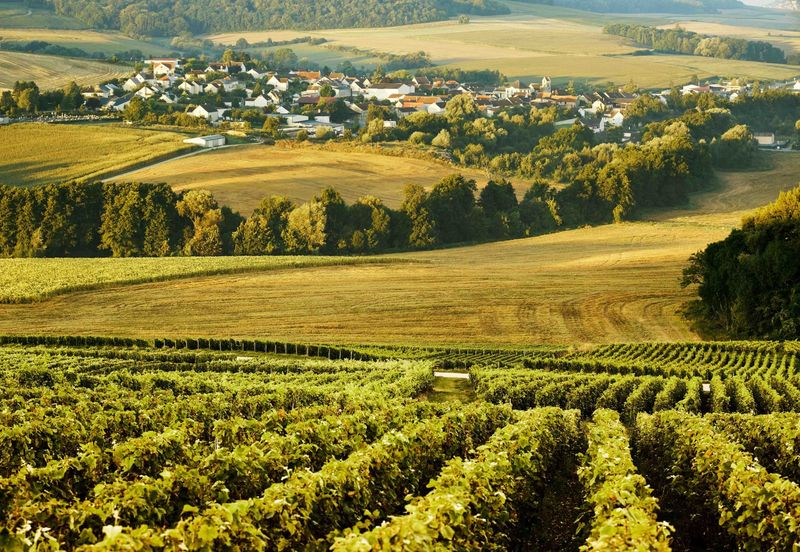
Reims and Épernay anchor the region, but they're not where the wine is made. Mathieu Roland-Billecart, who runs the seventh-generation family house Champagne Billecart-Salmon, puts it plainly: if you want to feel what Champagne is really about, you need to venture into the villages that ring these two cities. His family recently opened part of their historic home as an intimate tasting salon, the kind of gesture that would have been unthinkable a generation ago.
The advice we've heard repeated by nearly every winemaker we've spoken with in the region is this: visit three kinds of producers. Start with a large house that can offer a polished visitor center and demonstrate the industrial scale of champagne production. Then seek out a tiny grower, often a family operation where the same hands that prune the vines also bottle the wine. Finally, find someone in between, a mid-sized estate where you can see working facilities, walk through vineyards, and descend into cellars that still feel lived-in rather than museumified.
Among the large houses, Ruinart stands out not just for its age (it's the world's oldest champagne house) but for the way it's woven contemporary art into its identity. In the chalk cellars, you'll find both bottles and sculptures. Above ground, the new Nicolas Ruinart Pavilion is surrounded by gardens dotted with installations. When we last visited, artist Tadashi Kawamata had constructed his signature wooden structures, tree houses and nests perched among the vines like fantastical bird dwellings.
Down in Épernay, Moët & Chandon offers something most houses don't: a chance to watch à la volée disgorgement, the traditional hand method of removing sediment from bottles. It's one of those rare moments where you grasp the sheer physical skill that underpins what looks, in a flute, like effortless elegance.
For those who want context before diving into tastings, Pressoria provides an interactive primer on terroir and technique in Pommery's former pressing center. The experience is sensory rather than academic, designed to help you understand what you're tasting before you taste it.
New Audiences, Old Abbeys
In early summer, a new kind of event appeared on Champagne's calendar. Pop et Hip Hop, organized by the Burgundy-based travel company Hautes Côtes, brought emerging DJs and hip-hop artists to the grounds of an eleventh-century abbey for a day of music and tastings. Growers poured alongside grandes maisons like Krug and Armand de Brignac. The crowd was young, diverse, not the usual clientele you'd find at a formal cellar tour.
It's part of a broader shift. Next-generation makers, whether they've inherited historic houses or started their own micro-domaines, are looking beyond the traditional wine audience. They're collaborating with artists, hosting cultural events, and rethinking what it means to welcome people into the world of champagne. The result is a region that feels more dynamic, less insular, more willing to let outsiders in on the conversation.
Tables Worth the Journey
Champagne's dining scene has evolved in tandem with its hospitality. The region now holds thirteen Michelin stars across eight restaurants, a concentration that rivals some of France's most celebrated gastronomic corridors.
At the top of that hierarchy sits L'Assiette Champenoise, where Arnaud Lallement has earned three stars for cooking that treats local ingredients with an almost reverential precision. His family has run the brick-clad mansion for four decades, and the operation now includes twenty-five rooms and a spa, making it possible to settle in for a few days and explore the full range of his work.
Racine, helmed by Japanese chef Kazuyuki Tanaka, has long been a favorite among local sommeliers. More recently, his wife Marine opened Yumemi Saké et Bulles, a tiny izakaya-style spot with shared plates and a rotating champagne list. The space fills quickly; reservations are essential.
In Reims, Philippe Mille's Arbane occupies a nineteenth-century mansion and draws crowds for its three-course lunch menu, which shifts daily based on what's available at the market. It's the kind of place where you can eat exceptionally well without the formality or expense of a multi-starred dinner.
For something more intimate, ATOME offers a ten-seat private dining experience in what was once an artisanal épicerie. Aline and Eric Serva source ingredients with the care of curators, and the menu changes constantly. A vintage hi-fi system plays music at the volume of a Japanese listening bar. The couple also runs a small wine shop focused on eastern and central European bottles and grower champagnes, and Aline has begun producing her own limited-edition collaborations with winemakers like Olivier Horiot, each run capped at under a thousand bottles.
Out in the village of Avize, Domaine Jacques Selosse operates a ten-room hotel in a neo-classical mansion that feels more like staying in a private home than checking into a hotel. The restaurant's outdoor terrace serves bistro fare at lunch and more ambitious cooking in the evening, with menus that shift seasonally.
At Le Garde Champêtre, Japanese chef Kazuya Miyashita cooks vegetables from the estate's organic garden, often simply smoked or roasted over fire. The aesthetic is barnyard chic, the approach farm-to-table without the usual fuss.
Back in Reims, La Grande Georgette sits across from the cathedral, a convenient stop after admiring Marc Chagall's stained-glass windows. If you're in town mid-week, the Halles Boulingrin covered market is worth a visit. The arched Art Deco structure dates to the 1920s and hosts vendors selling local specialties. Nearby, Moklair micro-roasts coffee and even offers cold brew on tap, a rarity in France. Sacré Burger draws locals for its champagne list as much as its food.
For evening drinks, La Vertu, a newish bar à vins in the heart of Reims, pours wines and champagnes from small European producers. The team is young and gregarious, the vibe relaxed.
Places to Rest
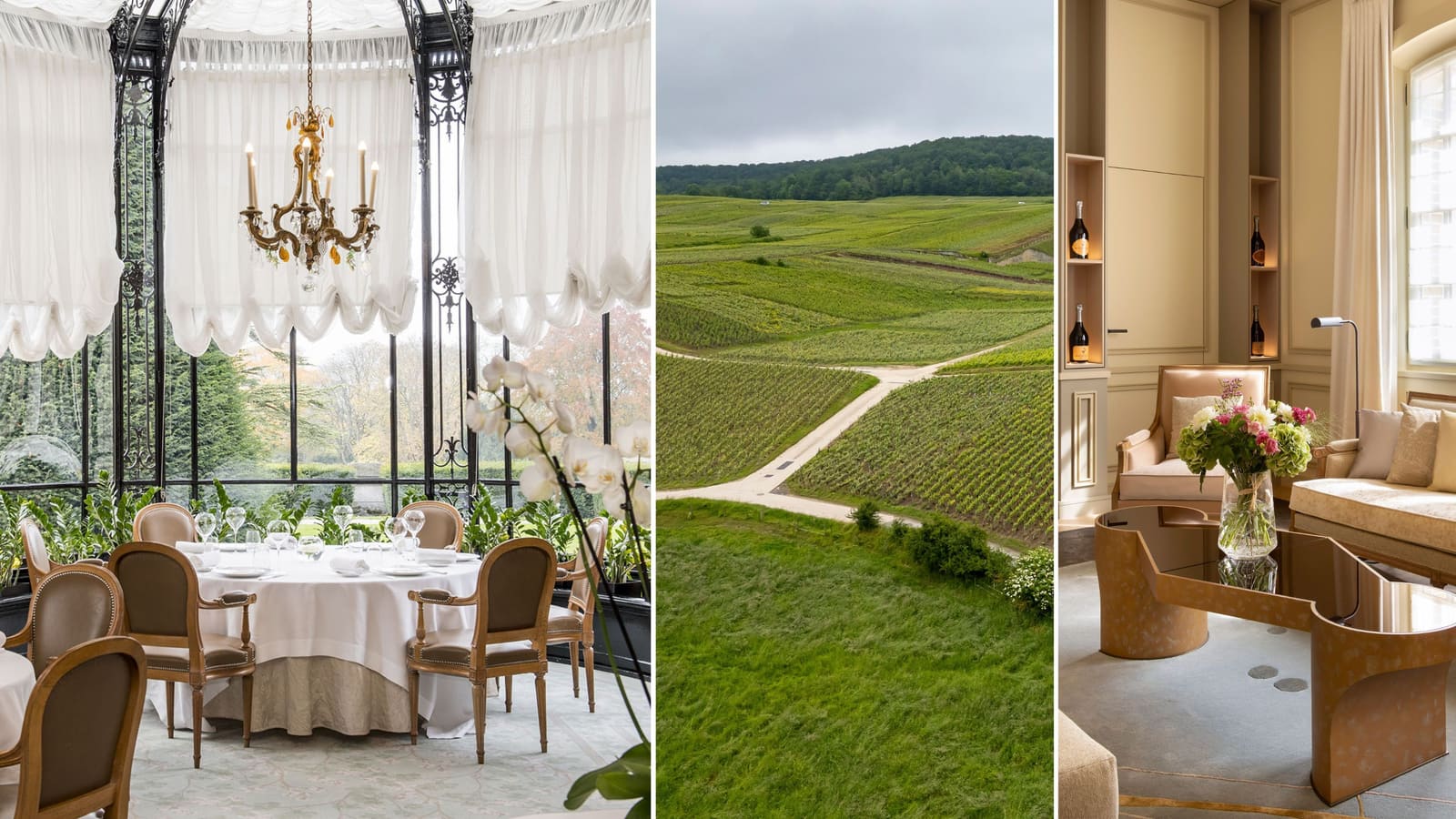
Domaine Les Crayères has been Champagne's grande dame for decades. Madame Pommery originally built the château-style residence, enlisting the landscape architect behind Paris's Tuileries Garden to design the seventeen-acre park. In the 1980s, French interior designer Pierre-Yves Rochon transformed it into a twenty-room hotel. Rooms are ornate, with patterned wall coverings and canopied beds sourced from Pierre Frey's historical archives. The estate holds a thousand different champagnes; you can sip them in Christophe Moret's two-starred Le Parc or on the terrace of the more casual Brasserie Le Jardin.
A newer arrival, Le N3 by Champagne Thiénot, occupies a period townhouse in central Reims, steps from the cathedral. The thirteen rooms and suite are minimalist, almost Scandinavian in their restraint, with herringbone floors and large bay windows. Below, the historic cellars of the Thiénot family maison offer tours and tastings. The rooftop champagne bar, with views across the city and cathedral, still feels like a secret despite its proximity to major landmarks.
Outside Épernay, Hostellerie Briqueterie & Spa occupies a former brick factory that's been transformed into a stylish country retreat. The aesthetic is warm, industrial elements softened by careful design. The property is part of Relais & Châteaux, and its Michelin-starred restaurant, Alcôve, draws diners from across the region.
Loisium Wine & Spa Hôtel Champagne, also near Épernay, spreads its hundred-plus rooms across vineyards, with floor-to-ceiling windows framing the vines. It's a modern counterpoint to the region's château properties, designed for visitors who want contemporary comforts and direct access to the landscape.
A Region Opening Up
Champagne's transformation isn't just about new hotels and restaurants. It's a fundamental shift in how the region sees itself. For generations, the grandes maisons operated with a certain reserve, their cellars and processes hidden behind high walls. Smaller producers, many of them family operations, had neither the resources nor the inclination to welcome tourists.
That insularity has softened. Winemakers now speak openly about their methods, their experiments, their philosophies. They're eager to share not just the finished product but the story of how it came to be. And they're recognizing that Champagne's future depends on attracting people who might not have grown up drinking it, who don't already know the difference between a blanc de blancs and a rosé.
The region is also grappling with how to balance growth with authenticity. As visitor numbers climb, there's a risk that Champagne could become overly polished, too focused on the tourist experience and not enough on the wine itself. But the winemakers we've spoken with seem acutely aware of that tension. They're determined to welcome outsiders without losing the qualities that make the region distinctive: the deep connection to terroir, the obsessive attention to craft, the knowledge that some things can't be rushed.
If you're planning a visit, consider staying at least two nights. Rent a car or hire a driver and explore the villages. Visit a mix of producers, from the largest to the smallest. Eat well, drink thoughtfully, and give yourself time to wander the vineyards and understand the landscape. Champagne rewards patience. The best experiences here unfold slowly, like the years a bottle spends aging in the chalk cellars beneath your feet.