When Rain Greens Corfu: A Season of Wild Herbs and Mountain Villages
On this Ionian island, May brings hikers, foragers, and the kind of bloom that makes other Greek islands seem austere by comparison.
The Island That Never Closes
Stand in Corfu Town on a February morning and you will see something rare in the Greek islands: cafés crowded not with visitors but with music students clutching scores, university undergraduates arguing over coffee, locals conducting the ordinary business of a place that does not hibernate. The Ionian island, pressed against the Albanian coast in Greece's northwest, refuses the binary that governs much of the Aegean. There is no dramatic shuttering in October, no resurrection in April. Corfu simply continues.
That continuity owes much to scale and circumstance. The island supports a university and a conservatory. Its size and cosmopolitan history have allowed it to retain residents rather than export them to Athens or Thessaloniki during the lean months. But it is in May, when the winter rains have done their work and the island erupts in green, that Corfu reveals its particular character most vividly.
A Different Kind of Traveller
Springtime visitors to Corfu tend to arrive with hiking boots rather than beach towels. May offers the temperate weather that makes the 180-kilometre Corfu Trail navigable, a route threading from the island's southern tip to its northern edge. The trail does not demand completion; sections can be walked in a day, though the full traverse takes a week or longer depending on pace and digression.
The landscape at this time of year justifies the effort. Months of rainfall have transformed the island into something lush and almost implausible, a green intensity that feels borrowed from a different latitude. Mornings and evenings provide the best walking hours, before the sun climbs too high. The coastline, in places overwhelmed by summer development, recedes in importance. The mountains and interior villages become the real geography.
Venetian Ghosts in the Kitchen
Corfu's food carries the imprint of empire in ways both obvious and subtle. The Venetian Republic governed here for more than four centuries, long enough to leave traces in architecture, dialect, and the spice cupboard. That last influence surfaces most clearly in tsigarelia, a dish of wild greens foraged in spring and sautéed with cinnamon, cloves, and cayenne pepper. The combination speaks to Corfu's position on historical spice routes, a culinary legacy that distinguishes the island's cooking from the mainland.
These greens, gathered from hillsides and roadsides during the rainy season, appear on menus throughout May. They are typically paired with onions and tomatoes, though preparations vary by household and taverna. The dish exemplifies a broader truth about Corfiot cuisine: it leans westward, toward Italy, in ways that other Greek islands do not. Pastitsada, a spiced meat stew served over pasta, and stifado, a slow-cooked beef and onion braise, both reflect this Adriatic tilt.
Marina's Tavern in Corfu Town serves these dishes in their traditional form, the kind of home-style cooking that survives not through innovation but through precise repetition. The restaurant operates year-round, its clientele a mix of locals and the handful of travellers who understand that May offers something summer cannot.
The Mountains Hold the Secret
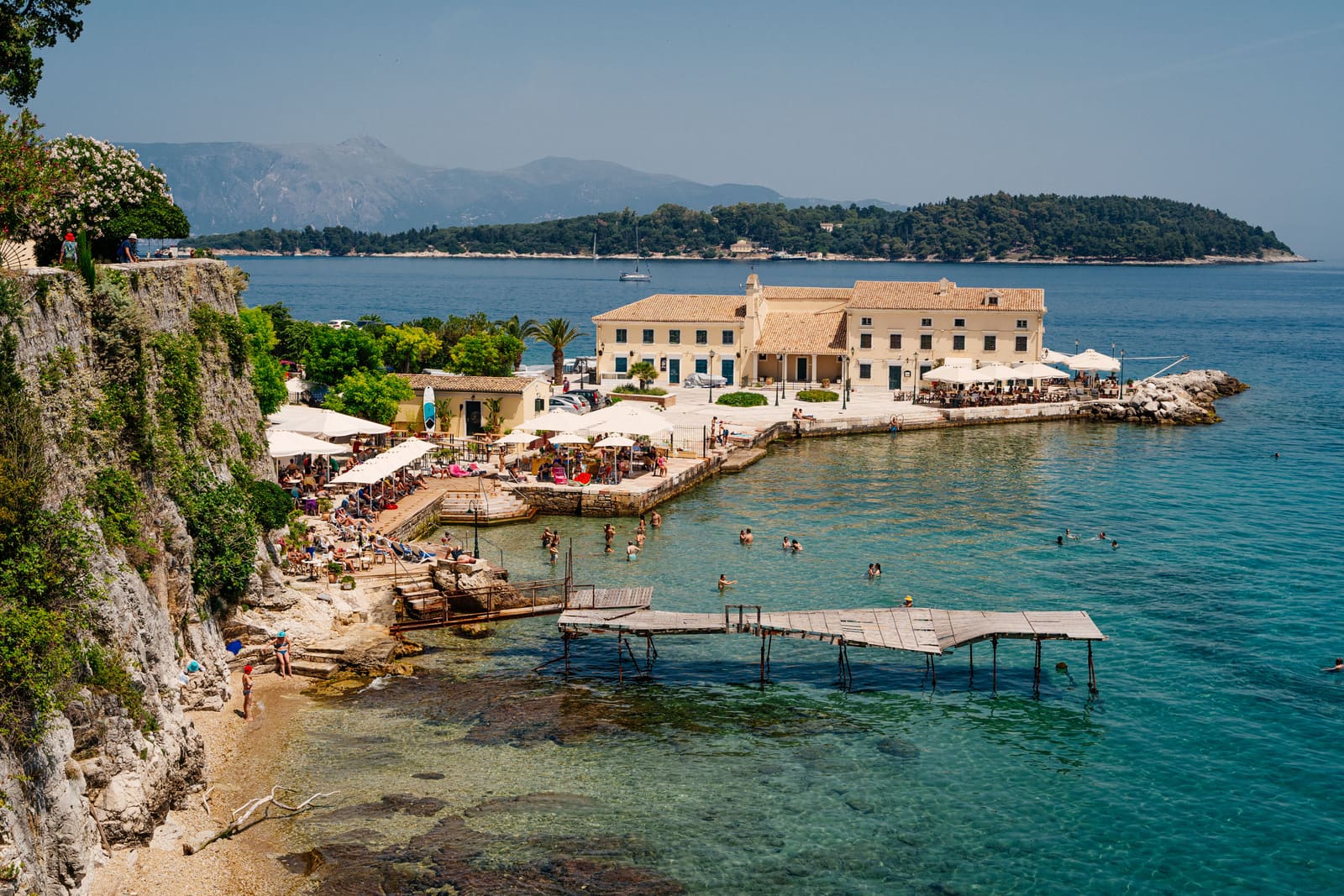
Mass tourism has claimed much of Corfu's coast, but the interior remains largely untouched. Mountain villages accessible by winding roads offer a glimpse of the island as it existed before the package holiday era. Weekends draw Corfiots themselves into these elevations, where stone houses cling to slopes and views stretch across valleys toward the sea.
The island's highest peak, Mount Pantokrator, rises to just over 900 metres. Beneath its pine-studded flanks, historic buildings have been repurposed as guesthouses and retreats. The Merchant's House, carved from a 14th-century Venetian structure, occupies one such cleft. Its six rooms feature stone walls and balconies that frame the Albanian Riviera across the strait. The renovation has preserved the building's medieval bones while installing contemporary comforts, a balance that reflects Corfu's broader negotiation between past and present.
A Reputation for Wildness
Greeks from other islands regard Corfiots with a certain wariness. The island shares with Crete a reputation for producing characters considered eccentric, volatile, or simply unmanageable by mainland standards. Whether this reflects anything empirical or merely persists as regional mythology is difficult to say. What is clear is that Corfiots themselves embrace the designation, wearing their supposed madness as a point of distinction.
This self-identification may relate to the island's complicated history. Unlike much of Greece, Corfu never fell under Ottoman rule. The Venetian period, followed by brief French and British administrations, produced a cultural trajectory that diverged from the rest of the nation. The Old Town's arcaded streets and neoclassical façades could belong to an Italian port. The island's alignment with Italy, both geographical and cultural, remains a source of pride.
When to Arrive, What to Expect
May represents the ideal convergence of conditions: manageable temperatures, peak bloom, and trails dry enough to walk without turning into mud channels. September and October bring their own appeal, though rainfall becomes less predictable. Summer, with its crowds and heat, transforms the island into something else entirely, a place where the coastline dominates and the mountains fade into backdrop.
The traveller arriving in May will find Corfu Town animated but not overwhelmed. Coffee shops fill with students and residents conducting the rhythms of ordinary life. The university ensures a baseline of activity that persists regardless of season. This continuity distinguishes Corfu from islands that feel performative in summer and abandoned in winter.
Walking as Method
To understand Corfu properly requires moving through it on foot. The Corfu Trail, established to showcase the island's interior, offers a structured way to engage with terrain that might otherwise remain inaccessible. The route passes through olive groves, crosses ridgelines, and descends into villages where tavernas serve food unchanged across generations.
Not every walker needs to complete the full distance. A single day's section provides sufficient immersion, particularly in May when wildflowers crowd the path and the air holds the last coolness of spring. The trail rewards patience and a willingness to deviate. Side paths lead to chapels, viewpoints, and clearings where the only sound is wind moving through cypress and pine.
The Taste of Continuity
Corfiot cooking resists the seasonal extremes that govern other Mediterranean cuisines. The island's fertility and year-round habitation mean that tavernas do not shutter for half the year. The dishes served in May appear again in November, their ingredients shifting with availability but their preparations remaining constant.
This continuity extends to home kitchens, where recipes pass not through written record but through demonstration and repetition. The number of tomatoes grated, the quantity of olive oil poured, the precise moment to add spices, all are learned by watching and doing. Food writer Anastasia Miari, a Corfiot herself, has spent years documenting these unwritten traditions, travelling to remote villages to photograph and record the knowledge held by older generations.
Her work captures something essential about Greek cooking: its resistance to codification, its reliance on instinct and adjustment, its deep roots in place. On Corfu, where Venetian influence complicates the purely Greek, this becomes even more layered. The spices in tsigarelia, the pasta beneath pastitsada, the coffee drunk in Italian-style rather than Turkish, all speak to an island that has absorbed multiple influences without losing coherence.
Beyond the Beach Myth
Corfu challenges the expectation that Greek islands exist primarily as summer beach destinations. Its university, its conservatory, its mountains, and its rainy winters all argue for a different understanding. The island functions as a place where people live and work, not merely visit. Tourism remains significant, particularly along the coast, but it does not define the entirety of Corfiot life.
For the traveller willing to visit outside peak season, this offers a rare opportunity: to experience a Greek island as something other than a resort. May provides the ideal conditions for this encounter. The weather cooperates, the landscape performs at its most dramatic, and the island's true character, forged over centuries of complex history, becomes legible in ways that summer obscures.
The wild greens foraged from hillsides, the spices carried along Venetian trade routes, the trails winding through mountains that mass tourism has not yet reached, all these elements converge in spring. Corfu in May is not a postcard but a living place, one that rewards curiosity and the willingness to walk inland, away from the sea, into the green heart of an island that never truly sleeps.