
In Vietnam, Europe Added More Visitors Than Asia, and Resorts Are Rebuilding Around the Fortnight Stay
Vietnam received 19.5 million international visitors in the first 10 months of 2026, up 13.8 per cent on the same period of 2025, according to the National Statistics Office (NSO) report published on 3 November. Figures from the Vietnam National Authority of Tourism (VNAT), reported by Viet Nam News the following day, show that 14.6 million of them came from Asia (up 7.3 per cent) and 3.22 million from Europe (up 51.5 per cent). Europe added about 1.09 million visitors over the year. Asia, a region more than four times its size, added about 992,000.
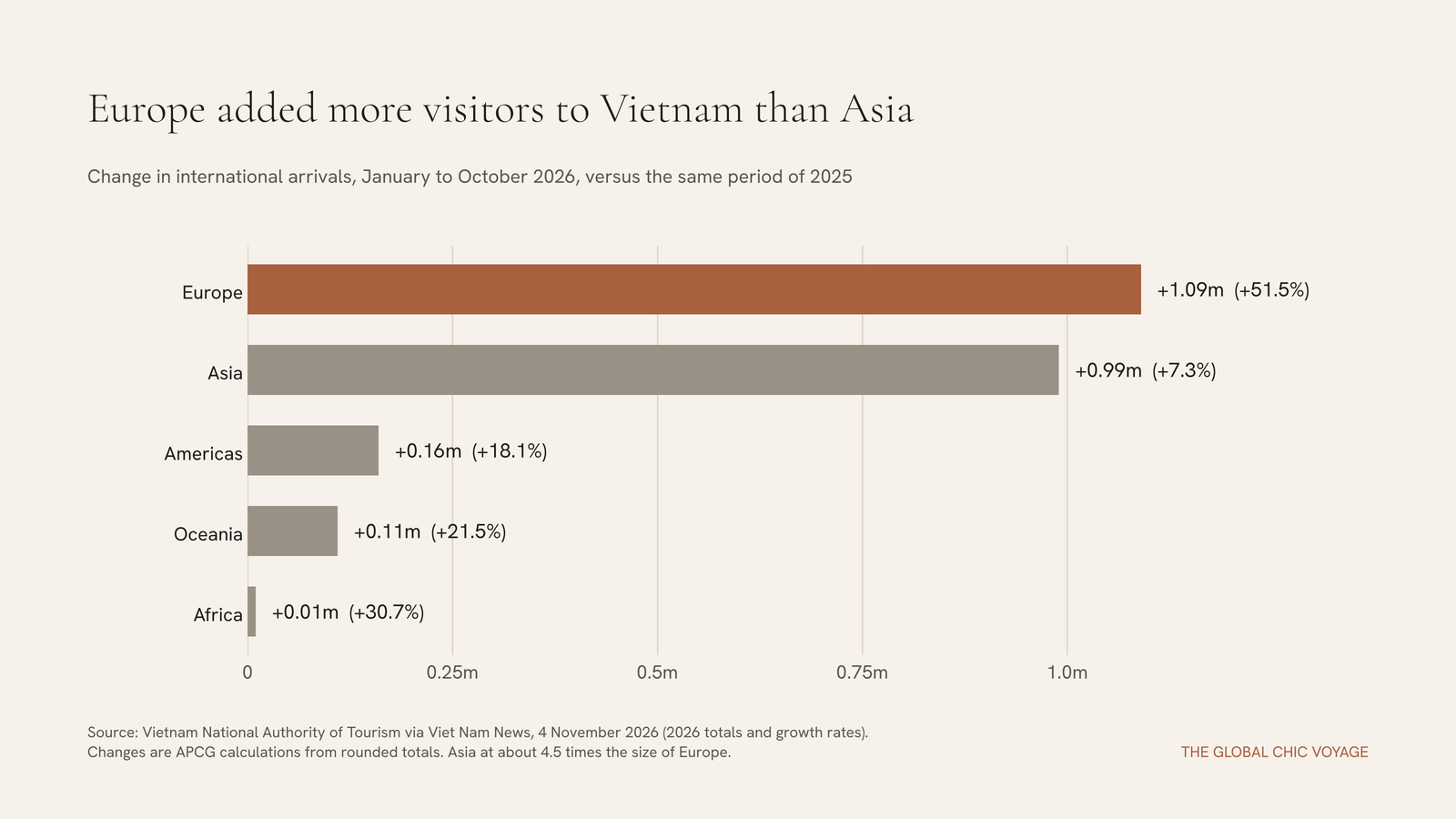
The headline total hides a change in who is filling the rooms. South Korea, the second-largest source market, is the only market in the top 10 that shrank, while Russia has more than doubled. The guests replacing Korean short breaks tend to stay a week or more, which changes what a beach resort or a luxury hotel has to sell. This piece argues that length of stay now deserves as much attention as arrivals, and that the evidence for it is real but thinner than the arrivals data.
Three markets account for most of the swing
VNAT figures for January to October put China at about 4.4 million visitors, South Korea at 3.4 million (down 6.3 per cent) and Russia at 1.25 million (up 150 per cent). VNAT growth for China over the 10 months was not reported in the coverage reviewed; at nine months it stood at 1.5 per cent, on 3.9 million visitors. Applying the stated growth rates to the rounded totals, Russia added roughly 750,000 visitors and Korea lost roughly 230,000. Both figures are APCG calculations. China and Korea together made up about 40 per cent of arrivals in the first half, per Tuoi Tre’s report of VNAT data on 4 July.
Korean travellers have not stopped travelling
VnExpress reported on 9 October that South Korean outbound trips rose about 2 per cent in the first eight months to more than 19 million, so the shortfall in Vietnam reflects where Koreans went. Yanolja Research found that only three of the 12 destinations Koreans visited most in the first half grew. Japan rose 18.6 per cent to 5.6 million visits, mainland China rose 16 per cent, Vietnam fell more than 2 per cent and Thailand fell 24 per cent.
The same report points to a won that touched 1,536 to the US dollar on 3 June, its weakest since 2009, and to about 1,000 flights cut between April and June by Korean carriers, mainly low-cost ones, after fuel prices rose. It also cites a destination life cycle of three to four years, with Da Nang, Nha Trang and Phu Quoc promoted in Korea since around 2023. The report attributes that last point to its own analysis and the sources it names, and it cannot be tested from outside.

What a fortnight guest is worth
Tuoi Tre reported on 13 July that Russian visitors typically stay seven to 21 nights. Russian arrivals in 2025 reached 689,714, up 196.9 per cent and above the 646,500 recorded in 2019, according to VNAT data cited by Vietnam Business Insider. Charter flights from Moscow to Cam Ranh resumed in March 2025, followed by routes to Phu Quoc. The Association of Tour Operators of Russia says Vietnam’s share of Russian package tour sales rose from 4.6 per cent to 7.8 per cent in a year, ahead of Thailand at 4.7 per cent and China at 4.3 per cent.
The Anam Group, which runs resorts at Cam Ranh and Mui Ne, says Russian and CIS guests made up about 15 per cent of its room nights in the first quarter of 2026, and that arrivals at The Anam Cam Ranh rose about 13-fold. Both are company figures that cannot be verified from outside, from an operator with an interest in the story.
The most recent market-by-market spending figures VNAT has published, in its 2018 annual report, reported on 30 July 2019, put average spending per visit at US$1,460 for Russia, US$1,100 for Korea and US$818 for China. On those numbers a Russian visit was worth about 33 per cent more than a Korean one and about 78 per cent more than a Chinese one. The data are eight years old, pre-date the pandemic and measure a whole trip, so they say nothing about nightly rates. Nguyen Tran Hoang Phuong, head of the Institute of Social Tourism Research, told Tuoi Tre in July: “The value of the Russian market is in long stays and willingness to pay for experiences.” That is an expert’s judgement and a plausible one, but no 2026 spending data by market was found to confirm it.
The complication: one market is carrying the Europe story
Russia accounts for roughly two thirds of Europe’s gain, by APCG’s calculation from the figures above, which leaves the rest of Europe adding about 340,000 visitors. The Russian surge depends on charter capacity that is under two years old and on a flight network a single schedule change could alter. Korea shows how quickly a favoured market can slip once a rival becomes cheaper or closer.
The run rate adds a second caution. VNAT’s full-year target is 25 million, which now requires 5.5 million visitors in November and December, about 2.75 million a month. October was about 1.8 million, a figure derived from the 17.7 million recorded at nine months and the 19.5 million at 10, both rounded. July’s 1.67 million, up 6.6 per cent, was a 10-month low in growth, per Trading Economics. A seasonal December lift could narrow the gap, though nothing in the published data shows by how much. The wider market is soft: UN Tourism put global international tourism growth at 0.4 per cent in the first half and cut its full-year forecast to 1 to 2 per cent from 3 to 4 per cent.
The NSO report adds little on spending. It gives retail sales and consumer services as a single figure, VND 695.5 trillion in October, up 14.7 per cent, with no split for accommodation or travel. Consumer prices rose 5.09 per cent in October on the year. In real terms, retail and service growth is therefore well below 14.7 per cent, which is APCG’s inference from the two NSO figures.
Why that may not matter much
Three things soften the concentration risk. First, European growth reaches beyond Russia: at nine months every European market VNAT listed was up, including Poland (49 per cent), the Czech Republic (26.6 per cent), Switzerland (25.7 per cent), Sweden (23.6 per cent), Germany (16.1 per cent), France (13.6 per cent) and the United Kingdom (9.7 per cent). Second, other long-haul markets are growing. Australia rose 21.3 per cent to 543,000 over the 10 months, and the Americas rose 18.1 per cent to 1.04 million. Third, CBRE rated Vietnam the strongest hotel performer in Asia Pacific in the first half, with gains in both average room rate and occupancy, according to Real Estate Asia on 25 September. The article gave no figures.
The real test is whether longer stays show up in revenue. VNAT has not published 2026 spending or length of stay by market in anything reviewed for this piece. Until it does, the case that Russian and European guests are worth more than the Korean ones they replace rests on 2018 data and operator statements.
What to watch
The evidence so far suggests Vietnam’s growth is moving from short-haul Northeast Asian markets to long-haul and long-stay ones, and that resorts with beach, family and wellness product are the first to feel it. Three things will settle how far that goes. The NSO report for 11 months, scheduled for 3 December, will show whether monthly arrivals are moving toward the 2.75 million the target needs. VNAT’s full-year market table for 2026 will show whether Korea’s decline deepens and whether Russia holds above 1.25 million. And the winter charter schedules from Moscow to Cam Ranh and Phu Quoc, together with Korean carriers’ restored capacity, will show which supply is actually on offer.
Sources: This article draws on the National Statistics Office’s October 2026 socio-economic report, Vietnam National Authority of Tourism data as reported by Viet Nam News, VOV, Tuoi Tre and VnExpress, Yanolja Research, the Association of Tour Operators of Russia, The Anam Group, CBRE as reported by Real Estate Asia, UN Tourism and VNAT’s 2018 tourism annual report.
Vietnamese names and terms appear without diacritics in this edition for international readability.




- TRENDS & INSPIRATIONWhat Memory Research Says About Considered Travel
- TRENDS & INSPIRATIONJetour Wants to Be Part of the Trip, and It Has Started With 300 Clubs
- TRENDS & INSPIRATIONAsia's Autumn Breakout Cities Are Mostly Chinese Itineraries Redrawn
- STYLE & CULTUREThere Is a Reason People Get Close: Justin Mott on Photographing the Guardians of the Last Animals