Three Design-Driven Journeys Rewriting the Language of Luxury Travel
From a pearl-lit museum trail in Muharraq to haute couture aboard a French ship, the craft-heritage continuum is redefining where and how we encounter beauty.
The Pearl Trail That Illuminates Memory
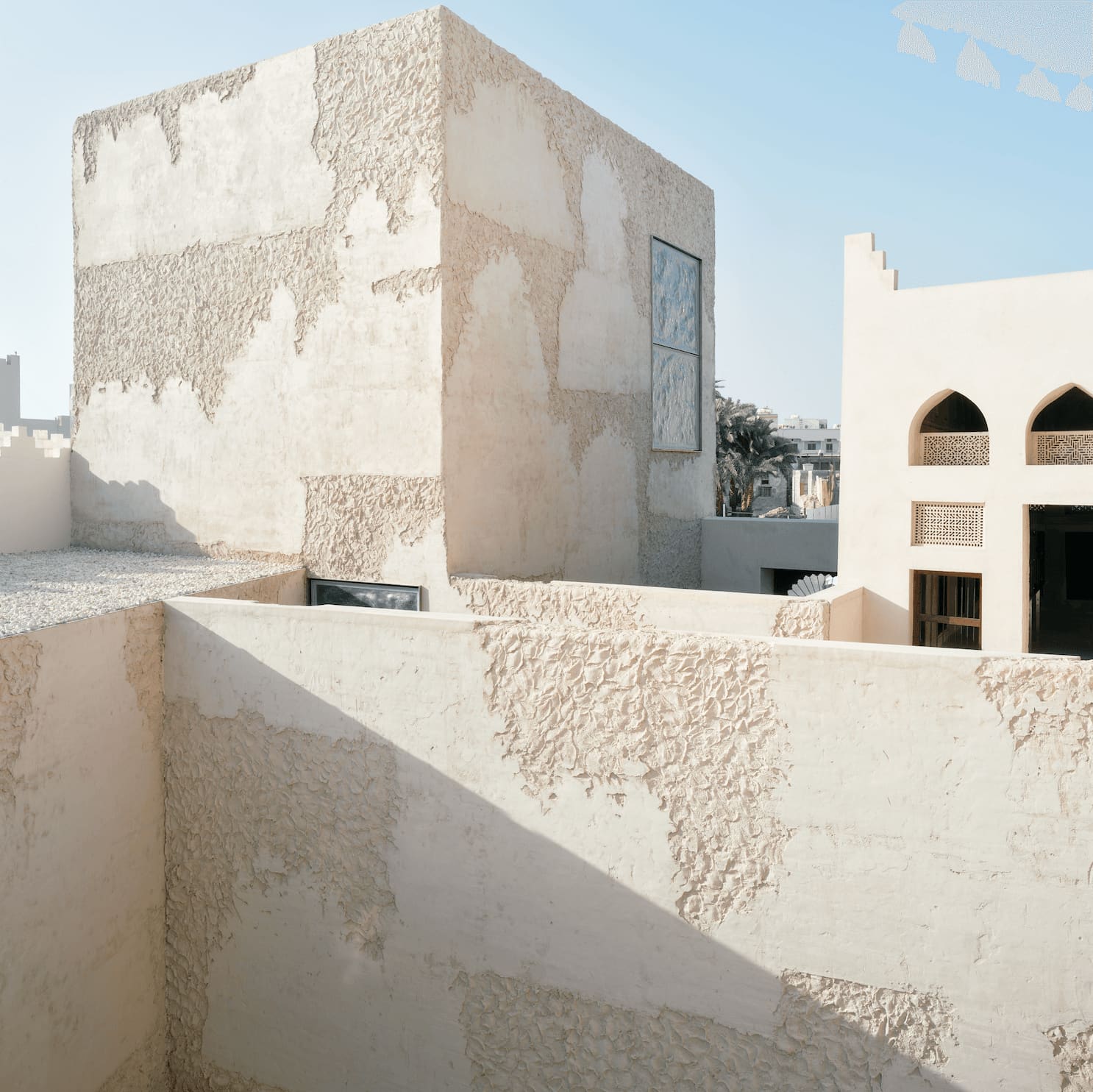
Step into the old merchant quarter of Muharraq, where the light falls differently. Here, along a two-mile corridor that threads through Bahrain's coastal heart, terrazzo lampposts capped with pearl-shaped bulbs mark the way forward and backward at once. The Pearling Path, as it is known, stitches together seventeen sites that once formed the economic and social fabric of a city built on the backs of divers who descended into the Gulf's depths with little more than nose clips, stone weights, and leather finger covers. Flame trees shade the public squares. A pedestrian bridge arcs toward the original shoreline, now mostly swallowed by development, offering a view of what was and what remains.
The Siyadi Pearl Museum, which opened two years ago inside the former residence of a prosperous merchant family, anchors this urban constellation. The building itself speaks in the dialect of wealth accumulated through risk: high ceilings, elegant proportions, rooms that once held the spoils of a trade that sent men to sea for months at a stretch. Inside, the museum's collection narrates two parallel stories. One is of fortune, told through the grand living quarters where merchants and traders conducted business and displayed their status. The other is of hardship, rendered tangible in the simple, worn tools that divers carried aboard dhows, instruments of survival in an industry that extracted beauty at great human cost.
What distinguishes the museum from other heritage projects is its integration into a living streetscape. The Pearling Path is not a relic cordoned off for tourists; it is a route that residents still walk, where history is encountered as part of the everyday rhythm rather than as spectacle. The pearl-bulb lampposts, whimsical yet purposeful, guide visitors through a narrative that resists flattening the past into nostalgia. Instead, the path insists on complexity: the coexistence of opulence and exploitation, the ways in which craft and commerce have always been entangled.
Couture as Cartography
In September 2027, Ponant will chart a course along Italy's western coast that treats fashion not as decoration but as destination. Aboard Le Boréal, an intimate vessel that accommodates fewer than three hundred passengers, the itinerary unfolds as a study in how place and making inform one another. The ship departs from Tuscany and sails southward before turning north toward Venice, stopping at ports where Italy's most storied fashion houses maintain ateliers, archives, and ancestral ties.
Passengers will spend time with a tailor at Brioni, learning the geometry of a perfect alteration, the way fabric must yield and hold tension simultaneously. At Pomellato, they will watch a master craftsperson cleave gemstones, a process that requires both technical precision and an almost intuitive sense of where a stone wants to break. In Florence, two historic palazzi open their doors: Palazzo Gucci, a monument to the brand's public face, and the fifteenth-century Palazzo Settimanni, where the archives are kept. The latter is particularly revealing, a space where sketches, samples, and correspondence trace the evolution of a house that has always understood fashion as theatre.
What Ponant has engineered here is less a cruise than a mobile seminar, one that positions haute couture not as aspirational consumption but as a lens through which to read Italian history, geography, and social structure. The maisons featured are not arbitrary; each is rooted in a specific regional tradition, whether Brioni's Roman tailoring or Pomellato's Milanese goldsmithing. The itinerary suggests that to understand Italian fashion is to understand the peninsula itself, the way craft knowledge has moved along trade routes and across generations, shaped by proximity to raw materials, by guild systems, by the patronage of merchant families not unlike those who built the grand houses along Bahrain's Pearling Path.
The Vessel as Statement
Walk into certain bars in Tokyo, Mexico City, Copenhagen, or Beirut, and you may find that the glass holding your drink commands as much attention as the liquid it contains. Artisanal glassware has become the quiet revolution in cocktail culture, a shift away from the industrial uniformity that long defined bar service toward vessels that are irregular, hand-blown, textured, sometimes asymmetrical. These are objects that carry the mark of their making, that refuse to disappear into function.
The trend reflects a broader rethinking of what hospitality means in spaces where design literacy is high. Bartenders and owners are commissioning pieces from studio glassblowers, seeking out vintage finds, or collaborating with ceramicists to create hybrid forms that blur the line between glass and clay. The result is a drinking experience that foregrounds materiality, that asks you to notice weight, surface, translucency. A coupe with a thumb-print indent. A tumbler with air bubbles trapped in the base. A flute that catches light unevenly, refracting it in ways that shift as you lift and lower the glass.
This is not about ostentation. The best examples are restrained, even austere, their beauty emerging from proportion and texture rather than embellishment. What they share is a refusal of the disposable, a commitment to the idea that every element of an experience, down to the vessel in hand, can carry meaning. In this sense, the rise of artisanal glassware is of a piece with the other movements chronicled here: a turning toward craft as a form of knowledge, toward objects that tell stories about the hands and places that shaped them.
The Through Line
What connects a museum trail in Bahrain, a fashion-focused cruise off the Italian coast, and a hand-blown glass in a Beirut bar is a shared conviction that luxury, properly understood, is not about accumulation but about attention. It is about slowing down enough to notice the pearl-shaped bulbs that light a path through Muharraq, to understand why a Brioni tailor makes a particular cut, to feel the weight of a tumbler that bears the fingerprints of its maker.
These experiences do not announce themselves loudly. They require a certain willingness to engage, to ask questions, to sit with the discomfort of not immediately understanding what you are seeing. They reward curiosity over consumption, presence over possession. And they suggest that the future of thoughtful travel lies not in the multiplication of destinations but in the deepening of attention, in learning to read the layers of history, craft, and intention embedded in the places and objects we encounter.
The pearl divers who once worked the Gulf waters, the tailors who still measure and cut by hand in Roman ateliers, the glassblowers who shape molten silica in studios from Scandinavia to the Levant are all engaged in forms of knowledge transmission that predate and will outlast any single trend. To travel in search of these continuities, to position oneself as a student rather than a consumer, is to participate in a different kind of exchange, one in which what you take away is not a souvenir but a shift in how you see.