When Santorini Sheds Its Summer Skin
Beyond the whitewashed postcard lies an island that only reveals itself after the last boat sails.
The Shift
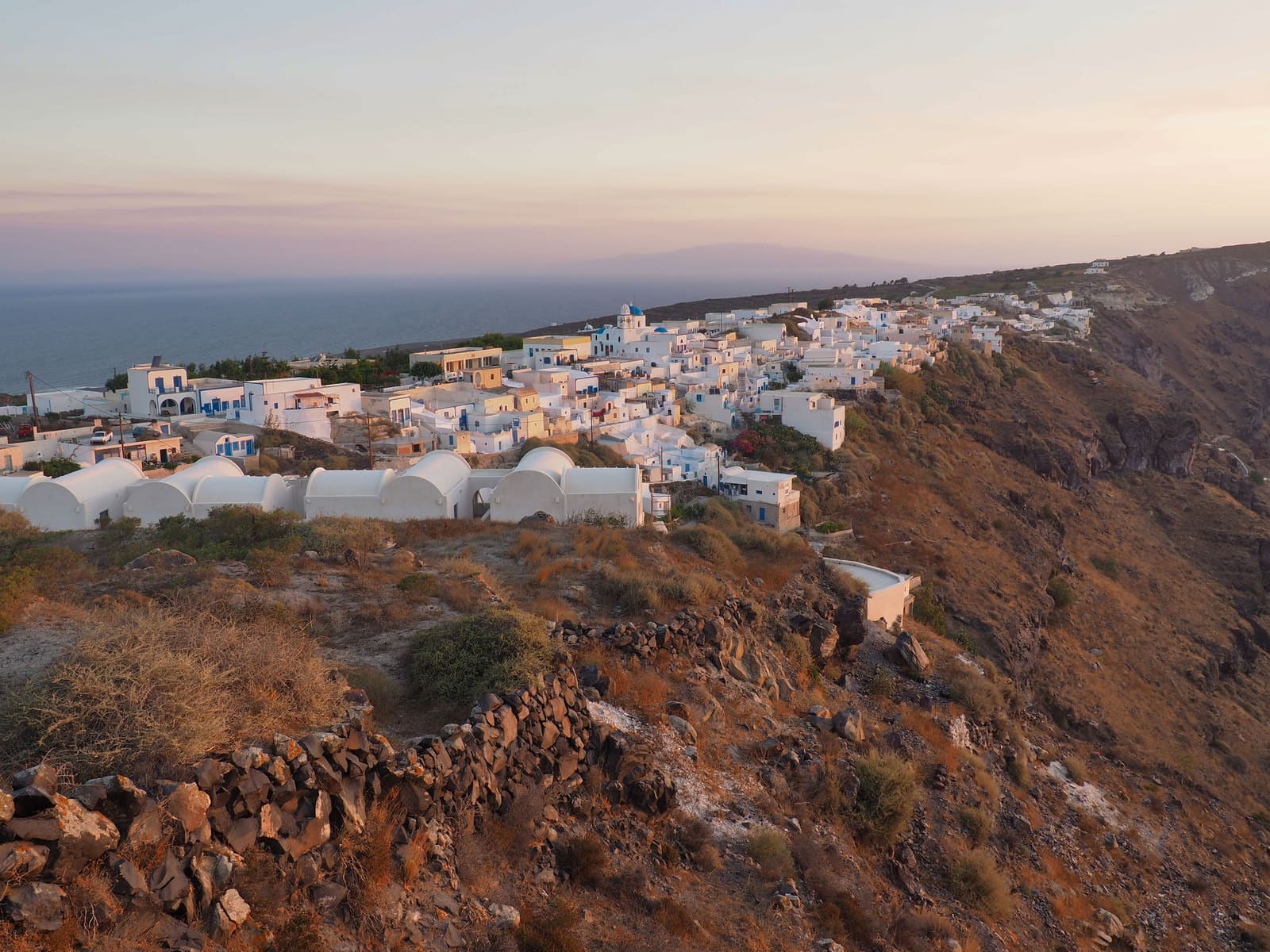
There is a moment, somewhere near the end of September, when the light on Santorini begins to change. The evenings cool enough that you reach for a sweater after sunset. The days contract. The fierce summer meltemi that rattles shutters and whips hair across faces gives way to something gentler from the north. Everything, suddenly, feels softer.
Michael Kouloglou has lived through eleven of these transitions. A winemaker who relocated from Piraeus to pursue what he calls "the mecca of Greek white wine," he has watched the island split into two distinct lives: the one that millions experience between June and September, and the one that begins in October and lasts until spring. The latter, he insists, is the Santorini that only residents truly know.
By harvest's end, both vineyard and vintner are spent. Weeks of adrenaline drain away, replaced by a bone-deep need for rest. Restaurants shutter their doors. Bars announce closing parties. Friends who vanished into the summer's relentless rhythm reappear, no plans necessary. You simply know you will see them somewhere, a glass in hand, as the season winds down.
A Different Visitor
Travellers still arrive in autumn, but they are a different breed. They come seeking what the high season obscures: walking paths through terraced vineyards, small chapels perched on cliff edges, wineries where conversations unfold without the press of a tour-bus schedule. They move slowly. They linger.
By late November, even these quiet seekers have departed. Seasonal workers board the last ferries. Locals speak of "the last boat" as a kind of unofficial calendar marker, the point at which the island returns almost entirely to those who remain through winter. Conversations stretch longer. People have time for one another again. The tempo of daily life slows to something resembling a heartbeat rather than a drumroll.
Kouloglou's small-batch Assyrtiko, produced under the Orycton label, draws from old vines scattered across the island. The wine earned recognition at the 2023 Decanter World Wine Awards, though that accolade matters less to him than the volcanic terroir itself and the wind conditions that allow him to surf and kitesurf when the vines rest.
The Church and the Calendar
What strikes him most about Santorini's year-round residents is how deeply the Orthodox Church shapes their sense of time. Nearly every chapel, no matter how small, honours a patron saint, and every saint's feast day calls for a panigiri: a village festival lit by candles, filled with traditional music, dancing, and local wine that flows late into the night.
Many locals still organise their agricultural year around these feast days rather than the Gregorian calendar. Pruning begins not in late November but after the feast of Saint Philip. It must finish before the feast of Saint Alexius. This is not quaint affectation; it is a system passed down through generations, still alive and functional.
Where the Island Gathers
During the off-season, life does not vanish. It simply relocates. Areas such as Karterados and Messaria, where people live year-round rather than operate seasonal businesses, become the true centres of activity. Closing parties range from raucous gatherings at beach bars to quieter evenings in traditional cafés. Later, as winter deepens and more socialising moves indoors, these central villages remain the island's beating heart.
Then there are the Askitaria: old stone monk lodgings carved into the cliff face of the mountain between Perissa and Kamari. In spring, locals sit there for hours, doing nothing in particular except gazing at the endless blue, the passing ships, the distant silhouettes of Anafi, Ios, and Anydro. It is a hidden, almost spiritual dimension of the island, one that requires no admission fee and offers no Instagram backdrop, only silence and expanse.
The Table
Kouloglou spends much of his off-season time at Pentozali, a traditional taverna serving mezze from Santorini and Crete. It becomes, in these months, a gathering place almost exclusively for locals. He often encounters someone fresh from a day's work in the vineyards. They sit together over wine and conversation, no rushing, no agenda.
The seasonal dish to order, if timing and luck align, is an omelette with wild asparagus. It is not a menu staple; it appears only when someone wakes early and gathers the asparagus fresh from the countryside. Another constant is the island's traditional fava, topped with sautéed onions. The dish is almost absurdly simple, yet when prepared properly, it requires nothing more.
The Water and the Wind
Autumn and winter on Santorini are warmer and sunnier than most anticipate. Rain, when it comes, is welcomed rather than cursed; the vines need it after months of summer drought. The main challenge, if it can be called that, is unpredictability. March, in particular, brings strong winds, cold snaps, and constant weather shifts that defy forecasting.
For Kouloglou, the Aegean's consistent winds make it ideal for kitesurfing. Specific weather systems during winter generate surf conditions that seem paradoxical for the region, yet a small, tight-knit community of surfers waits for precisely those moments. The water remains cold, but the sensation of paddling through the caldera in winter, with no cruise ships or catamarans, only the old quarries and rusty iron piers that hold fragments of the island's industrial history, is incomparable.
The Unfolding
A perfect Saturday in the off-season begins without a watch. Perhaps a walk through the narrow paths of the caldera in Fira or Oia. Later, friends converge. There is always an excuse for an impromptu barbecue, meat or fresh seafood depending on which friend happens to be a skilled fisherman. Coffee or wine. Conversation without rush. Sometimes, someone picks up a lute, a tsampouna, a violin. No plans, no appointments. The night unfolds on its own terms.
This is the Santorini that exists beneath the postcard: a place where time is measured not by hours but by saint's days, where the rhythm of life follows the vineyard rather than the tourist season, and where the island, after the last boat sails, belongs once more to those who know its true contours. It is not a destination that can be consumed in a long weekend. It is a place that reveals itself only to those willing to stay long enough to watch the light change, the wind shift, and the crowds dissolve into memory.