Where the Midnight Sun Meets the Morning Meal: Inside a Norwegian Island's Quiet Revolution
On Husøya, an archipelago community is rewriting the script on what it means to welcome travelers without losing itself.
A Harbor Built on Conversation
There is a moment, standing on the shore of Husøya with your back to the ocean, when you realize the buildings are not trying to disappear. The cluster of structures that form Ytri Island Retreat wears its colors openly: garnet, mint, silver. They are unapologetic in their presence, modeled after the fishermen's dwellings that have long dotted this stretch of the Træna archipelago. At midnight, when the sun refuses to set and instead moves sideways across the sky, the windows catch the light and throw it back toward the water in hammered-glass reflections.
This is not the kind of place that whispers about escape. It does not promise to erase you or your obligations. Instead, it asks a different question entirely: what if a hotel could be woven into the fabric of a place, rather than laid on top of it?
At Global Chic Voyage, we've watched the luxury hospitality conversation shift over the past decade, from pure exclusivity toward something more complex. The properties that hold our attention now are the ones attempting to reconcile beauty with responsibility, arrival with belonging. Ytri, which opened this past April on one of 477 islands in this northern Norwegian scatter, represents one of the more ambitious attempts at that reconciliation we've encountered.
The Long Journey as Filter
Getting here requires intention. From Bodø, a coastal city in Norway's north, the ferry journey spans 112 miles. There are no quick hops, no spontaneous weekend escapes. The distance acts as a natural threshold, a filter that ensures only those willing to commit to the journey will arrive. Helicopter transfers from Bodø can be arranged for those with different priorities, but the sea crossing remains the primary artery.
The inaccessibility is deliberate, a feature rather than a flaw. In an age when certain corners of Norway (the Lofoten archipelago, for instance, just hours away by boat) have begun to buckle under the weight of their own popularity, remoteness becomes a form of preservation. The hotel's activity guides speak openly about this. One, a water engineer who relocated to Træna seven years ago, notes that the islands' isolation protects them in ways that policy alone cannot. Only a certain volume of travelers can arrive by sea in any given period. The geography itself enforces a kind of equilibrium.
This is not to romanticize hardship. Winter storms here have been known to blow entire buildings into the water. The regional fishing industry, once the lifeblood of these islands, has hollowed out over the past generation. A decade ago, facing demographic decline, the municipality and a local development company called Træna 365 convened to imagine alternative futures. The idea of a retreat emerged from those conversations, not as an imposition from outside capital, but as a proposal from within the community itself.
Rooms That Frame Rather Than Contain
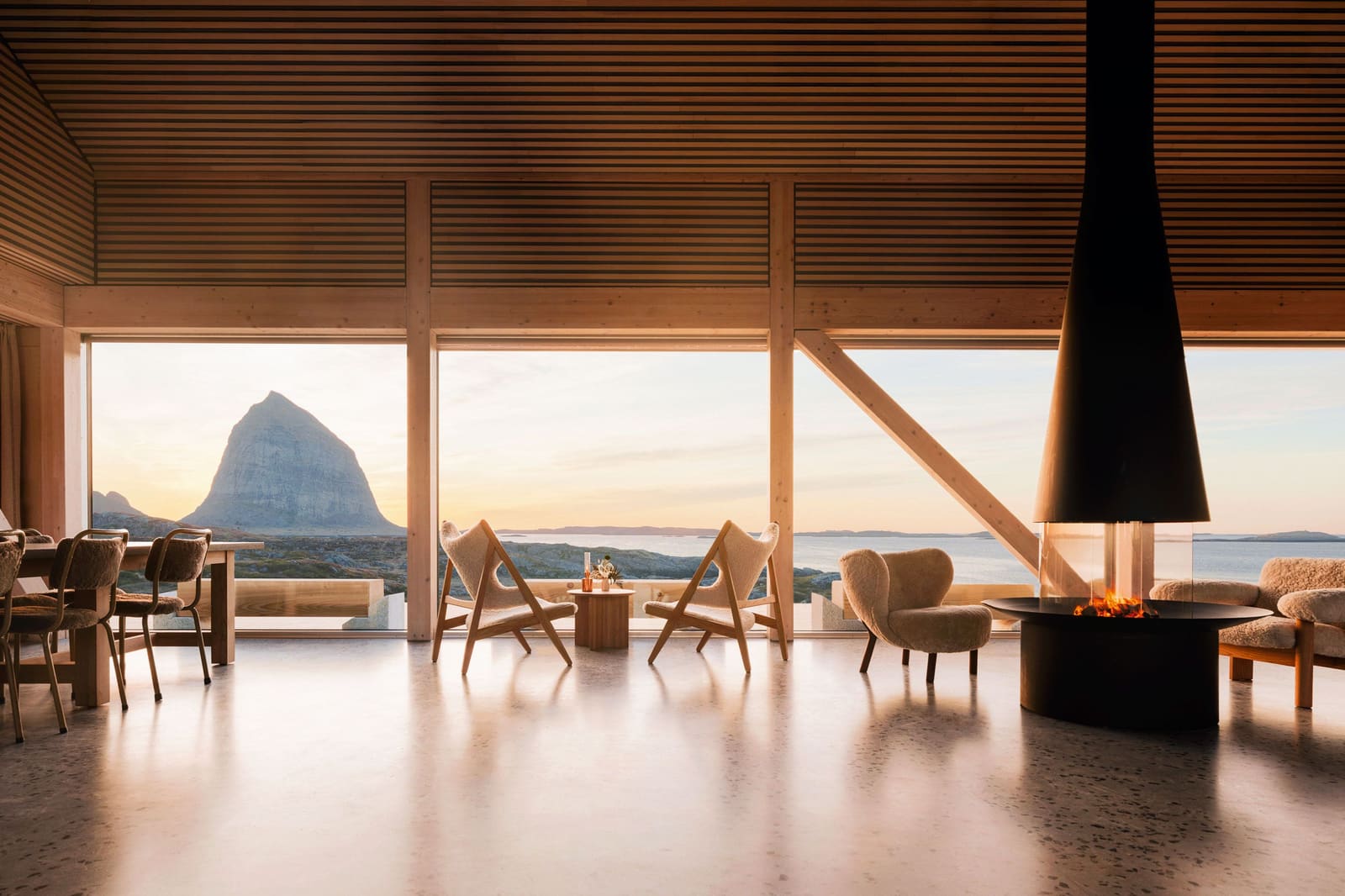
The 38 rooms and suites at Ytri practice a kind of restraint that borders on the monastic. High, pitched ceilings in pale wood evoke the geometry of churches. Norwegian wool blankets in deep blues and charcoal grays are folded across beds. Ceramic vases, slightly irregular in form, hold dried wildflowers. Bioelectric fireplaces provide warmth without smoke. The design firm Bonaparte Interiør sourced materials from the island itself: terrazzo floors made of local sand, stone, and shell; abstract prints by Norwegian artists; pine-scented toiletries from Skøn.
But the real design gesture is the window. Floor-to-ceiling glass in every room directs the eye outward, toward the shark-toothed peak of Trænstaven mountain, which rises from the ocean on the neighboring island of Sanna. In suites, smooth-edged bathtubs are positioned to hold this view. The message is clear: the architecture is not the destination. The landscape is.
This outward orientation extends beyond aesthetics. It reflects a philosophy about what luxury hospitality might mean in a fragile, finite context. Rather than create a self-contained world within the hotel, Ytri positions itself as a threshold, a vantage point from which to encounter the archipelago and its rhythms.
The Water as Archive
Sanna, the island visible from every room, holds stories that predate the concept of hospitality itself. At Kirkhelleren, a massive cave carved into the mountainside, archaeologists have unearthed fish hooks and tools dating back at least 9,000 years. Mass graves contain remains from the Black Death. This is one of the oldest continuously inhabited sites in northern Norway, a place where humans have pulled kayaks ashore, sought shelter, and buried their dead for millennia.
Each July, the Trænafestivalen music festival culminates in a performance staged at the cave's natural altar, a contemporary echo of the early travelers who made landfall here. The line between past and present is thin in places like this, where the landscape itself serves as a kind of archive.
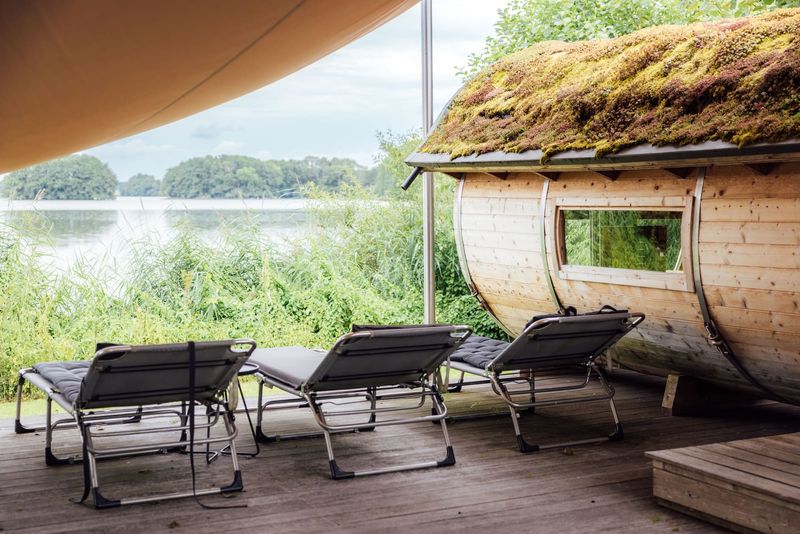
Ytri's activities are designed to deepen that encounter. Custom speedboats ferry guests to nearby islands for hikes and kayaking. Free-diving excursions allow the more adventurous to descend into kelp forests. For those less inclined toward cold-water immersion, flotation suits make it possible to drift on the surface, watching the underwater world and, in winter, the Northern Lights from a horizontal vantage. An ocean-facing sauna offers another form of negotiation with the elements.
One of the hotel's two activity guides, who also free-dives to harvest scallops and kelp for the restaurant, speaks about the work with a matter-of-factness that belies its rarity. This is not performance; it is provision. The line between hospitality and sustenance blurs.
A Meal That Maps the Journey
At Alma, the hotel's restaurant, breakfast unfolds with the care of a tasting menu: cured lamb, brown cheese, barley porridge, lentil hummus on seed crackers, coffee ground by a neighbor on another island. Dinner is a four-course progression that includes a melting brown butter candle, scooped up with bread, a tribute to the beacons sailors once used to navigate these waters.
But the chef's table is where the kitchen's ambition becomes clear. The 12-course menu reimagines a journey from Hawaii to Træna, two island chains at opposite ends of the earth. Whale tartare represents Hawaii. Mussel chowder in a batter cup nods to San Francisco. Cod tongue, battered and wrapped in newspaper, gestures toward London. The meal is not an exercise in fusion but in cartography, tracing a path across oceans and landing, finally, here.
Afterward, guests slip into the bracing sea, then wander under the midnight sun to the village pub to watch a World Cup match. This is where Ytri diverges most sharply from the conventional luxury retreat model. There is no attempt to insulate guests from the community or vice versa. The hotel does not position itself as a sanctuary from the world but as a participant in it.
The Metric That Matters
Since Ytri opened, Træna's population has increased by nearly two percent. It is a modest figure, easy to overlook. But in a region that has watched young people leave for decades, it is also a signal. The hotel has created jobs, not just in housekeeping and kitchen work, but in specialized roles: activity guides, free-divers, boat captains. Local suppliers provide ingredients. A man on a neighboring island grinds the coffee.
This is the quiet revolution the hotel represents, the one that matters more than any architectural accolade or design award. Social sustainability is an easy phrase to throw around; it is much harder to embed in operations. Ytri's investors, who also run a spa hotel in Sweden, spent six years in planning before opening. That timeline reflects the complexity of building something that serves both travelers and residents, that generates revenue without extraction.
The model is not without tension. Any influx of outside capital into a small community carries risk. Property values shift. Social dynamics change. But the fact that the hotel concept originated from local conversations, rather than being imposed from outside, offers a different starting point. The question is not whether tourism belongs here but how it might be structured to reinforce, rather than undermine, the community it touches.
The Surprise of Proximity
We have grown accustomed, in luxury travel, to the idea of escape. The remote lodge, the private island, the villa with no neighbors. These are the fantasies the industry has long sold: solitude, silence, separation. Ytri offers something adjacent but distinct. It is remote, yes. It is beautiful, undeniably. But it is not interested in erasing the presence of others.
Meals are taken at shared tables. Strangers become companions over the course of a 12-course dinner. The village pub is a five-minute walk. The midnight sun does not set, and neither does the hum of communal life. This is not the retreat for those seeking to disappear. It is the retreat for those curious about what it might mean to arrive somewhere and stay present, to be a guest in a place that is also someone's home.
The wildness of the Træna archipelago is real. Moss and wildflowers blanket the rocky tufts that stretch from the hotel to the sea. Swamp wool quivers in the breeze. Winter storms still blow with enough force to carry buildings into the water. But the story here is not one of conquest or domination, not the narrative of travelers subduing a harsh landscape through luxury. It is quieter than that, more provisional.
It is the story of a community deciding what kind of future it wants, and a hotel that chose to become part of that conversation rather than the end of it. In an industry that often measures success by how thoroughly a place can be transformed for the comfort of outsiders, Ytri suggests another metric: how well a hotel can integrate without erasing, how gracefully it can hold space for both travelers and residents, how honestly it can acknowledge that the best stories are the ones we share.