Where Madrid's Belle Époque Palaces Meet Modern Luxury
Between Hemingway's martini haunts and Michelin-starred gardens, Spain's capital unveils a new golden age of hospitality.
The Capital's Quiet Renaissance
There is a particular quality to late afternoon light in Madrid, the way it catches the gilt edges of neoclassical facades and pools in the courtyards of former ducal estates. For years, this light fell on a city content to let Barcelona claim the spotlight, to let Seville command the romantic imagination. Yet something has shifted in the Spanish capital over the past half-decade, a recalibration that has little to do with marketing campaigns and everything to do with substance.
The Golden Art Triangle alone would justify a pilgrimage: the Prado, Thyssen-Bornemisza, and Museo Reina Sofía, where Picasso's Guernica still stops visitors mid-stride. Add twenty-six Michelin-starred establishments and a new Formula 1 Grand Prix circuit, and Madrid's emergence feels less like reinvention than overdue recognition. The city's accommodation landscape reflects this transformation, a collection of Belle Époque landmarks and modernist statements that together articulate what Spanish luxury means in the twenty-first century.
Landmarks Reborn
The hotel that opened in 1912 across from Spain's parliament building has witnessed a century of political theater and artistic ferment. Pablo Picasso held court here. Salvador Dalí swept through its salons. Federico García Lorca lingered over coffee. Ernest Hemingway immortalized its martinis in The Sun Also Rises, a literary endorsement that still draws pilgrims to the circular bar beneath the Art Nouveau stained-glass dome.
Catalan designer Lázaro Rosa-Violán recently reimagined the property's 420 rooms and 50 suites, introducing hand-painted wallpaper inspired by Madrid's Royal Botanical Garden, intricate mosaics, and jewel-toned velvets in emerald and indigo. Original antique fireplaces remain, anchoring spaces that balance historical grandeur with contemporary ease. The Cúpola restaurant spreads beneath that famous dome, serving expansive breakfast buffets and à la carte dinners accompanied by a wine list spanning three hundred labels. Yet it is the wood-paneled 27 Bar, styled after an English gentlemen's club, that best preserves the spirit of those early twentieth-century literary gatherings.
A 1970s palace along a tree-lined avenue in the Salamanca district offers a contrasting vision of luxury. The Rosewood property, set amid embassies and high-end boutiques, houses 101 rooms and 57 suites distinguished by high ceilings, white wood paneling, and Marshall Bluetooth speakers. The Sense Spa includes a Turkish-style hammam, while the Salamanca Suite and Anglada House Suite provide private terraces with city views and the option of a personal chef.
What elevates the experience beyond amenity lists is the calibration of service. Premium rooms feature pillows monogrammed with guest initials, a gesture that manages to feel thoughtful rather than theatrical. The landscaped front gardens transform seasonally, hosting outdoor cinema screenings in summer and an ice-skating rink when temperatures drop. Chef Jesús Sánchez, whose main establishment holds three Michelin stars, oversees the Amós restaurant, where stuffed baby squid with hake pil pil demonstrates the technical precision that defines contemporary Spanish cuisine.
The Ritz Lineage
César Ritz designed only three hotels bearing his name: London, Paris, and the Madrid property that opened in 1910. The Spanish iteration, reborn under Mandarin Oriental stewardship in 2015, occupies a privileged position at the edge of Retiro Park, steps from the Prado. The 100 rooms and 53 suites showcase molded ceilings and a palette of gold, beige, and ivory that feels less like decoration than architectural necessity.
The Royal and Presidential Suites occupy the building's turrets, their circular bedrooms offering sight lines across the park and museum. Below, the mirrored Palm Court serves afternoon tea, while the two-Michelin-starred Deesa restaurant presents chef Quique Dacosta's seafood-focused compositions. The spa's heated indoor pool, set beneath chandeliers, captures the property's approach to luxury: historically informed, contemporarily executed. In the gardens, Dacosta's more casual Jardín restaurant interprets traditional tapas through techniques honed across multiple Michelin-starred kitchens.
Ducal Discretion
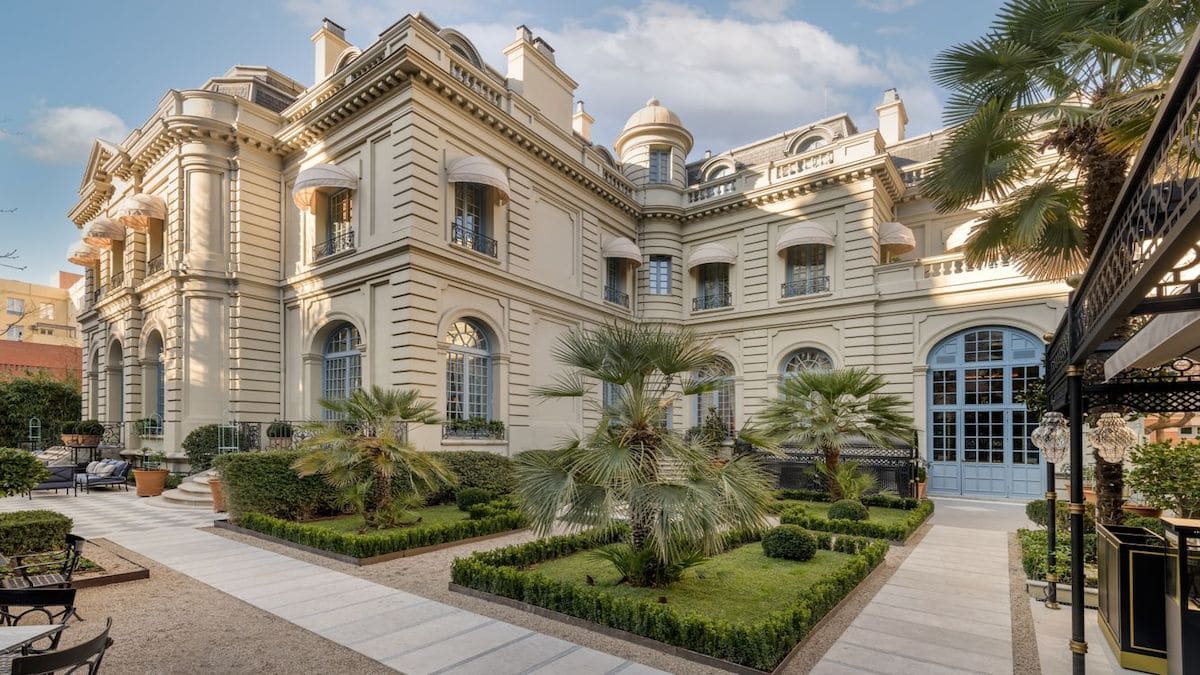
A nineteenth-century duke's residence in the Chamberí district has been reincarnated as a hotel that feels more like a particularly well-appointed private club. The Santo Mauro's 49 rooms and suites spread across the main palace, a guest villa, and converted stables, each space reflecting a different era of design philosophy. Some feature damask wallpaper and period antiques; others embrace minimalism with contemporary fireplaces and clean lines.
The all-red Louis XIV-style Salon Rojo sets the tone for a property that has never courted publicity yet consistently attracts high-profile guests. A separate gated entrance provides discretion for those who require it. The private gardens host a seasonal pop-up bar, while the main bar's velvet walls and mirrored surfaces frame an extensive collection of wine and whisky.
La Biblioteca Gresca, helmed by Catalan chef Rafa Peña, operates within the original library, complete with filled bookcases and nineteenth-century fireplaces. Red prawn croquettes and Iberian pork with tarragon demonstrate the kind of elevated yet unpretentious cooking that characterizes Madrid's current culinary moment, a deliberate step away from molecular gastronomy's theatrical excesses toward ingredient-focused clarity.
Contemporary Counterpoints
Not every significant Madrid property trades on Belle Époque pedigree. The five-story steel-and-glass Hotel Urban, positioned between the Prado and Thyssen-Bornemisza museums, houses the owner's extensive collection of tribal art from Papua New Guinea and ancient Egyptian artifacts. The 96 rooms and suites embrace a modernist aesthetic, dark woods and neutral tones providing a visual counterpoint to the classical architecture visible from the windows.
The rooftop terrace and glass-bottom pool offer perspective on the surrounding cityscape, while the ground-floor restaurant draws neighborhood residents alongside hotel guests, a sign of culinary credibility in a city where locals remain the harshest critics. This blending of hotel and neighborhood, of historical reverence and contemporary confidence, defines Madrid's current hospitality landscape more accurately than any single property could.
The New Madrid Sensibility
What unites these disparate properties is not style but philosophy. Where Barcelona often performs its sophistication, Madrid embodies it quietly. The city's luxury hotels reflect this temperament, offering grandeur without bombast, history without nostalgia, service calibrated to anticipate rather than announce.
The Formula 1 circuit will bring a certain kind of visitor, as will the Michelin stars and museum exhibitions. Yet Madrid's appeal has always rested on something less quantifiable: the quality of that late afternoon light, the rhythm of a city that never needed to prove itself and now finds itself proven nonetheless. The hotels serve as portals into this sensibility, spaces where the city's past and present coexist not as marketing narrative but as lived experience, where a martini beneath a stained-glass dome or a meal in a nineteenth-century library becomes a form of participation in Madrid's long, unfinished conversation with itself.