Isla Mujeres: Where Sculpture Gardens Sleep Beneath the Sea
A slender island off the Yucatán coast pairs submerged art installations with encounters alongside the ocean's largest fish.
A Different Tempo
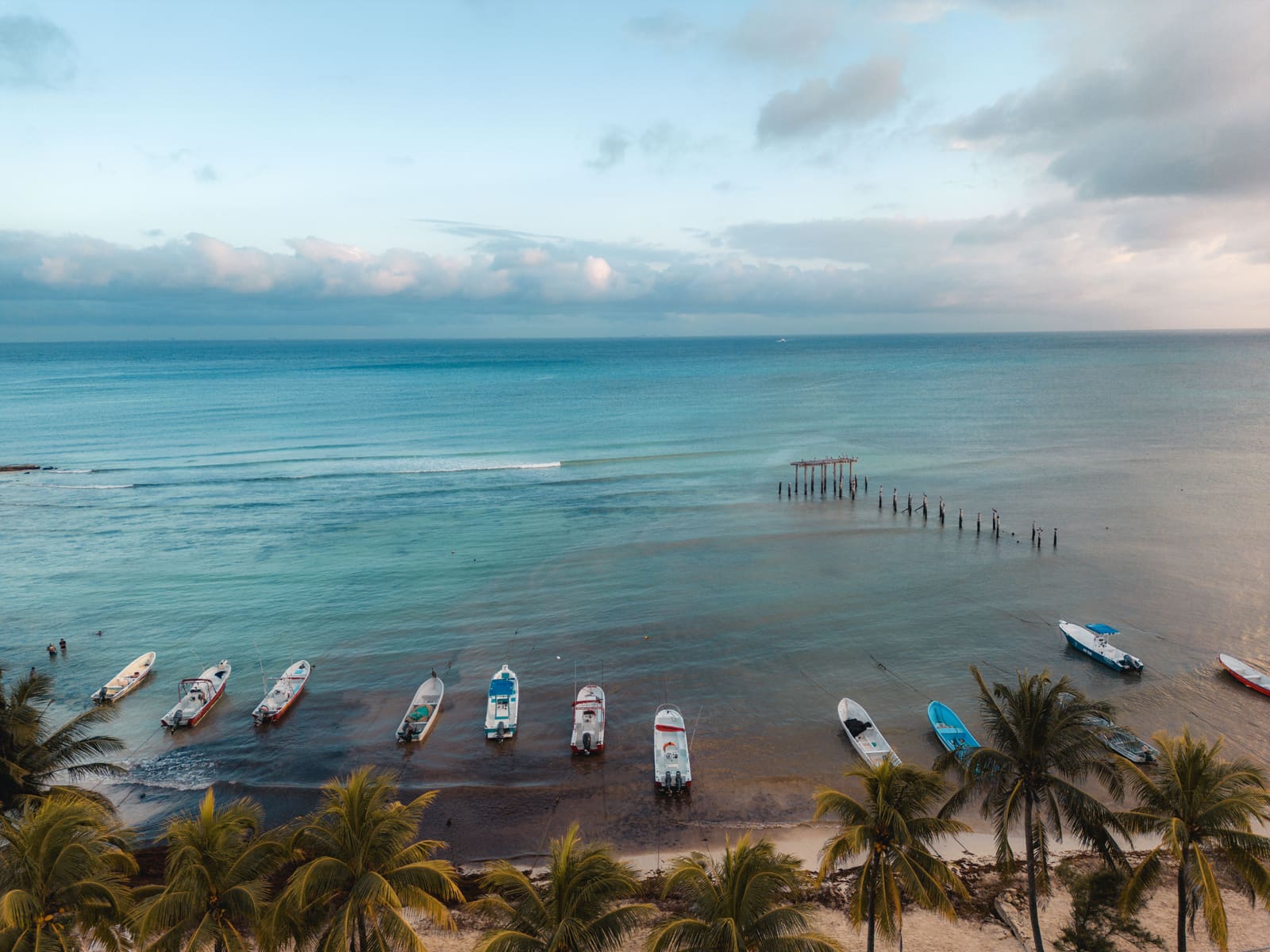
The ferry leaves Cancún's Puerto Juárez terminal every thirty minutes, cutting through turquoise shallows toward a silhouette that grows more distinct with each nautical mile. Isla Mujeres stretches barely seven kilometres from north to south, narrow enough that you can see both coastlines from certain vantage points along its spine. Golf carts outnumber cars here. The rhythm of the place announces itself the moment you step off the gangway: slower, salt-scrubbed, oriented toward water rather than asphalt.
The island takes its name from 16th-century Spanish explorers who encountered statues dedicated to Ixchel, the Maya goddess of fertility and the moon. Centuries later, the same Caribbean light that illuminated those shrines now draws a different sort of pilgrim, one seeking immersion rather than conquest.
Sculpture Beneath the Surface
A few hundred metres offshore, in water shallow enough that sunlight penetrates to the sandy floor, human figures stand in silent assembly. The Museo Subacuático de Arte holds more than five hundred sculptures anchored to the seabed, their forms designed by British artist Jason deCaires Taylor and installed between 2009 and 2013. Divers and snorkellers drift above tableaux of stone people frozen mid-gesture: a man watching television, a group seated around a table, a volkswagen beetle sprouting coral.
The installations serve a dual purpose. Aesthetically, they create an otherworldly gallery where angelfish weave through open mouths and elkhorn coral colonises outstretched hands. Ecologically, the pH-neutral marine cement encourages reef growth, redirecting pressure from natural formations stressed by decades of tourism. The figures age visibly, their surfaces softening under layers of algae and invertebrate life, becoming less sculpture and more habitat with each passing season.
Visibility in these waters typically exceeds fifteen metres. The museum occupies three separate sites, the largest accessible to snorkellers at depths between three and six metres. Guided tours depart from the island's western shore each morning, though independent exploration is permitted for those confident in open water.
Leviathan Season
Between late May and mid-September, whale sharks arrive in the warm shallows north of the island, following plankton blooms that concentrate near the surface. Rhincodon typus, the largest fish species on Earth, can exceed twelve metres in length, yet feeds exclusively on microscopic organisms filtered through raker pads in its enormous mouth. Swimming alongside one requires no particular bravery, only respect for the animal's space and a willingness to match its unhurried pace.
Tour operators working these waters follow protocols established by Mexican environmental authorities: engines cut at a designated distance, no more than two swimmers per shark, no touching. The encounters unfold without script. A shadow materialises beneath the boat, resolving into spotted flanks and a blunt head the width of a dining table. You slip into the water. The whale shark continues its trajectory, mouth agape, utterly indifferent to your presence. For ten or fifteen seconds you fin alongside, small and insignificant beside something so improbably vast, before it descends or accelerates beyond your capacity to follow.
The experience carries none of the adrenaline of apex-predator tourism. Whale sharks inspire awe of a quieter sort, the humbling realisation that the ocean sustains creatures operating on scales and timelines entirely separate from human concern.
Accommodation Across Spectrums
Isla Mujeres supports lodging options ranging from backpacker hostels in the compact town centre to all-inclusive properties that command the island's northern and southern tips. Several established resort brands maintain outposts here, offering the familiar infrastructure of buffet dining, poolside bars, and activity coordinators. These properties appeal to travellers seeking convenience, particularly families with children or groups assembling from different points of origin.
The town itself, clustered along the western shore, retains a grittier character. Family-run guesthouses occupy buildings painted in sun-faded pastels. Street tacos sell for a handful of pesos. Fishermen mend nets in the early morning while ferries discharge day-trippers who will retreat to Cancún before sunset. The contrast between resort enclave and working town remains visible but not jarring; the island is small enough that both coexist without pretending the other doesn't exist.
Accommodation philosophy here tends toward the straightforward. You come for water access, not architectural innovation. Rooms serve as staging areas for what happens offshore.
Navigating a Narrow Geography
A single paved road traces the island's length, though most visitors cover ground in rented golf carts that putter along at speeds barely exceeding a jog. Bicycles and scooters offer alternatives. The town occupies the northernmost section, walkable end to end in twenty minutes. South of the developed areas, the road climbs slightly toward Punta Sur, the island's southern extreme, where a small sculpture park and a clifftop temple dedicated to Ixchel overlook open water.
Playa Norte, a crescent of white sand on the island's northwestern edge, consistently appears on lists of exceptional Caribbean beaches. The water here remains shallow for thirty metres offshore, warm and still, the colour of pale jade. Palapas provide shade. Vendors circulate with cold beer and grilled fish. It is the sort of place that photographs beautifully but functions even better as a setting for doing very little.
Dining options concentrate in the town, where seafood dominates menus by default. Lionfish ceviche has become common in recent years, a culinary response to an invasive species decimating native reef fish populations. The preparation turns ecological challenge into something bracingly fresh, the fish's mild flesh cured in lime and mixed with tomato, onion, and cilantro.
The Calculus of Proximity
Isla Mujeres exists in the gravitational field of Cancún, close enough that day-trippers arrive in waves but far enough that overnight guests experience something distinct from the hotel zone's relentless energy. The island benefits from this adjacency, infrastructure and accessibility without the density that has transformed other Caribbean coastlines into continuous resort corridors.
Whether that balance holds depends partly on decisions made in planning offices and partly on the durability of the island's physical limits. You cannot widen Isla Mujeres. The amount of shoreline remains fixed. Development pressures that might sprawl endlessly on the mainland encounter here the absolute boundary of the sea.
For now, the island offers a proposition straightforward enough to require little embellishment: clear water, accessible marine life, and a geography compact enough to comprehend in a long weekend. The underwater sculptures will continue their slow transformation into reef. Whale sharks will return each summer, indifferent to human schedules. And the ferry will keep running, carrying people across a short stretch of sea toward a tempo calibrated differently than the place they left behind.