Inside the Lounge Culture of Newark Liberty International
Four distinct retreats in one American hub reveal how pre-flight waiting has evolved into an art form that rivals the journey itself.
The Skillet That Changes Everything
There is a moment, somewhere between the second bite of a warm chocolate chip cookie served in its own miniature skillet and the first glimpse of Manhattan's spires through floor-to-ceiling glass, when the airport ceases to be a place of transit and becomes something else entirely. At Newark Liberty International, that transformation happens quietly, in spaces designed to make you forget you are waiting at all.
The cookie arrives with vanilla ice cream slowly giving way to heat, a chocolate drizzle catching the light. It is plated for one, which feels right. Solo travel has its own rituals, and this dessert, offered within the dining room of the Polaris flagship lounge, has become one of them. Outside, aircraft taxi in orderly lines against a backdrop of the New York skyline. Inside, the hum of departure gates feels impossibly distant.
Newark has long served as the workhorse hub of the New York metropolitan area, a role that rarely inspired poetry. Yet over the past four years, the airport's lounge infrastructure has undergone a quiet metamorphosis, one that speaks less to the mechanics of air travel and more to the aspirations of those who move through it frequently. United Airlines, which operates nearly 70 per cent of flights at the hub according to the carrier, has invested in spaces that borrow from boutique hotel design, neighbourhood coffee culture, and an unexpectedly strong sense of place.
A Statement in 30,000 Square Feet
The lounge near Gate C123 in Terminal C opened in May 2022 and set the template for what would follow. Spanning 30,000 square feet with seating for 480, it announced that utilitarian waiting rooms were no longer the standard. The entrance ritual begins with a self-scan threshold and a pause at a station offering fruit-infused water, the kind of small gesture that signals intention.
The space unfolds in layers. Wooden shelving holds an eclectic mix of objects; murals commissioned in collaboration with the Newark Museum of Art and Gallery Aferro line the walls, created by local artists whose work captures the city's musical heritage and historical texture. Gilbert Hsiao and Dahlia Elsayed are among those whose pieces anchor the visual narrative.
What distinguishes this lounge is its commitment to tactile detail. Chefs and servers work behind a buffet where food is plated from cast-iron skillets, a departure from the usual chafing-dish monotony. A salad bar offers fresh components; entrees rotate. Business travellers gravitate toward recessed workstation booths upholstered in charcoal fabric, whilst others sink into plush seating near windows that frame the distant Manhattan skyline. Subway-style tiles and signage nod to the metropolitan context without veering into theme-park literalism.
Amenities include a full-service coffee bar, a premium spirits selection, wellness rooms, and spa-standard shower suites. The design manages to feel both considered and unstudied, a balance that is harder to achieve than it appears.
Circular Logic and Midtown Echoes
The second Terminal C lounge, positioned near Gate C74 and opened in October 2023, takes a different approach. Elevated above the terminal floor, its circular layout attempts to create a sense of continuous flow. At 18,000 square feet accommodating more than 400 seats, the proportions feel tighter, the mood more purposeful.
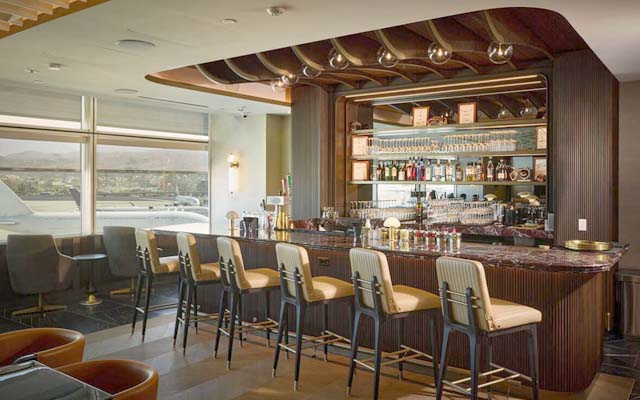
The design draws inspiration from midtown Manhattan, with ceiling art that references Grand Central Terminal's iconic constellation map. The buffet is segmented into distinct zones: a snack bar, a beverage station, a dessert counter where warm chocolate chip cookies appear during the breakfast-to-lunch transition. The self-scan entry, bar, and wellness room mirror the Gate C123 location, but the standout feature here is the counter seating along the windows. From this vantage, the terminal unfolds below, gates visible, boarding sequences observable. It is a perch for the kind of traveller who prefers to watch the choreography of departure rather than be absorbed by it.
Loft Aesthetics in a New Terminal
Terminal A, which opened in January 2023 and subsequently received recognition from Skytrax as the World's Best New Terminal, represents Newark's most ambitious reinvention. The terminal houses sensory rooms designed for neurodivergent travellers and features local food vendors, a nod to the broader shift toward place-based hospitality in airport design.
The United lounge near Gate A27 occupies 15,000 square feet and seats approximately 300, making it the smallest of the quartet. Yet the open-air configuration, suspended above the terminal without enclosing walls, generates an unexpected sense of spaciousness. It feels more like a loft than a lounge, airy and light-filled.
The buffet, bar, and wellness room follow the established formula, but the art programme distinguishes the space. A mixed-media mural by Newark artist Antoinnette Ellis-Williams commands attention, its scale and texture suited to the soaring ceilings. In late summer, the infused water station featured locally sourced Jersey peaches, sliced into heart shapes. It is the kind of small, perishable gesture that resists replication and signals care.
The Dining Room That Defines Luxury
The Polaris lounge, originally unveiled in May 2018 and expanded to 30,000 square feet in June 2025, operates under different rules. Access is restricted to passengers flying Polaris business class on long-haul international routes or first and business passengers on Star Alliance international flights departing the same day. It is now the largest facility in United's Polaris network, according to the airline.
The centrepiece is a full-service restaurant, reservation-only during peak periods, with bookings handled in person by the host upon arrival. Quoted wait times tend to compress; a 45-minute estimate often becomes 15 to 30. Solo tables face the tarmac, offering unobstructed views of the apron and, beyond it, the New York skyline. The seating is tight for laptop work, but the menu compensates.
Small plates include lump crab cake and fish tacos; soups rotate, with wild mushroom bisque appearing frequently. Mains range from a Polaris signature burger to seared scallops, plated with the kind of attention more common to urban brasseries than airport dining. The cocktail list features a house creation called the Polaris Star, built on gin, ginger honey, and lemon, alongside classics. An Aperol spritz, improbably appropriate at 30,000 feet, also makes the list.
And then there is the skillet cookie, warm from the oven, a single serving that has become something of a signature. It is difficult to overstate how much a well-executed dessert can shift the emotional register of air travel.
The lounge expansion incorporated space formerly occupied by a speakeasy concept called Classified, broadening sightlines toward the Manhattan skyline. Seating now includes a mix of solo tables, two-tops, and configurations that can be pushed together for groups of up to eight. The former dining area has been repurposed into buffet seating. Near the entrance, additional seating clusters beneath artwork commemorating the United Airlines NYC Half Marathon, a partnership that underscores the carrier's regional identity.
Amenities extend to private phone booths, showers, nap rooms with dedicated rest periods, and a staffed United help desk for rebooking and itinerary changes. The Polaris lounge does not merely offer comfort; it offers resolution.
The Geography of Waiting
What emerges across these four spaces is not uniformity but variation within a coherent philosophy. Each lounge interprets its terminal context differently. The Gate C123 location leans into Newark's industrial-creative identity; the Gate C74 space channels midtown efficiency; the Terminal A lounge embraces openness; the Polaris dining room elevates the pre-flight hour into an event unto itself.
The art programmes, sourced locally, ground each space in a specific cultural geography. This is not generic transit design; it is design that acknowledges Newark, Hoboken, Jersey City, and the broader New York metropolitan fabric. Subway tiles, peach hearts, murals referencing jazz and civil rights history - these are not decorative flourishes but acts of placemaking.
Food quality, too, has been calibrated upward. Cast-iron skillets, fresh salad components, desserts baked on-site, plated mains in the Polaris restaurant - all signal a departure from the steam-table paradigm that once defined lounge dining. The coffee bars are staffed, not automated. The bars pour recognisable spirits, not generic pours.
The wellness rooms and shower suites acknowledge the corporeal reality of long-haul travel. The nap rooms in the Polaris lounge go further, offering horizontal rest in a vertical world. These are not cosmetic additions; they are infrastructure for a class of traveller who spends more time in transit than at home.
The Ritual of Return
For those who pass through Newark with regularity, these lounges have become landmarks in their own right. The skillet cookie, the window counter overlooking Gate C74, the solo table facing the tarmac in the Polaris dining room - these are coordinates in a personal atlas of movement. They are the places where the journey pauses, where the body rests, where the mind shifts from the obligations left behind to the unknowns ahead.
There is a particular pleasure in knowing a space well, in understanding its rhythms and idiosyncrasies. The breakfast-to-lunch transition when fresh cookies appear. The quiet hour before the evening rush. The table that catches the best light. These are the small competencies that accumulate over time, the kind of knowledge that turns transit into something closer to routine, and routine into something almost like home.
Newark Liberty International will never be mistaken for a resort. But in these four lounges, the airport has carved out rooms that acknowledge the humanity of frequent travel, spaces that offer not just respite but a kind of dignity. The cookie is still the highlight, warm and generous and perfectly portioned for one. But the real luxury is the hour spent before it arrives, the window seat, the skyline, the knowledge that for a little while longer, you do not have to be anywhere else.