Where Stone Terraces Meet the Mediterranean: A New Haven Opens in Banyalbufar
Gran Hotel Margalida transforms a Mallorcan cliffside into a sun-drenched escape that balances coastal glamour with the quiet dignity of an ancient village.
A Village That Clings to Stone
The first thing you notice in Banyalbufar is the way the village seems to negotiate with gravity. Stone terraces, built by Moorish settlers in the 10th century, cascade down the cliff face in tiers so precisely laid that they appear geological rather than man-made. The town itself has followed this logic, houses stacking atop one another in a vertical embrace, their green shutters closed against the afternoon sun. Pink plaster and grey stone absorb the light. This is a place that has long understood discretion, where Danish bankers and architects have bought homes behind those shuttered facades, content to let the village keep its modest face turned to the world.
Into this landscape of restraint, Gran Hotel Margalida arrives with a different proposition. The 29-room property, developed by Annua Signature Hotels, does not whisper. It opens windows. It celebrates the view. Where neighbouring homes tuck themselves into the hillside, the hotel extends outward, offering terraces and balconies that frame the Mediterranean as though it were a living painting. This is the group's most ambitious project to date, a departure from the quieter rhythm of its existing properties on Mallorca, Menorca, and Lanzarote. Here, the intent is to summon something of the Riviera, to transplant a measure of Côte d'Azur ease onto a Balearic precipice.
The Language of Sunlight
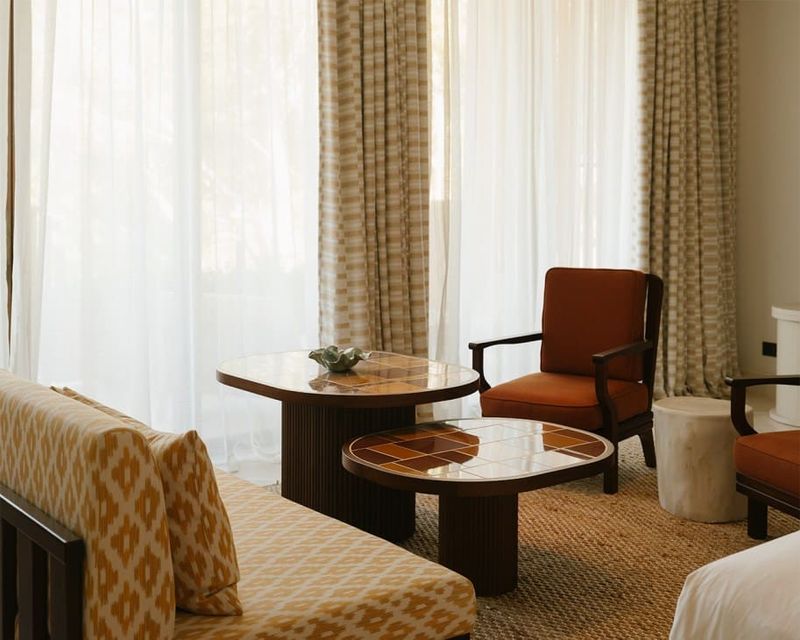
Virginia Nieto's interiors speak in a single, insistent colour. Yellow saturates every surface: bathroom tiles, parasols, upholstery, even the oversized pendant lights that hang from the ceilings like benevolent, shaggy creatures. It is not a timid yellow, not the pale wash of morning light, but the full-throated hue of lemon sorbet left to soften in the sun. Palm trees are painted directly onto walls, their fronds arching across plaster in gestures both playful and deliberate. The effect is less Mallorcan rusticity than it is a love letter to midcentury Mediterranean leisure, the kind that favoured pattern and boldness over the muted tones that have dominated design in recent years.
There are nods to local craft, woven baskets and ceramic details that anchor the hotel to the island, but this is not an exercise in folkloric authenticity. The design is slicker than that, more interested in mood than in ethnography. It succeeds in creating spaces that feel inherently optimistic, rooms where the act of waking feels like a minor celebration. The yellow light fittings from Yucatán, in particular, become a signature, their textured surfaces catching the afternoon sun and casting soft, dappled shadows across the walls.
Topography as Narrative
The building itself is a response to the land's refusal to flatten. Architects Álvaro Onieva and MR Studio have worked within the constraints of a narrow, steeply sloped site, resulting in a hotel that unfolds vertically rather than horizontally. Corridors twist and descend. Stairways appear where you least expect them. On arrival, navigation becomes a minor puzzle; the gym, fully equipped with weights and machines, seems to relocate itself daily, and finding one's room can require a moment of reorientation. This is not poor planning but the inevitable consequence of building on a cliff.
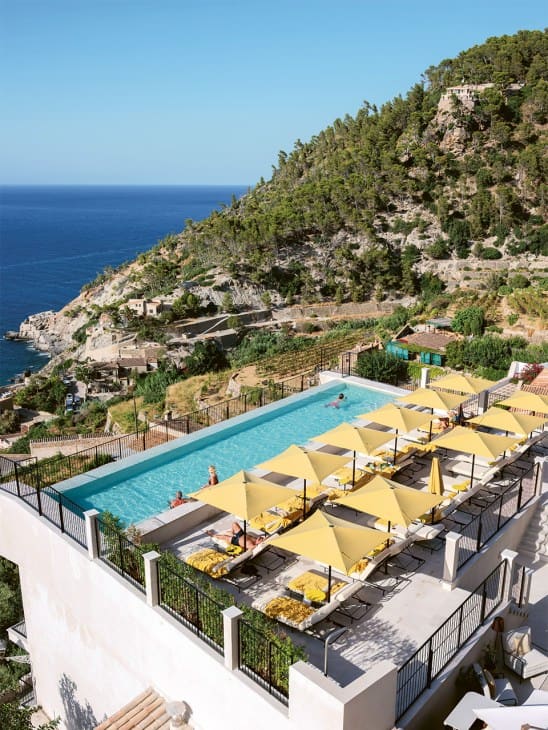
The reward for this complexity is the view. Every room, every terrace, every corner of the dining area commands a perspective that halts conversation. Yachts trace white lines across the water at dusk. Local residents, towels draped over shoulders, wind down the steep roads towards the sea, heading for one of the island's most dramatic swimming spots. The pool, a slender rectangle perched above the village, offers the sensation of floating above the Mediterranean, the horizon line blurring the boundary between water and sky. Guests tend to linger here longer than they intend, drawn into the rhythm of watching light change across the surface of the sea.
The Rituals of Arrival and Departure
The hotel is still finding its cadence. New openings carry a certain self-consciousness, a desire to explain themselves, and Gran Hotel Margalida has not yet fully shed this quality. The storytelling, though well-intentioned, occasionally intrudes. Cover versions of familiar songs play a touch too loudly in public spaces, filling silences that might be better left unfilled. The oyster bar, a handsome addition to the hotel's offering, has yet to become a fixture for local residents, though whether it will draw the architects and bankers who live behind those shuttered doors remains to be seen.
The food, however, holds its own. The kitchen turns out dishes that respect both ingredient and appetite, and the wine list reflects a thoughtful curation rather than an exhaustive catalogue. Dining on the terrace as the sun slips below the horizon becomes the sort of ritual that structures a stay, the kind of experience that guests begin anticipating hours in advance. Service, too, is a strength. The team moves with a quiet competence, attentive without hovering, capable of reading the mood of a room.
Where the Village Meets the Water
As the temperature softens in late afternoon, a migration begins. Residents and visitors alike drift downward, following the steep roads towards the sea. To the right of the hotel, a path descends to a walled dock where small boats rest in their moorings, protected from the swell. Here, on a sloping concrete slip, people gather on wooden boards, cerveza in hand, conversation unhurried. The scene has the easy intimacy of a ritual repeated daily, a social contract that requires no formal invitation.
Further along, across a scattering of rocks, a long concrete platform extends into the water, backed by a sheer cliff face. Entry into the sea is inelegant, a scramble over boulders that demands water shoes and a willingness to abandon grace. But the water, once reached, is worth the effort: clear, cold, bracing. Upon emerging, a waterfall tumbles over the cliff, offering a natural shower that tastes faintly of salt and stone. This is Banyalbufar stripped to its essence, a place where luxury means proximity to elemental things rather than insulation from them.
The Architecture of Escape
Leaving Gran Hotel Margalida requires winding back through the Tramuntana mountains, the road coiling through peaks and valleys in a series of hairpin turns. The sensation is one of reluctant departure, of reality reasserting itself after a suspension. The hotel succeeds in creating a haven, a place where the concerns carried in luggage can remain locked away for the duration of a stay. This is no small achievement in an era when escape often feels performative, when the act of retreating is documented and shared rather than simply lived.
What the hotel offers, ultimately, is not novelty but a particular quality of attention. It asks guests to notice the way light moves across water, the way stone terraces hold their shape against the sea, the way a village can be both discreet and welcoming. It channels the spirit of the Riviera without replicating it, honouring the restraint of Banyalbufar while offering a space where that restraint can be, for a moment, set aside. Whether it will become a fixture in the village's life or remain a place apart is a question that time will answer. For now, it stands as a bright, yellow-lit invitation on a clifftop, windows open to the sea.