An Island That Stood Still for Centuries Braces for the Camera's Gaze
Favignana, a sliver of Sicily that doubled as Ithaca in Christopher Nolan's epic, is learning what it means to be discovered
A Place Out of Time
There's a particular quality to islands that exist just beyond reach of the mainland: they move at a different tempo, preserve traditions that have elsewhere dissolved, and hold tight to rhythms shaped more by tides than by trends. Favignana, a seven-and-a-half-square-mile knuckle of rock and scrub rising from turquoise waters four miles off Sicily's western coast, has been one such place. Home to roughly three thousand souls, it has long been known for tuna fishing, a handful of beaches accessible only by foot, and the kind of quietness that makes city dwellers uneasy for the first day or two.
That quietness, however, is about to change pitch. Christopher Nolan chose Favignana to stand in for Ithaca in his adaptation of Homer's epic, and now the island finds itself in the peculiar position of being seen, catalogued, and increasingly desired by travelers who move through the world with a different agenda: not to stumble upon beauty, but to retrace its appearance on screen.
At Global Chic Voyage, we've watched this pattern repeat across continents. A director frames a cobblestone alley just so; a costume designer selects a palazzo with the right fall of afternoon light; and within months, the quiet place becomes a set, then a destination, then something else entirely. Favignana is the latest to enter this cycle, and the island is deciding, in real time, what it wants to become.
The Mechanics of Being Discovered
The numbers tell part of the story. Nolan's film earned more than two hundred and sixty-four million dollars worldwide on its opening weekend, and searches for Favignana on Google climbed forty percent year over year. Future Market Insights projects that film tourism will reach one hundred and fifty-seven billion dollars globally by 2036, a figure that reflects not just curiosity but a fundamental shift in how people decide where to go. We no longer travel solely to see; we travel to inhabit, however briefly, the frame we've already admired.
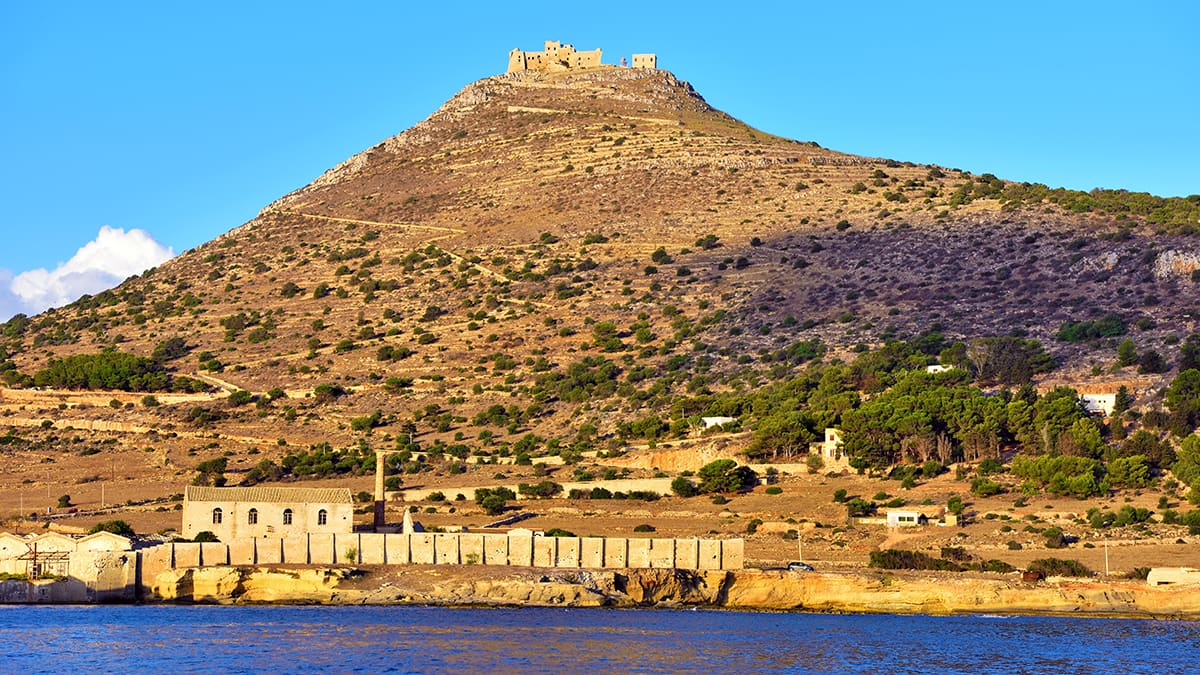
Favignana's mayor, Giuseppe Pagoto, is working with Sicily's culture department and the studio to convert the island's former Florio tuna-processing plant, which served as production headquarters, into a permanent exhibition space. The plan is to display costumes, equipment, and behind-the-scenes materials that will allow visitors to walk through the making of the film. It's a strategy borrowed from other locations that have leaned into their cinematic identities: offer not just the view, but the myth of proximity to the actors who stood there, the cameras that captured it, the craft that assembled illusion into narrative.
The fifteenth-century Castello di Santa Caterina, a fortress perched on Favignana's highest hill, served as the royal palace of Odysseus in the film. In reality, it's a ruin, open to wind and sky, with views that stretch across the Egadi archipelago. Whether it will remain a ruin, or whether scaffolding and signage and guided tours will reshape its atmosphere, remains to be seen.
What Happens When Summer Swells
Even before the film, Favignana was not untouched. Each summer, the population swells from three thousand to as many as fifty thousand, a seasonal inundation that strains water supplies, waste management, and the narrow roads that loop around the island's perimeter. The United Nations World Tourism Organization estimates that featuring a location in a major film can increase visitor numbers by twenty-five to forty percent, a projection that, for Favignana, could mean the difference between manageable and untenable.
Giacomo Incarbona, who leads the local hotel operators' association, believes the film will draw American travelers not just to Favignana but to western Sicily as a whole. The region has long lived in the shadow of Taormina and Palermo, places with deeper infrastructure and longer histories of accommodating foreign visitors. Whether smaller islands like Favignana, with limited lodging and few luxury properties, can absorb a new wave of interest without losing the qualities that made them appealing in the first place is the central question.
We've seen it answered in different ways. Queenstown in New Zealand managed to build a luxury travel economy around its film pedigree without entirely erasing its character. Other places, less fortunate or less deliberate, have become theme parks of themselves, where every view is framed for Instagram and every meal is staged for content. Favignana is at the crossroads, and the choices made in the next few years will determine which path it takes.
The Texture of a Place Before It Changes
What's worth preserving? The question sounds simple, but it's not. Favignana's identity has long been tied to the sea, to the mattanza, the centuries-old method of tuna fishing that was both ritual and livelihood. The Florio family built their fortune processing that catch, and the plant they left behind is now a monument to an industry that no longer sustains the island. Turning it into a film museum is, in one sense, pragmatic: it gives new purpose to a structure that might otherwise crumble. In another sense, it's a kind of surrender, an acknowledgment that the island's future lies not in what it produces but in what it represents to people passing through.
The rocky coastline, the coves with water so clear you can see shadows of fish on the sand below, the absence of boardwalks and beach clubs, these are the textures that made Favignana legible as Ithaca, as a place outside the churn of modernity. Whether those textures can survive their own popularity is a question without an easy answer. Tourism brings revenue, employment, and recognition. It also brings traffic, waste, and the slow erosion of the qualities that justified the journey in the first place.
The Calculus of Attention
Film tourism is, at its core, a kind of pilgrimage, one that replaces the sacred with the cinematic. Travelers arrive not to worship but to verify: to stand where a character stood, to see what the camera saw, to close the gap between screen and self. It's a fundamentally modern impulse, this desire to occupy the same coordinates as fiction, and it's reshaping destinations around the world.
The trend has accelerated in recent years, fueled by series like The White Lotus and Bridgerton, which have turned locations into characters in their own right. Tour operators now design itineraries around filming sites; luxury hotels create packages that promise immersion into the world of a show or film. The experience is sold not as discovery but as recognition, a chance to step into a story you've already consumed.
For Favignana, the calculus is delicate. The island lacks the hotel capacity of more established destinations, and its infrastructure was never designed for sustained high-volume tourism. Local authorities are now considering measures to manage crowds, though the specifics remain vague. Reservation systems, visitor caps, and seasonal restrictions are all possibilities, each with trade-offs. Too much control, and you risk alienating the travelers who bring economic benefit. Too little, and you risk the kind of overtourism that has plagued Venice, Barcelona, and Santorini, places where residents have become extras in someone else's vacation.
What Remains When the Cameras Leave
At Global Chic Voyage, we've always believed that the best travel is attentive, that it requires not just seeing but listening, not just arriving but lingering. Film tourism, for all its energy, often operates on a different principle: it's extractive, transactional, a matter of ticking boxes and moving on. The challenge for places like Favignana is to encourage a slower, more considerate form of attention, one that values the island not as a backdrop but as a living place with its own rhythms and constraints.
There's no blueprint for this. Some destinations have managed it through deliberate pacing, through partnerships with operators who prioritize low-impact travel, through storytelling that emphasizes context over spectacle. Others have simply been overwhelmed, their infrastructure and culture reshaped by forces they couldn't control or didn't anticipate.
Favignana is still deciding which story it wants to tell. The exhibition at the Florio plant will open, the searches will continue to climb, and the ferries from Trapani will carry more passengers each season. Whether the island can hold on to the qualities that made it worth filming in the first place, whether it can be both seen and preserved, is a question that will be answered not by policy alone but by the daily choices of everyone who arrives, everyone who profits, and everyone who calls it home.
The camera has already moved on. Nolan and his crew have packed their equipment, dismantled the sets, and turned their attention elsewhere. But the gaze they invited lingers, and with it comes the slow, irreversible work of being watched.