A Sicilian Baroque Town Where the Piazzas Still Belong to the Locals
Militello Val di Catania offers the architecture, the intimacy, and the unhurried rhythm that mass tourism has erased elsewhere.
The Architecture of Stillness
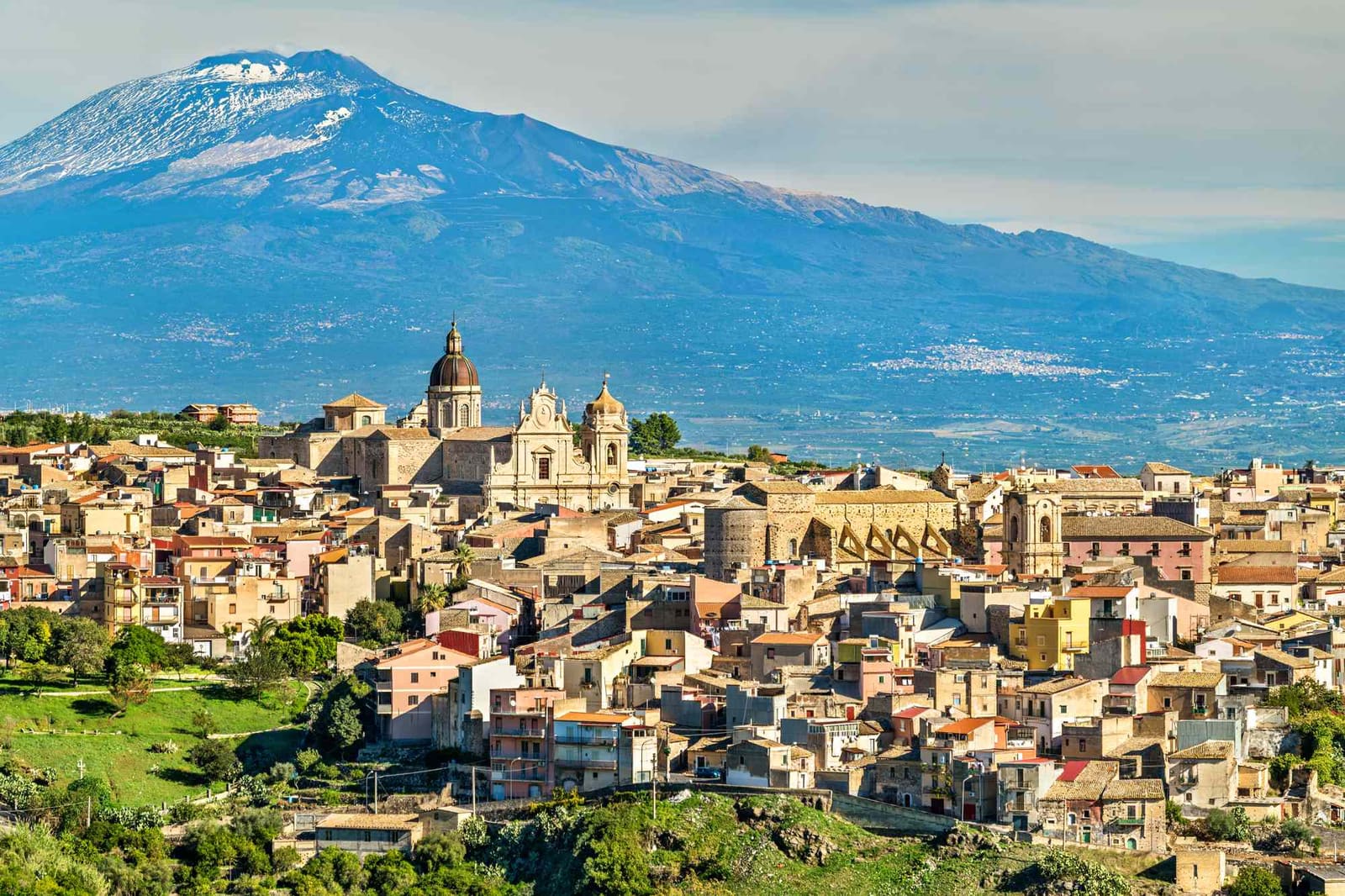
There is a particular quality to light in the late afternoon when it catches the honey-colored limestone of a Baroque façade, when shadows lengthen across an empty piazza, and when the only sound is the distant clatter of plates from a kitchen somewhere beyond a half-open door. Militello Val di Catania, perched in the hills southeast of Mount Etna, possesses this quality in abundance. The town does not announce itself. There are no tour buses idling at the edge of the historic center, no selfie queues outside the churches, no menus translated into six languages. Instead, there is stone, and silence, and the kind of beauty that asks nothing of you except that you slow down.
Recognized formally among Italy's Most Beautiful Villages, Militello carries its accolades lightly. The designation, awarded by the Associazione dei Borghi più Belli d'Italia, serves less as a tourism marketing tool here than as a quiet confirmation of what locals have always known: that their town, rebuilt in the wake of the catastrophic 1693 earthquake that leveled much of southeastern Sicily, represents one of the finest expressions of Sicilian Baroque architecture still standing. Eight of its monuments are inscribed on the UNESCO World Heritage List as part of the Late Baroque Towns of the Val di Noto, yet the recognition has not translated into the kind of visitor influx that has transformed other World Heritage sites into open-air museums. At Global Chic Voyage, we've watched this pattern repeat itself across Europe: the gap between designation and discovery can, in rare cases, persist for decades. Militello occupies that gap.
Piazzas as Living Rooms
The town's spatial grammar revolves around its piazzas, each one functioning less as a stage for tourist performance than as an extension of domestic life. Piazza Municipio, anchored by the town hall and the Church of San Nicolò, unfolds in a sequence of interconnected squares that feel designed for lingering rather than passing through. In the early evening, when the heat has lifted, older men gather on benches beneath the palms, and children trace elliptical patterns on bicycles across the paving stones. There is no programmed animation, no sponsored festival, just the ordinary choreography of a town that still knows how to inhabit its public spaces.
The Church of Santa Maria della Stella, with its convex façade and intricate stone carvings, anchors another piazza to the north. The building's exterior, a study in controlled exuberance, demonstrates the Baroque impulse to animate stone, to make it ripple and breathe. Inside, the nave stretches toward an apse decorated with frescoes that have survived centuries of earthquakes, renovations, and the slow erosion of institutional memory. We've returned to churches like this across Sicily, and what strikes us each time is not the grandeur but the intimacy: these were buildings designed to serve small communities, and they retain that scale even as the communities themselves have contracted.
The Quiet Luxury of the Quotidian
Militello's restaurants do not announce themselves with neon or Michelin stars. They are, almost without exception, family-run establishments where the menu changes according to what the market offered that morning and where the dining room might double as the family's own living space once service ends. At Trattoria da Nino, a narrow room with a dozen tables and walls lined with photographs of three generations, the pasta alla Norma arrives as it should: eggplant fried in olive oil until the edges char, tomato sauce that tastes of summer, ricotta salata grated over the top. The recipe has not changed in forty years, because there is no reason to change it.
This is not the kind of cooking that requires explanation or elaboration. It is ingredient-driven in the truest sense: the quality of the eggplant, the acidity of the tomato, the minerality of the cheese. What we've come to understand, after years of eating our way through Italy's lesser-known towns, is that this approach to food is inseparable from a broader philosophy about place. Where mass tourism takes hold, restaurants begin to anticipate and then cater to external expectations. Menus expand, dishes become milder, presentation becomes more Instagram-ready. In Militello, the restaurants still cook for their neighbors.
The Geometry of Reconstruction
To walk through Militello is to move through a living document of post-disaster urban planning. After the 1693 earthquake reduced the medieval town to rubble, reconstruction followed the principles of Baroque rationalism: wide streets laid out in a grid, buildings aligned to create visual axes, churches positioned to serve as focal points. The result is a town that feels both planned and organic, where the regularity of the street pattern does not preclude the kind of small-scale variation that gives a place texture.
The Palazzo Baldanza, with its balconies supported by grotesque corbels, exemplifies the local aristocracy's embrace of Baroque theatricality. These were not buildings designed for defense or fortification; they were designed to be seen, to project wealth and taste into the public realm. What makes them compelling now is their state of gentle decay. Paint peels from shutters, weeds sprout from cornices, and yet the underlying structure remains sound. There is something honest about this kind of aging, a refusal of the cosmetic interventions that have turned other historic towns into Disneyfied versions of themselves.
The Economics of Emptiness
Militello's lack of crowds is not accidental; it is the result of geography, infrastructure, and a certain resistance to the machinery of tourism promotion. The town sits roughly equidistant from Catania and Ragusa, but far enough from either to discourage day-trippers. There is no train station. The roads that wind through the Hyblaean hills are narrow and slow. Hotels are few, and those that exist are small, often converted from historic buildings without the amenities that package tourists expect.
This isolation has preserved the town, but it has also hollowed it out. Like much of inland Sicily, Militello has been losing population for decades as young people migrate to Catania, Rome, or further north in search of work. The piazzas are empty not only because tourists have not discovered them, but because there are fewer locals to fill them. What we are witnessing, then, is a town caught between two futures: one in which it becomes another stop on the Baroque Sicily circuit, complete with boutique hotels and wine bars, and another in which it continues its slow fade into demographic irrelevance.
Why Some Places Resist Discovery
At Global Chic Voyage, we've spent years trying to articulate what makes certain places feel authentic and others feel curated. The answer is never simple, but it often has to do with the presence or absence of a functional local economy that exists independently of tourism. Militello still has that economy, barely. There are still bakeries that open before dawn to serve workers, still hardware stores that stock nails and twine rather than souvenir ceramics, still bars where the primary clientele is local and the primary offering is a morning espresso and cornetto.
This is the paradox of travel writing: to describe a place like Militello is, in some small way, to endanger it. To say that it is beautiful and uncrowded is to invite the very crowds that would erode its beauty. And yet to say nothing is to consign it to obscurity, to allow the demographic and economic pressures that are emptying Italy's inland towns to continue unchecked. There is no resolution to this paradox, only the hope that travelers who do make the journey will do so with a certain lightness of footprint, a willingness to eat where the locals eat, to linger in the piazzas without performing their presence, to understand that the town's value lies not in its potential as a backdrop for content but in its continued existence as a living place.
The Light Returns
We return, in the end, to the quality of light. In Militello, as the afternoon stretches toward evening, the Baroque façades take on a warmth that no photograph quite captures. The stone seems to hold the day's heat, releasing it slowly as the temperature drops. In the piazzas, the first lights flicker on in the surrounding buildings, and the geometry of the space shifts from public to intimate. This is the moment when the town feels most itself, when the architecture and the light and the rhythm of daily life align into something that feels less like a destination than a privilege to witness.
Militello Val di Catania will not remain undiscovered forever. The logic of tourism, the pressures of economic necessity, and the sheer beauty of the place will eventually draw more visitors. But for now, it exists in that rare state of grace where a town can still be both beautiful and lived-in, where the piazzas belong to the people who have always known them, and where the past is not a commodity but a presence, woven into the stones and the light and the unhurried passage of days.