The ER 110 Untouchable Imagines Superyacht Design Without Compromise
A Canadian studio's latest concept sketches a vertical bow, fold-out terraces, and interiors that blur the line between vessel and villa.
A Silhouette That Refuses to Whisper
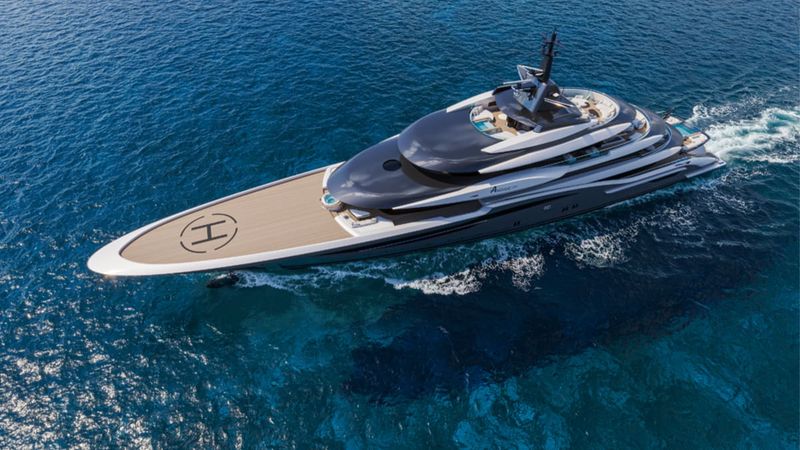
There is a particular kind of ambition visible in the profile of a superyacht concept, the sort that announces itself before you've read a single specification. The ER 110 Untouchable, a recent study from ER Yacht Design, possesses that quality. Its near-vertical bow cuts upward like a shard of polished steel, a gesture more common to contemporary architecture than to vessels meant for open water. This is not a yacht that borrows from tradition. It is one that seems to have arrived from a parallel timeline where form and function negotiated different terms.
At Global Chic Voyage, we've watched the language of yacht design shift in recent years, moving away from the soft curves and teak-laden classicism that once defined luxury at sea. What ER Yacht Design proposes here is not merely a departure but a provocation. The ER 110 Untouchable is a study in how far design can stretch before it loses sight of the water beneath it. And yet, for all its sculptural audacity, the concept remains rooted in the practical rituals of life aboard: dining, lounging, sleeping, and the quiet pleasure of watching the horizon from a private terrace.
Exterior Architecture as Statement
The most immediate impression the ER 110 makes is one of verticality. That bow, rising sharply from the waterline, establishes a visual tension that carries through the entire length of the vessel. It is a choice that speaks to a broader trend in superyacht design, where the exterior silhouette is treated less as a functional envelope and more as a sculptural object in its own right.
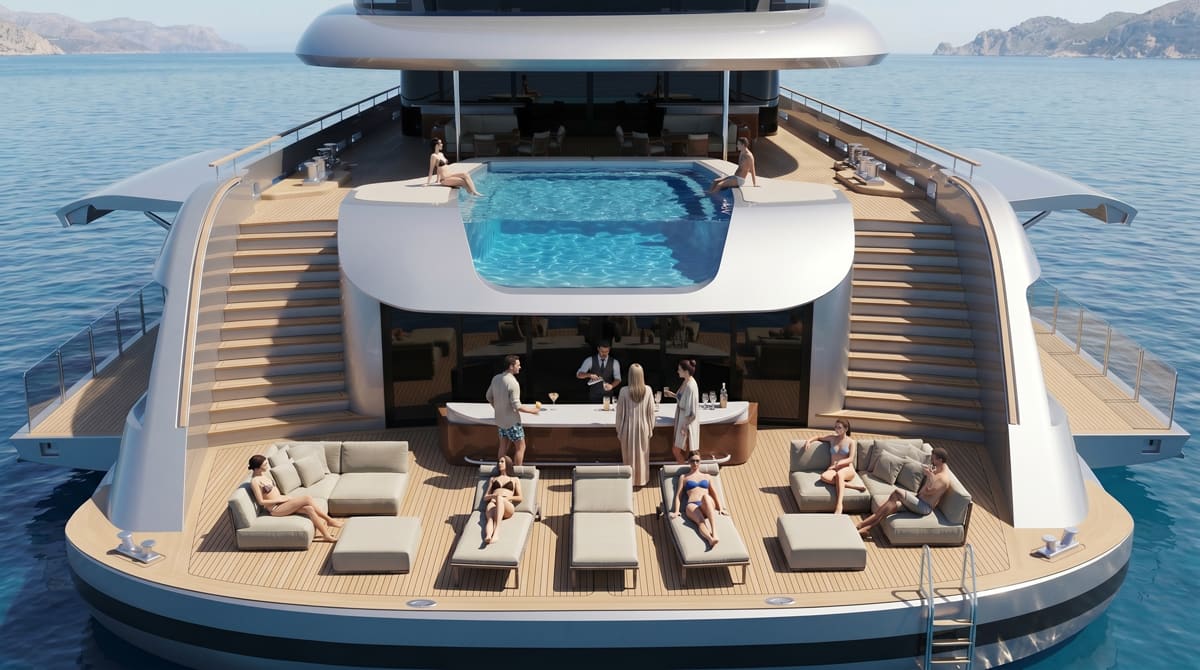
But the drama of the bow is balanced by the aft decks, which open out in a series of layered terraces. These are not static spaces. Fold-out platforms extend the usable deck area, creating pockets of privacy that can be adjusted depending on the moment. It is a strategy we have seen employed in high-end residential design, where walls and floors are no longer fixed but responsive, and it translates surprisingly well to the marine context. The result is a vessel that can contract or expand depending on whether the owner seeks solitude or spectacle.
The beach club, positioned low and close to the water, reinforces this sense of fluidity. It is designed to feel less like a compartment within a yacht and more like a pavilion that happens to float. Glass panels frame views in every direction, and the threshold between interior and exterior dissolves in a way that would be familiar to anyone who has spent time in a modernist villa on the Mediterranean coast.
Interiors That Prioritize Space Over Ornament
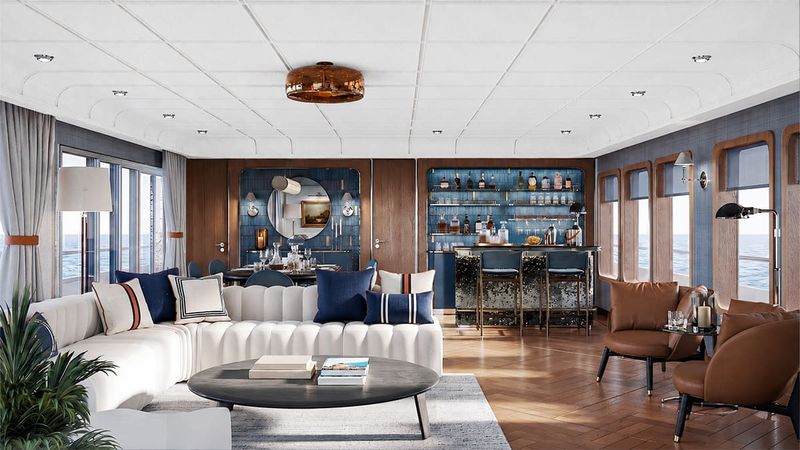
Inside, the ER 110 Untouchable adopts a palette and spatial logic that feels more aligned with contemporary residential design than with the mahogany-paneled tradition of yachting. The main salon is defined by volume rather than decoration. Ceilings are high, walls are pale, and furniture is spare. There is an absence of clutter, a deliberate withholding that allows the architecture itself to become the primary experience.
The dining room continues this restraint. A long table anchors the space, but the real focus is the light that floods in from floor-to-ceiling windows. It is a room designed for meals that stretch into the evening, where conversation matters more than ceremony. The aesthetic here is not about opulence in the traditional sense but about the luxury of space, of air, of unobstructed views.
The owner's suite, positioned to maximize privacy and light, follows a similar philosophy. The sleeping area is open and unadorned, with a bed that faces outward toward the sea. The en suite bathroom, rendered in stone and glass, feels more like a spa than a functional space. There is a sense throughout that the design is less interested in impressing guests than in creating an environment where the owner can retreat entirely from the world.
Customization as Core Philosophy
What distinguishes the ER 110 Untouchable from many concept yachts is the explicit emphasis ER Yacht Design places on adaptability. The studio has made clear that the design is available for further customization, a signal that this is not a finished product but a starting point. In an industry where bespoke is the baseline expectation, that openness is less a selling point than a necessary acknowledgment of how the ultra-high-net-worth client approaches acquisition.
This flexibility extends beyond finishes and materials. The layout itself, while presented in a specific configuration, is intended to be rethought depending on the owner's priorities. Some may prioritize guest cabins; others may want larger communal spaces or dedicated wellness areas. The concept, in other words, is a framework rather than a prescription.
At Global Chic Voyage, we have observed a shift in how clients engage with yacht design. There is less interest in off-the-shelf solutions and more appetite for vessels that reflect personal philosophies, whether that means sustainability, minimalism, or a particular aesthetic lineage. The ER 110 Untouchable, in its stripped-down elegance and structural boldness, seems designed to accommodate that kind of client. It is not trying to be all things to all people. It is trying to be one thing, very well, and then inviting the owner to decide what that thing should become.
The Broader Conversation Around Concept Yachts
Concept yachts occupy a curious position in the design ecosystem. They are not products in the traditional sense but rather proposals, exercises in what might be possible if budget, engineering, and ambition were to align. Some never leave the rendering stage. Others serve as calling cards for studios hoping to attract commissions. A few, however, become touchstones that influence the direction of an entire sector.
The ER 110 Untouchable falls into that third category. Its design choices, particularly the vertical bow and the fold-out terraces, are likely to reappear in future projects, either by ER Yacht Design or by studios watching closely. The emphasis on volume over ornament, on light over luxury in its more baroque forms, reflects a broader cultural shift that has been underway in architecture and interiors for the better part of a decade. What we are seeing now is that shift reaching the water.
There is also a practical dimension to these concepts that is easy to overlook. They serve as testing grounds for ideas that may not yet be technically feasible but are worth exploring. The fold-out terraces, for instance, require engineering solutions that are non-trivial. By presenting them in a concept, the studio is not only showcasing its vision but also opening a dialogue with shipyards, engineers, and clients about what can be built, how, and at what cost.
A Vessel That Asks Questions
The ER 110 Untouchable does not arrive with answers. It arrives with questions. What does a superyacht look like when it prioritizes architecture over tradition? What happens when the interior design language of a private home is applied to a vessel that moves? How much flexibility can be built into a design before it loses coherence?
These are not rhetorical questions. They are the kinds of inquiries that drive the evolution of any design discipline. And they are questions that the clients who commission these vessels are increasingly asking. The days of the superyacht as a floating palace, with all the attendant gilt and grandeur, are not over. But they are no longer the only option. The ER 110 Untouchable suggests an alternative: a vessel that is as much a work of contemporary design as it is a mode of transport, a place to live as much as a place to travel.
At Global Chic Voyage, we remain curious about where this trajectory leads. The yachts we return to, the ones that linger in memory, are rarely the most ostentatious. They are the ones that understand restraint, that know when to step back and let the ocean do the talking. The ER 110 Untouchable, for all its boldness, seems to understand that balance. It is loud where it needs to be and quiet everywhere else. And in that tension, it finds its voice.