Five Studios Reimagine the Gentleman's Yacht
Numarine's Classic range becomes a canvas for international designers to explore what timeless luxury means at sea.
A Platform, Five Visions
There is something quietly radical about handing the same blank canvas to five different artists and letting them work without constraint. Numarine has done precisely that with its Classic range, inviting design studios from four countries to create distinct interior schemes for the 38XPC and 39MXPC models. The result is not a catalogue of options but a study in how perspective shapes luxury, how a tub or a piece of paneling can anchor an entirely different experience of being at sea.
The Turkish yard introduced its Classic range earlier this year, drawing inspiration from 1960s superyacht aesthetics while integrating contemporary naval technology. The exterior lines, penned by Can Yalman with naval architecture by Umberto Tagliavini, nod to the gentleman's yacht and the Mediterranean cruiser. But it is inside where the real conversation begins. Each of the five studios - Hot Lab from Italy, Ofist from Turkey, Vallicelli Design from Italy, Sturge & Toth from the U.K. and Austria, and Carla Guilhem from the United States - was given freedom over materials, color, form, and atmosphere. What they produced is a collection that Numarine now calls Atelier, a term that signals craft and authorship rather than assembly-line customization.
Warm Wood and Geometric Discipline
Hot Lab's approach is rooted in restraint. The Italian studio selected a warm wood as the signature material, threading it through the main salon, the owner's suite, and the bathroom. The wood is balanced by a palette of whites and beiges, surfaces that recede rather than announce themselves. What gives the scheme its structure is geometry: square and rectangular motifs appear on floors and ceilings, creating a visual rhythm that is orderly without being rigid. The effect is one of calm authority, a space that feels considered rather than decorated.
This is design that trusts materials to carry meaning. The wood is not merely a finish; it becomes the organizing principle, a through-line that unifies disparate spaces. Hot Lab's interiors suggest a kind of modernist discipline, where luxury is expressed through proportion and texture rather than ornament.
Nature as Narrative
Carla Guilhem takes a different path. Her scheme for the Classic range is exuberant, layered with pattern and reference. Swirling motifs and bold marbles set the tone, but it is the details that give the design its character: abstract blue birds on wallpaper, palm trees and jungle cats on pillows, organic forms that evoke tropical abundance. This is not nature as backdrop but as protagonist, a deliberate counterpoint to the maritime setting.
The approach speaks to a broader trend in luxury interiors, where biophilia - design that connects occupants to the natural world - has moved beyond potted plants and large windows. Guilhem's work suggests that nature can be interpreted, stylized, woven into the fabric of a space without literalism. The result is interiors that feel alive, that invite curiosity rather than passive appreciation.
The Maritime Club Revisited
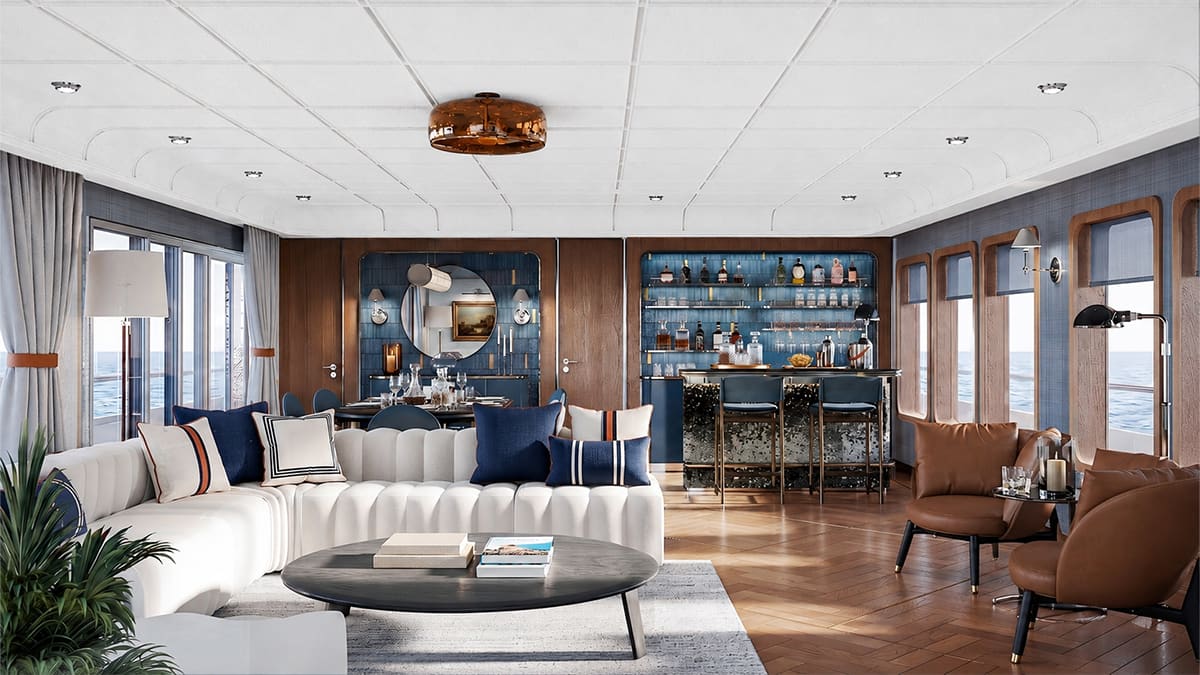
Ofist's design leans into archetype. The Turkish studio chose the language of the classic maritime gentleman's club: wood paneling, leather upholstery, a palette dominated by blues and deep earth tones. The bathroom features a freestanding tub positioned to overlook the sea, a gesture that is both practical and symbolic. This is design as ritual, as a return to codes and conventions that have signified seafaring privilege for more than a century.
Yet there is nothing nostalgic about the execution. The materials are contemporary, the proportions refined. Ofist is not recreating the past but distilling it, identifying the elements that still resonate and stripping away the rest. The scheme works because it understands that tradition is not static; it is a set of principles that can be reinterpreted for each generation.
Marble, Paneling, and the Power of Green
Sturge & Toth also gravitate toward drama, but their palette is cooler, more sculptural. The standout feature is the bathroom, clad in deep green marble that feels both opulent and grounding. Elsewhere, white wood paneling defines the main salon, paired with plush furniture and linens in soft, neutral tones. The contrast between the green marble and the white paneling creates a dynamic tension, a play between weight and lightness.
The green marble is a bold choice. It anchors the bathroom in a way that feels almost geological, as if the space were carved from a single stone. Against the open expanse of the sea, such solidity is reassuring. Sturge & Toth understand that luxury is not always about openness and light; sometimes it is about enclosure, about creating a space that feels protected and enveloping.
The Circle as Organizing Idea
Vallicelli Design chose geometry as its organizing principle, but where Hot Lab favored the square and rectangle, Vallicelli embraced the circle. Curved forms appear in the ceiling of the main salon and bedroom, in the sculpted furniture, in the interplay of surfaces. The effect is fluid, almost cinematic, as if the interiors were designed to accommodate movement rather than stillness.
Circular motifs have a long history in yacht design, where they echo portholes, helms, and the horizon itself. Vallicelli's scheme is a meditation on that lineage, a way of acknowledging the vessel's maritime context without resorting to cliché. The curves soften the interiors, making them feel more intimate even as they maintain a sense of openness.
Wellness as Standard
Across all five concepts, Numarine has integrated wellness features that go beyond the expected spa or gym. Options include infrared saunas, cold therapy, and other modalities that reflect a growing demand for vessels that support physical and mental well-being. This is not an add-on but a core part of the offering, a recognition that contemporary luxury is increasingly defined by how it makes people feel rather than what it displays.
The wellness emphasis also speaks to a shift in how long-range yachts are used. These are not trophy assets meant for occasional display but platforms for extended voyages, for living at sea in a way that requires the same infrastructure and amenities as life on land. Numarine's approach is to build that infrastructure into the design from the beginning, rather than retrofitting it later.
What Atelier Means
According to Numarine, the Atelier initiative is meant to give potential owners a clearer sense of what customization can achieve. Rather than asking clients to imagine possibilities in the abstract, the yard is offering five fully realized visions, each distinct enough to serve as a starting point for further personalization. Patrik von Sydow, the yard's CEO, described the approach as making the yacht "much more personal from the very beginning of the ownership journey."
The strategy is both practical and philosophical. On one level, it simplifies the design process by providing concrete examples. On another, it signals a shift in how yards think about their role. Numarine is not merely building hulls and leaving the rest to interior designers; it is curating a collection of perspectives, positioning itself as an editor as much as a manufacturer.
The Classic Range in Context
The 38XPC and 39MXPC are part of Numarine's broader effort to blend historical reference with contemporary performance. The 38XPC draws from the gentleman's yacht tradition, while the 39MXPC evokes the Mediterranean cruiser, a vessel designed for coastal exploration rather than transatlantic passage. Both models feature long-range capabilities, a nod to the yard's Turkish heritage and its proximity to both the Mediterranean and the Black Sea.
The choice to name the line Classic is telling. It suggests permanence, a design philosophy that resists trend cycles in favor of enduring principles. Yet the Atelier concepts demonstrate that timelessness is not monolithic. Each studio's interpretation is rooted in different traditions, different geographies, different ideas about what makes a space feel lasting. The common thread is a commitment to craft, to materials that age well, to forms that do not announce their era too loudly.
Beyond the Template
What Numarine has created with Atelier is less a product line than a framework for conversation. The five concepts are not meant to be chosen off the shelf but to provoke questions: Which materials resonate? Which atmospheres feel right? How does one want to experience time at sea? By presenting fully realized interiors rather than mood boards or sketches, the yard gives clients a vocabulary for articulating preferences they might not yet have words for.
This is design as education, a way of showing what is possible before the client even knows to ask. It also reflects a broader shift in the superyacht industry, where customization is no longer a luxury but an expectation. The challenge for yards is to make that customization legible, to offer enough structure that clients do not feel overwhelmed by choice. Numarine's solution is to provide strong creative starting points, as von Sydow put it, and let the client's own vision emerge from there.
The Atelier collection will debut aboard the 38XPC and 39MXPC models, but its influence may extend further. If the initiative succeeds, it could become a template for how yards approach interior design across their fleets, a way of balancing creative freedom with the practicalities of production. For now, it stands as an argument that the best luxury is not singular but plural, not a single definition of elegance but a conversation among many.