Eight Vessels That Defined the 2026 Cannes Yachting Festival
From a pocket rocket that hits 47 knots in under half a minute to a catamaran steered by artificial intelligence, this year's flotilla rewrote the rules of maritime ambition.
A Festival of Maritime Reinvention
The September sun had barely cleared the palms along the Boulevard de la Croisette when the first tender shuttles began threading through the Vieux Port, ferrying brokers and builders between a hundred-plus world premieres spread across two harbour zones. The 49th Cannes Yachting Festival, held over six days last week, brought more than five hundred vessels to the French Riviera, from rigid inflatables to superyachts exceeding a hundred feet. While international flight cancellations kept visitor numbers below projections, the show floor itself hummed with deal-making energy, particularly among the Italian yards that arrived in force.
Ferretti Group alone moored twenty-two yachts in Cannes, including four global debuts. British builder Oyster Yachts used the event to announce its first bluewater sailing catamaran, the C60, and Pearl Yachts lifted the curtain on the Pearl 73, with exterior lines by Dixon Yacht Design and interiors by Kelly Hoppen. Yet it was the Italian contingent that dominated the conversation, fielding craft that ranged from carbon-fibre sprinters to tri-deck explorers wrapped in moss-green velvet and patinated brass. What follows are eight vessels that, in design ambition or engineering novelty, stood apart from the flotilla.
Azimut Grande 44M 'Shabby'
The first hull in Azimut's Grande 44M series carries a name that undersells its achievement. Positioned as the flagship of the Italian yard's Low Emission fleet, this 44-metre motor yacht delivers a thirty per cent reduction in carbon dioxide output compared with conventionally powered vessels of similar displacement, according to Azimut. A carbon-fibre foil beneath the waterline cuts drag, while the so-called dual-mode hull marries the fine entry of a fast displacement form forward with the stability of a semi-planing shape aft.
The interior, conceived by m²atelier, layers latticed leather panels against slabs of contrasting marble, a tactile palette that reads richer than the minimalist grain typical of contemporary yacht design. Alberto Mancini's exterior profile keeps the superstructure low and the sheerline taut, a silhouette that privileges speed over volume.
Forte47 Gran Turismo
Forty-seven feet long, forty-seven knots at full throttle, reached in under thirty seconds: Paolo Giordano's exterior design for the Forte47 Gran Turismo turns the number into a manifesto. This pocket express cruiser packs two double guest cabins, each with private head, and a cockpit that expands to forty square metres when fold-down side wings deploy. Deep lounge seating frames the aft deck, configured for languid afternoon crossings between Antibes and Saint-Tropez.
Customisation extends beyond layout. The first hull wore a bespoke Porsche bronze paint finish, and Forte Yachts offers an optional enclosed cockpit with heating for owners who plan to cruise northern latitudes. The Gran Turismo is less a tender substitute than a credible weekend vessel, proof that performance and liveability need not occupy opposite ends of the beam.
Sirena 118 'Ikigai'
At 36 metres, Sirena Marine's flagship arrived in Cannes wearing an interior that borrowed less from yacht-design convention than from the patinated romance of early ocean exploration. Riveted wall panels, oversized vintage luggage trunks, and mirrors aged to a pewter bloom evoke the cabins of Jacques Cousteau or Robert Ballard, set against moss-green velvet, burgundy leather, and mustard linen upholstery.
The bespoke first hull showcases a split owner's suite that spans two decks: the main-deck portion houses the sleeping quarters and ensuite, while a private cinema and study occupy the deck below, accessed by an internal staircase. It is an unusual configuration, one that privileges solitude and variety of mood over the conventional single-level master. The result feels less like a yacht interior and more like the private quarters of a collector who happens to live at sea.
Riva 56 Super Rivale
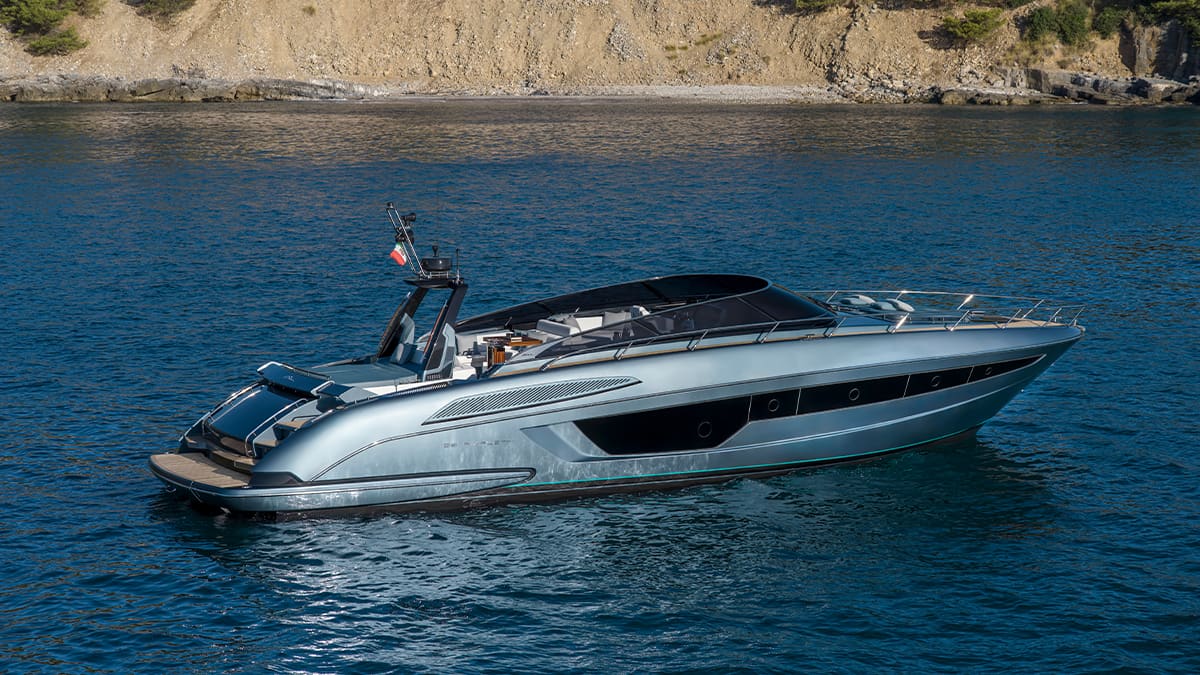
Riva's evolution of its 56-foot Rivale, first launched in 2017, arrived this year wrapped in a denim-toned Blu Sera hull that softens the model's otherwise sharp-edged profile. The Super Rivale distinguishes itself with a revised windscreen geometry: a counter-curve that lifts the deck profile and lends the boat a more athletic stance. Side grilles nod to automotive design language, a detail that feels appropriate given the twin 1,200-horsepower MAN V8 engines capable of pushing the hull to 38 knots.
The update is subtle but legible, a reminder that heritage builders can refresh a successful platform without abandoning the proportions that made it resonate in the first place. The Super Rivale reads as refinement rather than reinvention, and that restraint is itself a kind of luxury.
Sunreef Ultima 88
The Polish builder's 27-metre catamaran closed the festival on a high note, winning Catamaran Best Design at the 2026 World Yachts Trophies. The Ultima 88's appeal rests on two features: a vast aft Ocean Lounge with bulwarks that hinge open to erase the boundary between cockpit and water, and a shallow draft suited to the sandbars and coral shelves of the Bahamas and the Exumas.
The vessel is also among the first to integrate Sunreef's WETRA operating system, an artificial-intelligence platform that consolidates navigation, propulsion monitoring, and onboard systems management into a single interface. Tennis professional Carlos Alcaraz has reportedly signed for the third hull, a detail that underscores the catamaran's crossover appeal beyond the traditional superyacht owner demographic.
Custom Line Navetta 35 'Goal'
Ferretti Group's Custom Line set out to deliver a tri-deck motor yacht that maximised social space without exceeding the 35-metre length overall. The first hull, christened Goal, devotes more than 280 square metres to lounging, dining, and entertaining, wrapped in a palette of ivory, caramel, and cream chosen by the owner.
The key move was the removal of the external staircase on the main deck aft, a structural omission that freed the cockpit and upper deck to function as uninterrupted social zones. The trade-off is a slight loss of circulation redundancy, but for an owner who values open-plan gathering spaces over compartmentalised privacy, the Navetta 35 delivers a compelling answer to the question of how much volume a 35-metre hull can reasonably contain.
Riva 96 Argo Super
Riva's near-30-metre flagship represents the upper end of the yard's motor-yacht range, and the Argo Super refines the original 96-footer with updated materials and a revised sundeck layout. The hull retains the plumb bow and flared topsides that have become Riva signatures, but the interior leans toward warmer tones and layered textures, a departure from the high-gloss lacquer that dominated earlier models.
Performance remains brisk: twin engines deliver a cruising speed in the mid-twenties and a top end nudging 30 knots, figures that position the Argo Super as a genuine long-range cruiser rather than a displacement trawler. The vessel occupies a middle ground between the sprint-focused smaller Rivas and the more leisurely pace of true explorer yachts, a niche that suits owners who want both speed and the ability to cross an ocean without refuelling every third day.
The Italian Ascendancy
The dominance of Italian builders at this year's festival was not accidental. Yards such as Azimut, Riva, Sirena, and Custom Line have spent the past decade investing in carbon-composite construction, hybrid propulsion, and modular interior systems that allow for deep personalisation without requiring bespoke tooling. The result is a generation of vessels that balance serial-production efficiency with the bespoke finishes once reserved for one-off commissions.
That balance was visible throughout the festival, from the Forte47's Porsche-hued hull to the Sirena 118's riveted explorer aesthetic. Each vessel carried the imprint of an owner's particular vision, yet none required the multi-year build schedules typical of true custom projects. It is a model that suits the current buyer demographic: clients who want distinction but lack the patience for five-year delivery windows.
What the Flotilla Suggests
Taken together, the eight vessels profiled here sketch a picture of where yacht design stands in 2026. Sustainability features such as carbon-fibre foils and hybrid propulsion are no longer experimental add-ons but baseline expectations, particularly among buyers under fifty. Customisation has moved from paint and upholstery into structural decisions, with split-level owner's suites and fold-down bulwarks becoming standard request items rather than engineering challenges.
And speed, once the preserve of day boats and tenders, now extends into the 30- and 40-metre range, with builders proving that a yacht can hit 38 knots and still offer guest cabins with ensuite heads and a galley capable of serving dinner for ten. The line between express cruiser and liveaboard yacht has blurred, and the festival's standout vessels are those that refuse to choose one category over the other.
The French Riviera has hosted yacht shows for nearly half a century, and the event at Cannes remains one of the calendar's most reliable barometers of where maritime design is heading. This year's flotilla suggested an industry less interested in incremental refinement than in asking whether the assumptions that have governed yacht layout, propulsion, and finish for the past two decades still hold. On the evidence of these eight vessels, the answer is already taking shape in carbon fibre, patinated brass, and denim-blue gelcoat.