Where Pacific Surf Meets Huichol Spirit at Conrad Punta de Mita
On the quieter shore of Mexico's Riviera Nayarit, a new resort weaves indigenous tradition into a framework of three pools, seven kitchens, and uninterrupted horizon.
A Different Stretch of Coast
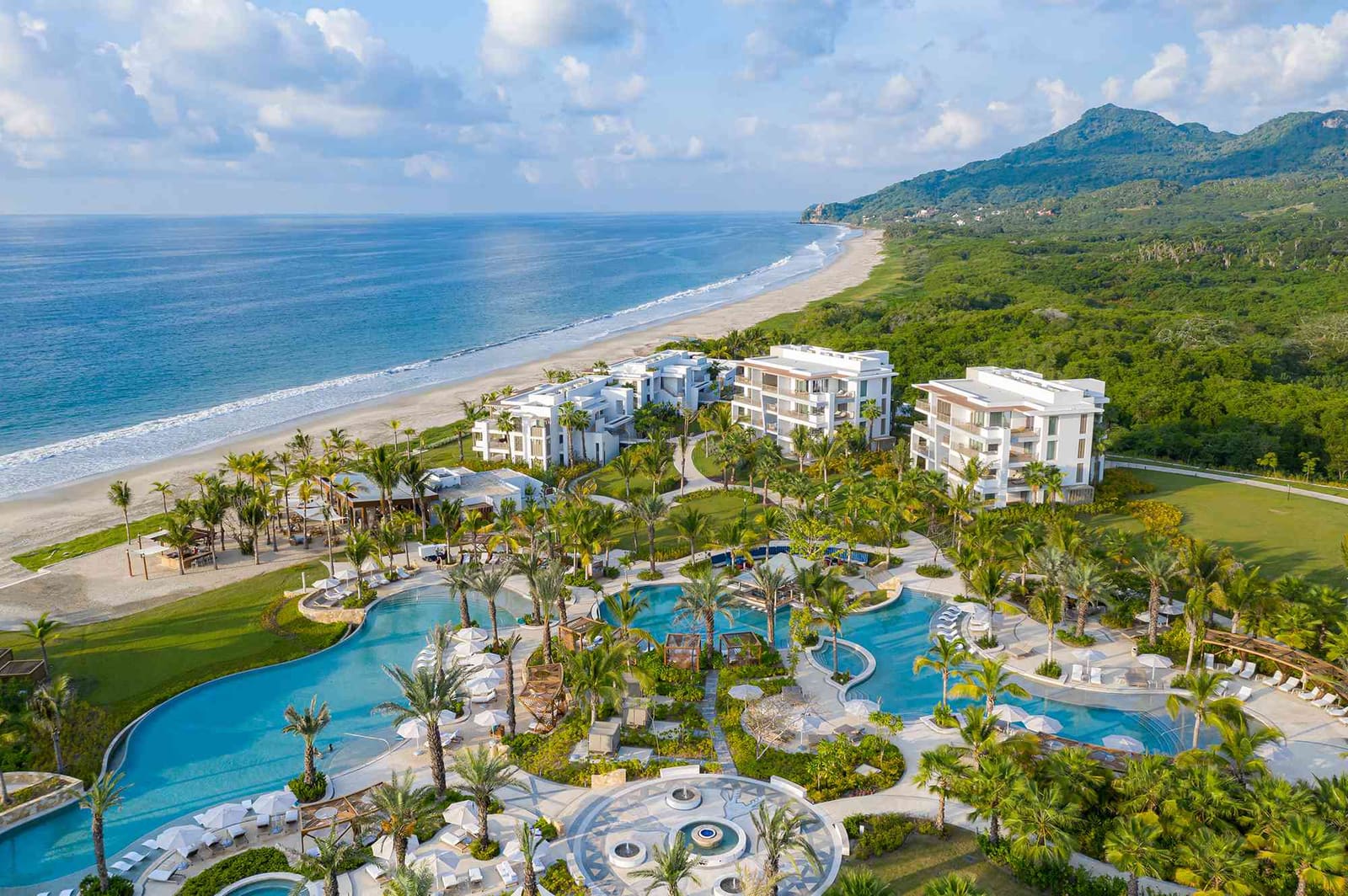
The road from Puerto Vallarta airport curves north, leaving behind the high-rise corridor for a landscape of fishing villages and palapa-roofed taco stands. By the time you reach Punta de Mita, the Pacific has taken on a different character: wider beaches, fewer umbrellas, surf breaks that locals guard with quiet pride. This is Riviera Nayarit, the quieter sibling to its southern neighbor, and it is here that Conrad has planted its newest flag.
The resort sits on a crescent of sand that once served as communal fishing ground for Huichol families, and the design team made a deliberate choice to honor that lineage. Walk through the lobby and you will notice woven panels in geometric patterns borrowed from yarn paintings, low-slung furniture in native hardwoods, and a color palette pulled from the region's clay and indigo dye traditions. It is not appropriation; it is acknowledgment, the kind that requires consultation and collaboration rather than catalog shopping.
Three Pools, Three Philosophies
Water defines the property. The main infinity pool stretches parallel to the beach, its edge designed to vanish into the horizon line at sunset. Families claim the shallow end by mid-morning, while couples drift toward the deeper section where submerged loungers allow you to read without ever leaving the water.
The adults-only pool occupies the northern corner, ringed by daybeds and a swim-up bar that pours mezcal flights alongside cold-pressed juices. Silence is not enforced, but the crowd self-selects for it. The third pool belongs to the spa pavilion, fed by a thermal spring that the Huichol people have used for centuries. Temperatures hover near body heat, and the water carries a faint mineral scent that clings to skin long after you towel off.
Floating breakfasts arrive on lacquered trays, a ritual borrowed from Bali but adapted here with tropical fruit from nearby Compostela and sweet breads baked in-house. The logistics are less romantic than the photographs suggest: a staff member wades in, anchors the tray to your lounger with clips, and reminds you to finish within thirty minutes before the sun softens the butter. But for those thirty minutes, it works.
Suites That Open Outward
The accommodations favor space over ornament. Each suite runs deep rather than wide, with sliding glass walls that retract to erase the boundary between bedroom and terrace. Floors are polished concrete, cool underfoot even in afternoon heat. Bathrooms are carved from a single slab of Oaxacan marble, with rain showers large enough for two and soaking tubs positioned to face the ocean.
Beachfront suites sit close enough to the surf that you can hear the break from bed, a rhythmic crash that either lulls you to sleep or keeps you awake, depending on your tolerance for natural metronomes. Upper-floor suites sacrifice immediate beach access for unobstructed views and marginally more privacy, though privacy is relative when your terrace overlooks the infinity pool.
Minibar contents are curated rather than corporate: small-batch tequila from a distillery in Tequila, chocolate from a women's cooperative in Guadalajara, and bottled water from a spring in the Sierra Madre. It is a small gesture, but it signals intent.
Seven Kitchens, Seven Interpretations
The resort operates seven distinct dining concepts, a number that feels ambitious until you realize each one serves a specific appetite. The flagship restaurant focuses on coastal Mexican cuisine, with a menu that changes according to what the fishing boats bring in. Grilled octopus arrives with burnt orange mole, its char softened by the sauce's sweetness. Whole snapper is filleted tableside, its skin crackling and gold.
A Japanese concept occupies the second floor, offering omakase at a twelve-seat counter where the chef works in near silence. The fish is flown in twice weekly from Tokyo's Toyosu Market, a logistical feat that adds weight to every bite of toro and uni. Purists may balk at eating sushi this far from its source, but the execution is disciplined.
Poolside, a taco bar operates from noon until dusk, serving versions that veer closer to street food than resort approximation. Carnitas are slow-cooked in copper pots, their fat rendered to a sheen. Al pastor is shaved from a vertical spit, its edges caramelized. Tortillas are pressed to order, still warm when they reach your hands.
The remaining four venues include a beachfront grill, a lobby bar that doubles as a coffee roastery, a patisserie with French technique and Mexican flavors, and a mezcaleria that stocks over one hundred labels, many from single-village producers whose bottles never make it to export markets. You could spend a week here and never repeat a meal.
The Spa and Its Debt to Tradition
The spa program draws heavily from Huichol healing practices, a collaboration that involved months of dialogue with local elders. Treatments incorporate native plants: damiana for muscle tension, copal resin burned to clear airways, and blue agave applied as a poultice. The signature ritual lasts ninety minutes and begins with a temazcal-style steam bath, followed by a full-body massage using warmed volcanic stones.
Therapists are trained in both Western and indigenous techniques, and the menu makes space for guests to choose their own path. You can book a straightforward deep-tissue session or opt for a ceremony that includes chanting, herbal smoke, and a closing prayer. The latter is not theater; it is offered with the same seriousness as any other treatment, and guests are briefed beforehand on what participation entails.
What Anchors It
Punta de Mita remains a working fishing village, and the resort exists in conversation with that reality rather than in spite of it. Staff are drawn largely from nearby towns, and the property runs a hospitality training program that has placed graduates in roles across the region. Local artisans are commissioned for everything from lobby sculptures to guest-room textiles, and their names are displayed alongside their work.
This is not altruism; it is pragmatism. A resort that alienates its neighbors invites resentment. One that integrates itself into the local economy builds goodwill, which translates into smoother operations and a guest experience that feels rooted rather than imported.
The beach itself is public, as all beaches are in Mexico, and fishermen still launch their pangas from the sand each morning. Guests sunbathing on resort loungers will occasionally see a net hauled in fifty meters away, a reminder that this coastline serves multiple purposes. It is a juxtaposition that some luxury travelers find jarring and others find grounding.
The Broader Canvas
Riviera Nayarit has spent the past decade positioning itself as an alternative to the saturated resorts of Cancún and Los Cabos, and properties like Conrad Punta de Mita are central to that effort. The region offers longer stretches of undeveloped coast, stronger ties to indigenous culture, and a tourism infrastructure that is still finding its shape. That fluidity can be an advantage: fewer crowds, more negotiation, a sense that you are arriving early to something rather than late.
But it also means inconsistencies. Road conditions deteriorate outside the main corridor. Restaurant quality in nearby towns ranges from exceptional to indifferent. The English-language signage that travelers rely on is less ubiquitous here than in more established destinations. These are not flaws unique to Nayarit; they are the trade-offs of choosing a region that has not yet been fully smoothed by mass tourism.
The Measure of a Stay
A resort like this one succeeds or fails on whether it can justify its own scale. Seven restaurants, three pools, and a spa pavilion are only assets if they feel necessary rather than excessive. Conrad Punta de Mita manages that balance most of the time, offering enough variety to prevent restlessness without tipping into sprawl. The property is large enough to contain multitudes but small enough that you can walk from your suite to the beach in under three minutes.
What lingers after departure is not the floating breakfast or the infinity pool, though both photograph well. It is the quieter details: the way the lobby fills with copal smoke each evening, the fishermen's pangas cutting through the surf at dawn, the bartender who remembers your mezcal preference on the second night. These are the gestures that suggest a property is paying attention, not just to its guests but to the place it inhabits.
Riviera Nayarit is still writing its story, and this resort is one chapter in a longer narrative. Whether that narrative coheres into something distinct or dissolves into the generic luxury of every other beach destination will depend on how many properties follow this lead, anchoring themselves in the culture and landscape rather than simply occupying it.