Where Waterslides Meet House Reefs: The Maldives Rewrites Island Luxury
Beyond the overwater villa, a new generation of resorts is suspending spas above lagoons, sinking restaurants beneath the surface, and making coral conservation as central as the infinity pool.
The Formula, Reimagined
The morning light catches the surface of the lagoon at Huvafen Fushi, and somewhere beneath the ripples, a spa treatment room hovers in silence. Guests descend through a bamboo-swathed tunnel, past the beach villas with their twin pools, down to a submerged sanctuary where sharks and angelfish drift by at eye level. By nightfall, the same space transforms: a private dining alcove, the ocean pressing against the glass, a chef preparing courses while manta rays glide overhead.
This is not the Maldives of a decade ago. The archipelago has always been synonymous with seclusion and sand, but the current wave of properties is pushing the boundaries of what island luxury can mean. It is no longer sufficient to offer an overwater villa and a house reef. Now, resorts dangle treatment rooms above the water, carve dining spaces into coral gardens, and weave conservation work into the daily rhythm of a stay.
The Architecture of Escape
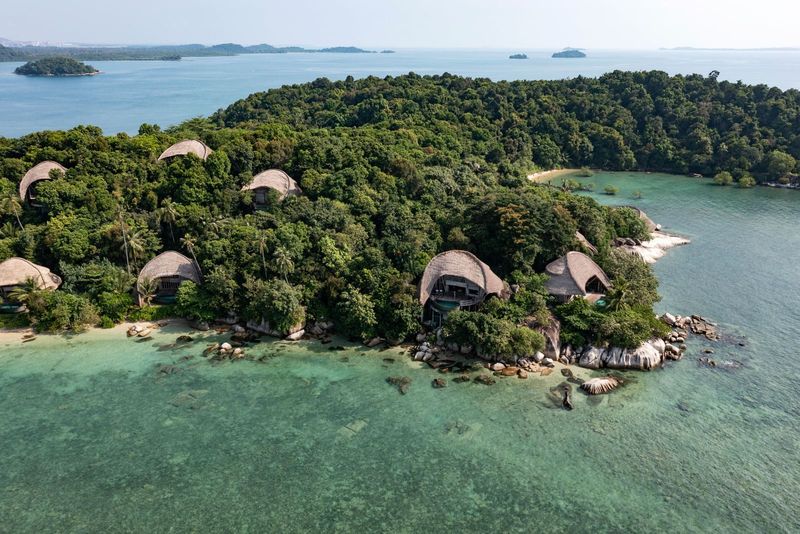
At .Here Baa Atoll, the question of beach versus overwater becomes irrelevant. Each of the seven residences stretches the width of the island, offering sand at one end and a ladder into the Indian Ocean at the other. Sky infinity pools on the first floor cascade down to smaller plunge pools below, while hammocks and swings punctuate the outdoor spaces. The interiors lean into texture: voluminous cushions, cloud lamps, fringed curtains that move with the breeze.
Joali Maldives, situated in the relatively undeveloped Raa Atoll, takes a different approach. Istanbul-based architects Autoban designed 73 villas, each with palm roofs and rose-gold taps shaped like giant pebbles. The Mediterranean influence is unmistakable, from the sky-blue shutters at the sunset-facing Mura Bar to the wicker globe lamps and chic cane sofas. Silk gowns hang in wardrobes, one-off prints created in collaboration with Ardmore, which designs for Hermès. Across the island, unexpected sculptures appear: a manta-ray tree house, an underwater coral garden, art installations that interrupt the jungle canopy.
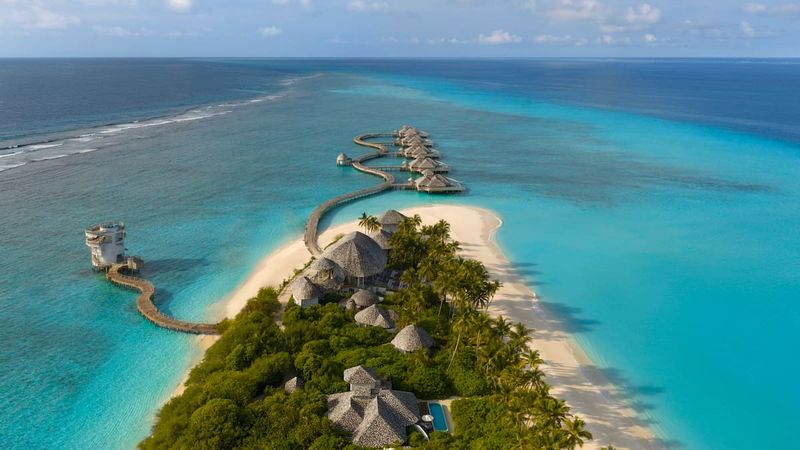
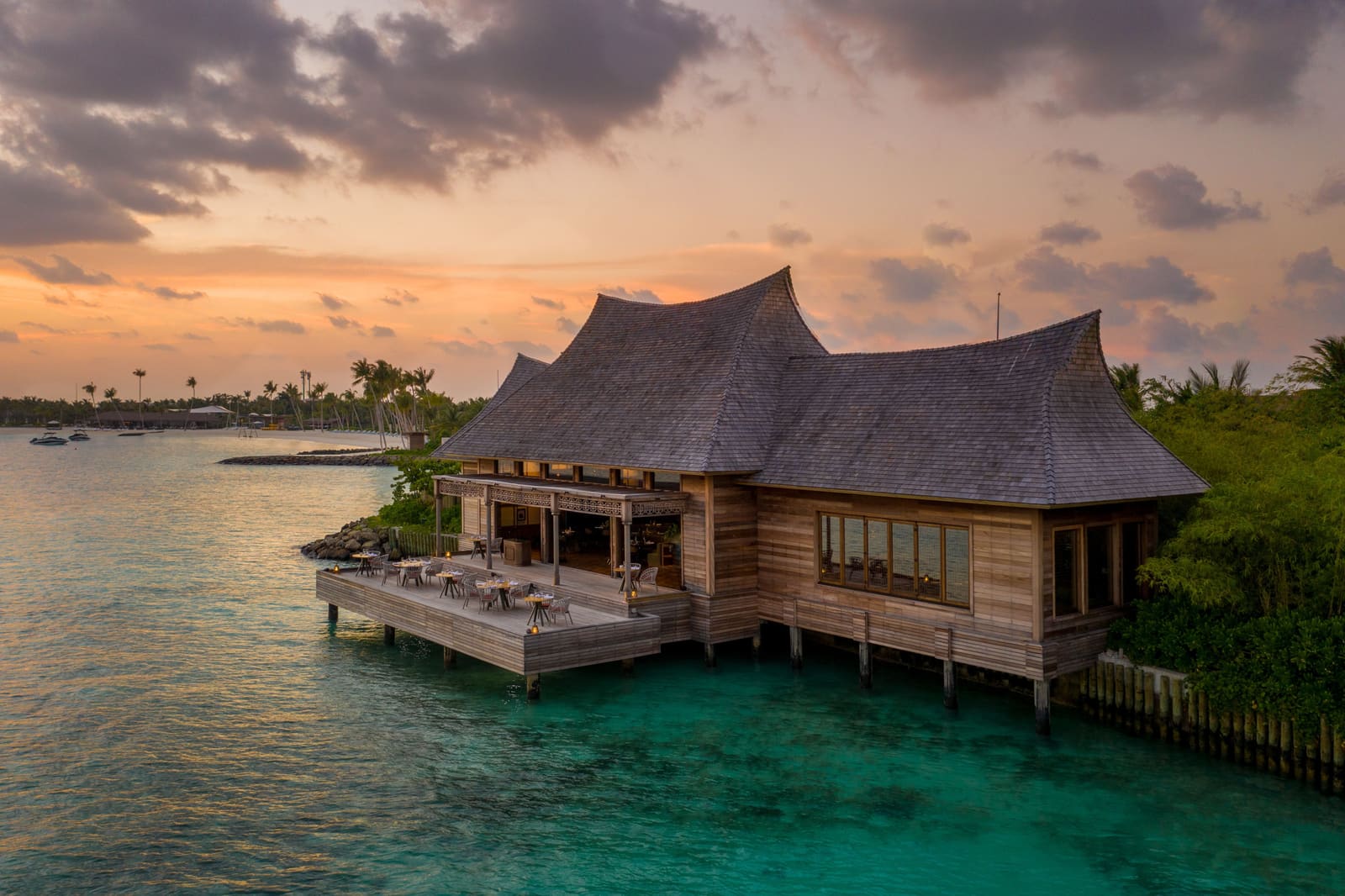
The design ethos at Alila Kothaifaru Maldives is quieter but no less considered. Thick jungle vegetation gives the 27.6-acre property an already-settled-in feel, despite its relative youth. The 80 villas, all with private pools, are split between overwater and beach options, the latter offering sunrise or sunset orientations. Bathrooms in the overwater villas open directly to the sea, a detail that collapses the boundary between shelter and element.
Service as Choreography
At The Nautilus, which opened in 2019, the concept of rigid schedules dissolves entirely. There are no fixed opening hours, no dress codes, only a plethora of choices and a staff trained to anticipate rather than react. The 26 houses, some beachfront and others overwater, come with private pools, separate living quarters, and personal butler service. Champagne in bed, breakfast aboard a yacht, an impromptu swim with manta rays: the resort specializes in bespoke vacations, meaning guests craft their stay to match whatever vision they arrived with.
Huvafen Fushi has built its reputation on a similar philosophy. Returning guest rates are high, a testament to the property's ability to make visitors feel not only welcomed but known. Staff remember preferences for still or sparkling water, the names of children, favorite tables. On one visit, a projector materialized after dinner, ready to play a film beneath the stars. On another, an underwater spa was transformed into a private dining room, a chef guiding guests through a menu while tropical fish swam past.
The Conservation Imperative
Sustainability is no longer a footnote in the Maldives. Most resorts now operate their own conservation projects and coral programs, weaving environmental stewardship into the guest experience. At .Here Baa Atoll, located within a UNESCO Biosphere Reserve, the Water Sports Center offers a Coral Conservation Course, allowing guests to snorkel the reef alongside marine biologists. The emphasis is on education rather than spectacle, an acknowledgment that luxury and ecological responsibility need not exist in separate spheres.
Six Senses Kanuhura, the second Six Senses property in the Maldives, occupies a trifecta of natural coral islands in the Lhaviyani Atoll. The flourishing house reef is a focal point, and complimentary daily activities include not only yoga and meditation but also programs centered on marine conservation. The property's commitment to sustainability extends to its dining: Drift, a small café on sister island Jehunuhura, sources ingredients locally, while The Point, a circular building on the sunset side of the island, houses both a Spanish restaurant and a rooftop infinity pool with minimal environmental impact.
The Social Equation
Not all Maldivian resorts lean into barefoot seclusion. The St. Regis Maldives Vommuli Resort attracts a fashionable crowd, a clientele more likely to wear Chanel heels on the beach than flip-flops. At sunset, honeymooners gather at a bar shaped like a whale shark, sipping martini shots while a DJ plays breezy beats in a midriff-bearing top. The scene feels almost Manhattan-like, an improbable collision of high fashion and turquoise lagoons.
This version of Maldivian luxury is less about disappearing into nature and more about curating a particular aesthetic. The American hotel brand opened on Vommuli in 2016, claiming a prime stretch of tropical paradise and building a property that caters to guests who view a resort stay as an extension of their social identity.
The Atoll Effect
Geography plays a significant role in shaping the character of each property. Joali's location in the Raa Atoll, a region less developed than the more accessible atolls closer to Malé, lends the resort a sense of remoteness without sacrificing sophistication. The mood is laid-back Mediterranean luxe, a departure from the Paradise Found clichés that dominate much of the Maldivian hotel landscape.
Alila Kothaifaru, also in the Raa Atoll, sits about 45 minutes north of Malé International Airport by seaplane. The island's long white beaches and thick palm groves create a sense of arrival, a feeling that one has crossed into a different realm entirely. Two restaurants and two bars serve the 80 villas, while a spa hides deep within the jungle vegetation.
Cheval Blanc Randheli, often cited as one of the most luxurious properties in the Maldives, occupies its own private island, a common configuration in the archipelago. The resort's appeal lies in its ability to balance scale with intimacy, offering world-class amenities without the sense of being part of a crowd.
The Rituals of Arrival
Arrival by seaplane or speedboat sets the tone. At Huvafen Fushi, guests are welcomed by staff armed with cold towels and refreshing drinks, then chaperoned through a bamboo-swathed tunnel to their villa. The choreography is deliberate, designed to mark the transition from the outside world to the island's particular rhythm.
At .Here Baa Atoll, each residence is assigned a Roohu, a butler who conjures experiences ranging from spa treatments to activities at the Water Sports Center. Chef Georgios Vasilopoulos, previously of Raffles Dubai and Nobu Matsuhisa Mykonos, oversees the open-air restaurant, Safar. He also served as personal chef to the royal family of Jordan, though he remains tight-lipped about that chapter. His seafood barbecues, however, speak for themselves.
The New Baseline
The caliber of stays across the Maldives is uniformly high, a reality that makes distinguishing between properties a matter of nuance rather than broad strokes. Boutique stays and lo-fi boltholes are rare; instead, world-class hotels spread across private islands, each nestling state-of-the-art spas and multiple restaurants among lush jungles, pristine beaches, and vibrant house reefs.
Waldorf Astoria Ithaafushi has become a benchmark for overwater bungalows, while Anantara Kihavah Maldives is frequently cited for its appeal to couples. Lux* South Ari Atoll, meanwhile, caters to families, offering a range of activities and amenities designed for guests traveling with children.
Six Senses Kanuhura exemplifies the new baseline. The 91 beachfront and overwater villas, including 12 sprawling retreats, are decked out in warm woods, peach, and teal, with beds hung with billowing nets. Seven bars and restaurants include not only Drift and The Point but also a range of dining experiences that span Spanish cuisine, local seafood, and wellness-focused menus. Complimentary daily activities include core training, yoga, meditation, and sound healing, alongside a spa that ranks among the best in the archipelago.
The Question of Scale
Size matters in the Maldives, though not always in the ways one might expect. Larger resorts can offer a wider range of dining and activity options, but smaller properties often excel at personalized service. The Nautilus, with only 26 houses, can afford to be bespoke in ways that a 100-villa resort cannot. Huvafen Fushi's relatively modest footprint allows staff to remember guest preferences and anticipate needs, a level of attention that becomes logistically challenging at scale.
.Here Baa Atoll, with just seven residences, pushes this logic to its extreme. The property functions less like a traditional resort and more like a private estate, where every detail can be tailored to individual guests. The trade-off is a lack of variety in dining and social spaces, but for travelers seeking absolute seclusion, the equation balances in favor of intimacy.
The Pull of Return
High returning guest rates suggest that the Maldives has mastered something beyond the mechanics of luxury hospitality. The islands offer not just an escape but a particular kind of rhythm, a slowing of time that is difficult to replicate elsewhere. At Huvafen Fushi, guests speak of feeling as though they have the island to themselves, even when other visitors are present. The architecture of the property, with its scattered villas and private beaches, creates pockets of solitude that allow for both connection and withdrawal.
Alila Kothaifaru achieves a similar effect through its professional yet friendly staff, who remember not just names but preferences, creating a sense of familiarity that makes a repeat visit feel like a homecoming. After a few days, the resort begins to feel less like a hotel and more like a temporary residence, a place where routines can take root even in the midst of vacation.
The Underwater Turn
The trend toward underwater spaces represents a logical evolution in a destination defined by its relationship to the ocean. Huvafen Fushi's submerged spa and dining room are among the most dramatic examples, but other properties are following suit. The appeal is visceral: to sit beneath the surface, surrounded by marine life, is to experience the Maldives from an entirely new vantage point.
Joali Maldives has installed an underwater coral garden, a sculptural installation by Misha Kahn that doubles as both art and habitat. The piece is accessible to snorkelers and divers, allowing guests to engage with the reef in a way that is both aesthetic and ecological. The Japanese restaurant Saoke, one of three dining venues on the island, serves 50 different sakes, a detail that underscores the property's commitment to curated experiences.
The Verdict of Light
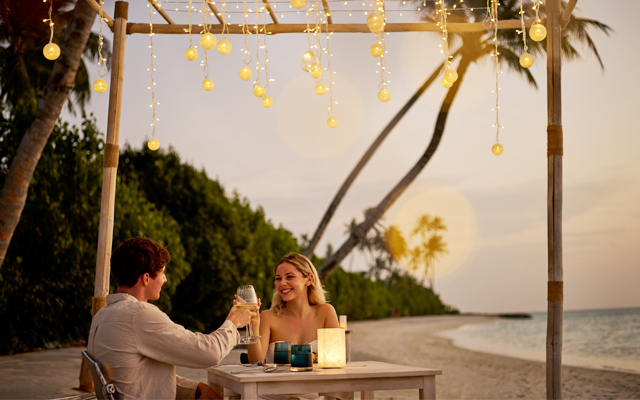
Ultimately, the Maldives reveals itself in the quality of light. The way morning sun breaks across the lagoon at Six Senses Kanuhura, illuminating the turquoise shallows and aquamarine depths. The golden hour at Joali, when the sky-blue shutters of the Mura Bar glow against the horizon. The starlit sky above a private dinner at Huvafen Fushi, where a chef prepares a Sri Lankan tasting menu in the sand.
These moments, more than any amenity or architectural flourish, define the appeal of the archipelago. The Maldives has always been a place where natural beauty is the primary draw, and the new generation of resorts has learned to frame that beauty without overwhelming it. Waterslides and underwater dining rooms are impressive, but they succeed only when they enhance rather than eclipse the elemental experience of being surrounded by ocean, sand, and sky.