Beyond the Postcard: Greece's Most Storied Shores
From shipwrecks frozen in time to pink-sand crescents, the beaches that reveal a deeper Aegean
A Different Kind of Blue
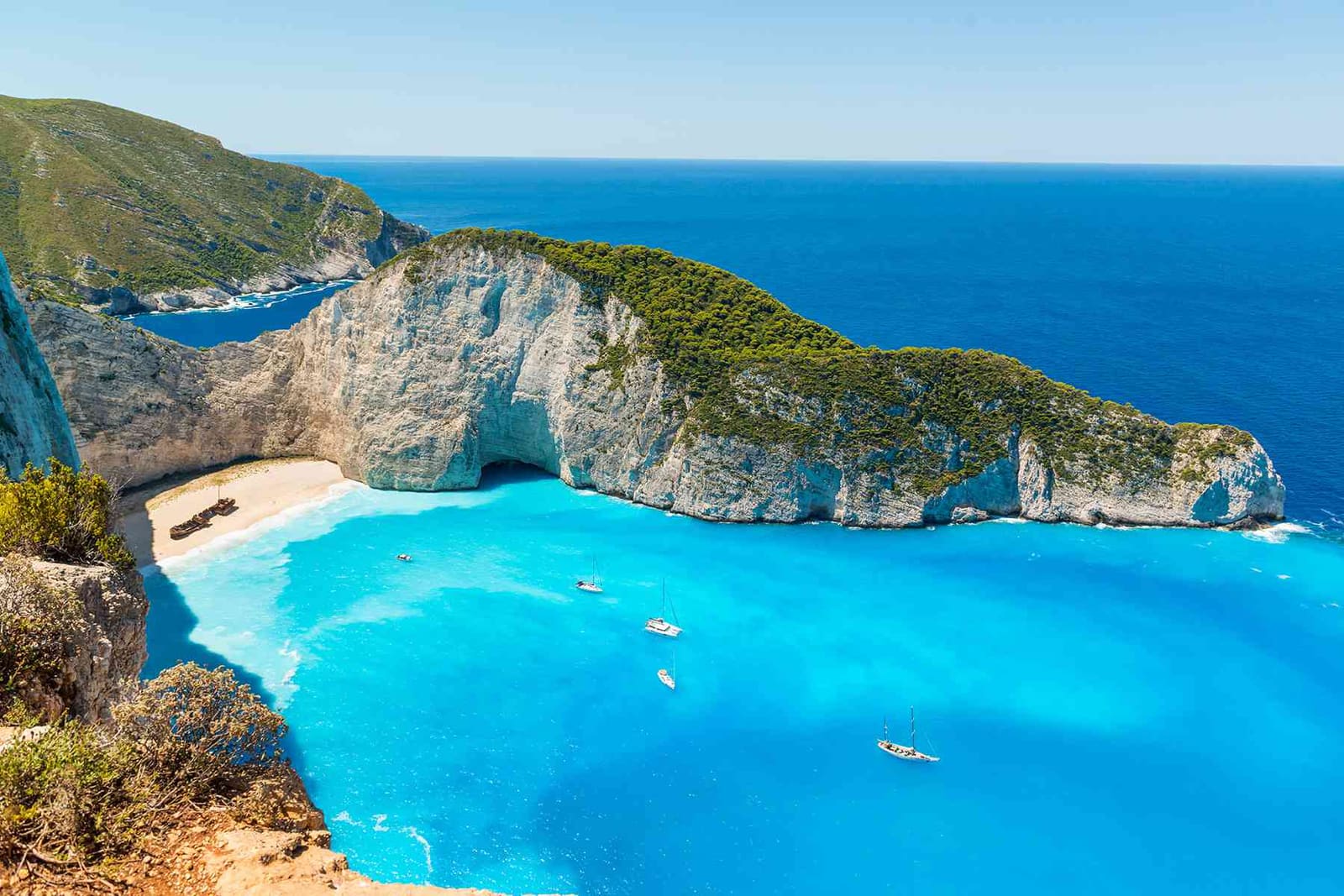
There is a stretch of coast on Zakynthos where the water is so impossibly turquoise it seems Photoshopped into existence, and yet the story that holds your attention is not the colour but the rust-eaten freighter beached in the sand. We have learned, over years of returning to the Greek islands, that the most compelling shores are those that carry more than beauty - they carry narrative, accident, geology, myth. The beaches that linger in memory are rarely the easiest to reach.
At Global Chic Voyage, we have watched the conversation around Greece's coastline shift. A decade ago, the discourse centered on Mykonos and its parade of beach clubs. Today, travellers are seeking out the volcanic crescents of the Cyclades, the wild western flanks of Crete, the Ionian hideaways where pine forests meet limestone cliffs. These are not destinations to tick off in an afternoon. They are places that ask for time, for scrambling down footpaths, for accepting that the taverna might be closed and the only shade is the shadow of a cave.
The Wreck and the Bay
Navagio Beach - Shipwreck Bay - is perhaps the most photographed cove in Greece, and for good reason. The freighter Panagiotis, stranded here since 1980 under circumstances still debated, has become a kind of accidental monument, a frame within a frame. The beach is accessible only by boat, a fact that preserves its drama but also concentrates crowds in high season. What photographs rarely convey is the scale: the cliffs rise nearly two hundred meters, sheer and pale, and the water is so clear that the seabed appears painted in shades of cobalt and aquamarine.
The wreck itself is a study in contrasts - decay against perfection, industry against nature. It is also a reminder that many of Greece's most arresting landscapes are accidents, collaborations between human error and the Aegean's relentless beauty.
Pink Sand and Volcanic Memory
Elafonissi, on Crete's southwestern tip, is famous for its pink sand - a phenomenon caused by crushed shells and coral fragments mixing with the white. The effect is subtle, more blush than bubblegum, and it shifts with the light. At dawn, the sand appears almost lavender; by midday, it is pale rose. The beach is also a nature reserve, protected for its dune systems and the sea daffodils that bloom in late summer.
What we appreciate about Elafonissi is that it resists easy categorization. It is family-friendly - shallow, warm, gently sloping - but also ecologically significant, a breeding ground for loggerhead turtles. The local tavernas serve grilled octopus and dakos, and the road there winds through olive groves and gorges, a journey that feels like a reward in itself.
Elsewhere, on Santorini, the beaches are darker, stranger. Red Beach, near Akrotiri, is hemmed in by rust-coloured volcanic cliffs, the sand a deep oxblood. The landscape is almost Martian, and the lack of facilities - no sunbeds, no umbrellas, just rock and sea - gives it a raw, elemental quality. Perissa and Kamari, on the island's eastern coast, are black-sand expanses, the result of ancient volcanic eruptions. The sand absorbs heat ferociously; by afternoon, it is too hot to walk barefoot, and the contrast between the black shore and the white-washed villages behind is stark, almost cinematic.
The Ionian's Green Edge
The Ionian islands offer a different palette entirely. Here, the landscape is greener, softer, more forested. Myrtos Beach, on Kefalonia, is often cited as one of the most beautiful in Greece, and it lives up to the claim. The beach is a long arc of white pebbles, framed by cliffs thick with cypress and wild herbs. The water is a gradient - pale turquoise near the shore, deepening to sapphire farther out.
What makes Myrtos compelling is not just its aesthetics but its position within the island's geography. The drive down is vertiginous, the beach appearing and disappearing around hairpin bends. The descent feels like a descent into another era, one where beaches were not yet infrastructure but simply places where land met water.
Nearby, Egremni Beach - before the 2015 earthquake that destroyed its access road - was similarly dramatic, reachable only by hundreds of steps carved into the cliffside. Recent efforts have restored limited access, but the beach retains a sense of remove, of being slightly beyond reach.
The Dodecanese and the Weight of History
In the Dodecanese, beaches are often layered with history. Lindos, on Rhodes, is overlooked by an ancient acropolis, the ruins of a fourth-century temple to Athena Lindia. The beach itself is crescent-shaped, sheltered, lined with tavernas and sunbeds, but the presence of the acropolis above transforms it. You swim in the shadow of antiquity.
Tsambika Beach, also on Rhodes, is less crowded, a long stretch of golden sand backed by low hills. The water is calm, almost lagoon-like, and the beach is named after the monastery perched on the mountain behind it. Locals believe that women who climb to the monastery and pray at its icon will conceive; the beach, in turn, has become a place of quiet pilgrimage, a blend of leisure and devotion.
On Karpathos, Apella Beach is smaller, more secluded, reached by a winding road through pine forest. The sand is coarse, the water startlingly clear, and the bay is sheltered enough that it feels private even in August. This is the kind of beach that rewards patience - the drive is long, the facilities minimal, but the sense of discovery is intact.
The Cycladic Quiet
The Cyclades, beyond Mykonos and Santorini, hold some of Greece's quietest shores. Kolympithres, on Paros, is a series of small coves divided by smooth granite boulders, sculpted by wind and water into organic shapes. The effect is almost sculptural, and the beach has a playful quality - children climb the rocks, couples tuck into the shaded alcoves.
On Milos, Sarakiniko is otherworldly. The landscape is lunar - white volcanic rock, carved by the sea into caves and tunnels and smooth plateaus. There is no sand, only rock, and the water is an electric blue. It is a beach for exploration rather than lounging, a place where the geology is the attraction.
Kleftiko, also on Milos, is accessible only by boat. The rock formations here are monumental - white sea stacks rising from the water, pierced by arches and caves. Pirates once used these caves as hideouts, and the name means "the hideaway." Today, it is a snorkeling destination, the water so clear that you can see the seabed at ten meters.
Why These Shores Endure
What unites these beaches, beyond their beauty, is a quality of resistance. They resist homogenization, resist the impulse to make coastal landscapes uniform and predictable. Some are difficult to reach, others are protected by regulations or geography. Many lack the infrastructure that defines a "resort beach" - no rows of sunbeds, no beach clubs, no jet skis.
This is not to romanticize inaccessibility, but to acknowledge that the beaches we remember are often those that demand something of us: a hike, a boat ride, an acceptance of pebbles instead of sand, heat instead of shade. They are places where the landscape still dictates the terms, where the Aegean's geology and history are not backdrop but subject.
The Practicalities of Return
Visiting these beaches requires planning. Many are seasonal, accessible only between May and October. Some, like Navagio, are best visited early in the morning or late in the afternoon to avoid crowds. Others, like Elafonissi, are protected areas with restrictions on camping and fires.
Transport varies. Rental cars offer the most flexibility, especially on larger islands like Crete and Rhodes. Boat tours are essential for Kleftiko and Navagio, and local operators on each island offer half-day and full-day excursions. Ferries between islands are frequent in summer but less reliable in shoulder seasons.
Accommodation ranges from luxury resorts to family-run guesthouses. On smaller islands like Milos and Karpathos, booking ahead is essential, as inventory is limited. On Crete and Rhodes, options are more plentiful, but proximity to the beaches you want to visit should guide your choice.
What We Carry Back
The beaches we return to in Greece are never just about the blue, though the blue is extraordinary. They are about the wreck that anchors a bay, the volcanic sand that stains your feet pink or black, the monastery on the hill, the pirate cave, the acropolis casting its shadow across the water. They are about the drive down the mountain, the boat rocking in the swell, the taverna where the octopus is grilled over charcoal and the wine is resinated and cold.
These are shores that hold their stories close, that do not yield everything at first glance. They are places where the Aegean's long history - volcanic, mythic, maritime - is still legible in the landscape, still present in the colour of the sand and the shape of the rock. And they are places, we have found, that reward the kind of travel that is less about collection than about attention, less about the postcard than about the moment when the light shifts and the water changes colour and you realize you are standing somewhere that has been shaped by forces far older and more patient than tourism.