Beyond the Auctions: A Deeper Look at Tsukiji's Hidden Culinary World
The neighborhood's legendary eel bowls, concealed omakase counters, and tuna craftsmen reveal a Tokyo food culture that persists long after the market's famous relocation.
The Neighborhood That Refused to Fade
There is a particular quality to the light in Tsukiji at half past six in the morning, when the alleyways still smell of brine and ice melt, and the men in rubber boots move with the economy of gesture that comes from decades of the same precise work. The wholesale market may have relocated to Toyosu years ago - taking with it the predawn tuna auctions that once drew crowds of jet-lagged tourists - but the neighborhood itself has proven far more resilient than anyone predicted. What remains is something quieter, more intricate, and in many ways more revealing of Tokyo's relationship with its food.
At Global Chic Voyage, we've watched Tsukiji transform not into a ghost district, as some feared, but into a concentrated expression of craft and continuity. The stalls that stayed are the ones whose reputations were built not on the spectacle of wholesale bidding but on the patient accumulation of skill: third-generation knife sharpeners, eel specialists whose recipes predate the war, omakase counters tucked into spaces barely wider than a corridor. This is the Tsukiji that locals have always known, stripped now of its tourist veneer and all the more compelling for it.
The Architecture of Appetite
To understand Tsukiji is to understand a particular strain of Tokyo urbanism - the kind that prioritizes function over form, yet achieves a kind of accidental poetry in the process. The outer market area, the Jogai Shijo, is a warren of narrow lanes where wooden storefronts lean slightly into one another, their signage faded by decades of salt air. There are no grand vistas here, no Instagram-ready backdrops. The appeal is cumulative, sensory, best absorbed at walking pace with attention to detail.
The shops themselves operate on a logic of specialization that can seem almost absurd to outsiders: one stall sells only dried bonito, another only kombu from Hokkaido's northern coasts. A third deals exclusively in tamago-yaki, the sweet layered omelet that requires a particular grade of copper pan and a wrist technique passed from master to apprentice. This is not quaintness for its own sake but the residue of an older economic model, one in which depth of knowledge in a single domain was considered more valuable than breadth.
We've found that the best way to approach Tsukiji is not with a checklist of must-visit spots but with a willingness to follow appetite and curiosity in equal measure. The neighborhood rewards aimlessness, or what the Japanese might call burabura - the act of wandering without fixed purpose.
Where Craft Becomes Ritual
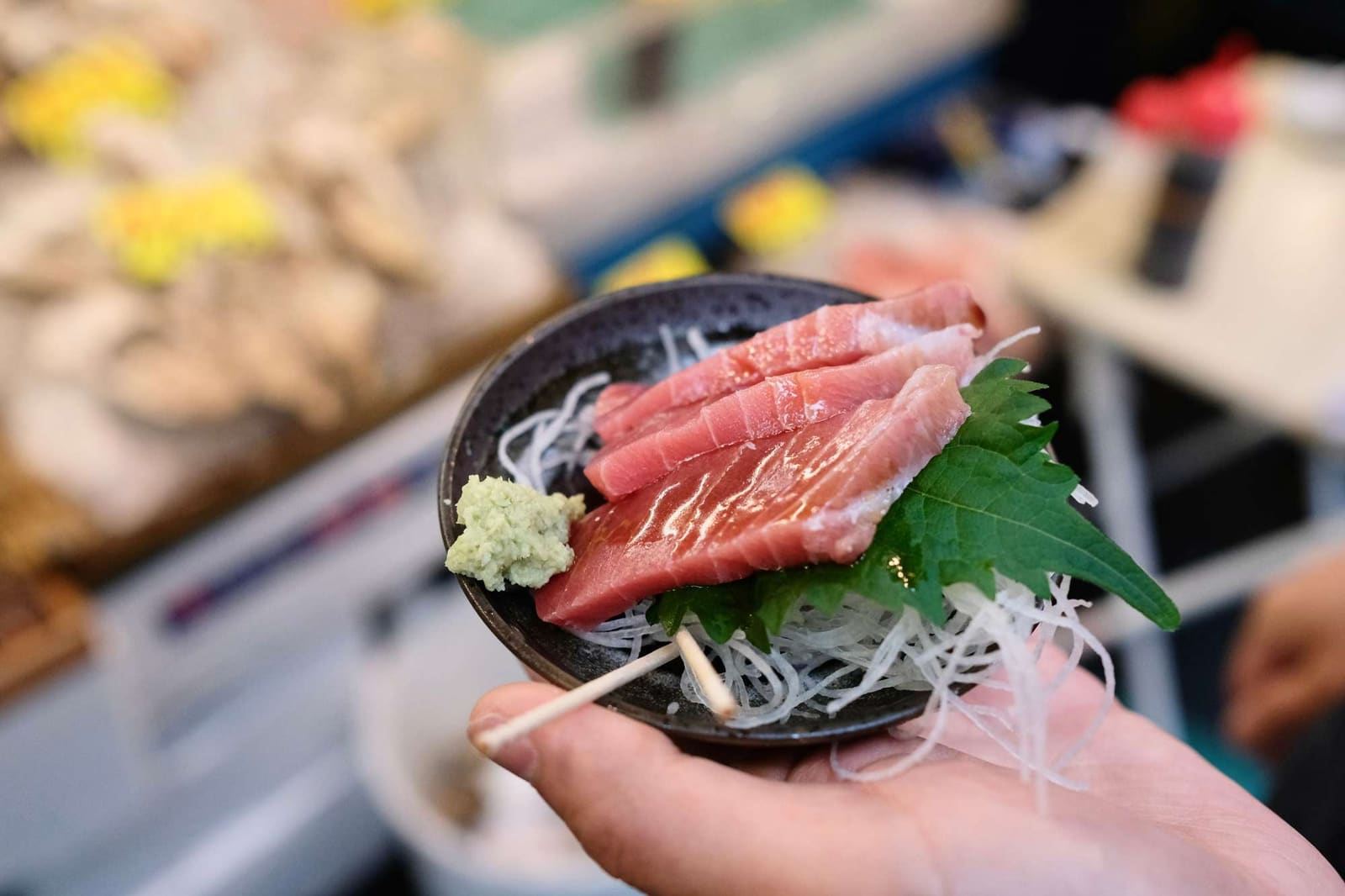
The tuna cutters of Tsukiji occupy a particular place in the city's culinary hierarchy. These are not chefs in the conventional sense but specialists whose entire practice revolves around the breakdown of a single species. A bluefin tuna can weigh upward of two hundred kilograms; to portion it correctly requires an understanding of muscle structure, fat distribution, and the subtle gradations of quality that exist even within a single fish.
The knives they use - some as long as a man's arm - are forged in workshops that have been producing blades since the Edo period. The steel is a high-carbon alloy that holds an edge of extraordinary sharpness but requires daily maintenance. We've watched these cutters work in the early morning hours, their movements fluid and unhurried, each stroke of the blade deliberate. There is no wasted motion, no flourish. The work is a study in efficiency elevated to the level of art.
What strikes us most is the lack of theatricality. In an age when so much of food culture has been absorbed into the logic of performance and social media, Tsukiji's craftsmen remain stubbornly indifferent to spectacle. They work because the work itself demands precision, and because there are customers - mostly other professionals in the trade - who can discern the difference between a cut made with care and one made in haste.
The Eel Houses and Their Secrets
Tsukiji is home to several unagi restaurants whose reputations extend well beyond the neighborhood. Eel, in the Japanese culinary tradition, is not simply grilled fish but a dish that requires a multi-stage preparation involving steaming, glazing, and a final char over binchotan charcoal. The result is a texture that is at once tender and slightly crisp, the flesh infused with a sweet-savory tare sauce that has been refined over generations.
The best of these establishments occupy small storefronts that could easily be mistaken for private residences. There are no English menus, no accommodations for dietary restrictions. You sit at a counter worn smooth by decades of use, and you eat what the chef prepares. The rice arrives in a lacquered box, each grain glossy with the rendered fat of the eel. The dish is deceptively simple - rice, eel, sauce, perhaps a scattering of sansho pepper - but the balance of flavors is the product of years of calibration.
We've returned to these eel houses repeatedly, not because the dish changes but because it doesn't. In a city that reinvents itself with alarming speed, there is something deeply satisfying about a bowl of unagi-don that tastes exactly as it did thirty years ago. It is continuity made edible, tradition without nostalgia.
Omakase in the Margins
Tucked into the side streets that radiate from the main market area are a handful of sushi counters that operate on the omakase model - chef's choice, no menu, no substitutions. These are not the high-profile establishments that appear in international dining guides but smaller, more idiosyncratic operations run by chefs who left prestigious kitchens to open their own places.
The format is intimate by necessity: most of these counters seat no more than eight or ten guests. You sit facing the chef, who works from a refrigerated case stocked with the day's purchases from the market. The progression of the meal follows a rhythm that is both structured and improvisational, each piece of nigiri a response to the quality of the ingredients at hand.
What we appreciate most about these hidden omakase experiences is their lack of pretension. The chefs are happy to explain their choices - why this particular cut of tuna, why the rice is seasoned with red vinegar rather than white - but there is none of the performative solemnity that can sometimes afflict high-end sushi. The atmosphere is convivial, focused, the kind of place where regulars are greeted by name and newcomers are welcomed with genuine warmth.
The Persistence of Place
Tsukiji's survival as a culinary destination speaks to something larger than nostalgia or tourist appeal. It is evidence of a food culture rooted not in novelty but in the patient refinement of technique, in the belief that mastery of a craft is a lifetime's work and not a stepping stone to something else.
The neighborhood's future is not without uncertainty. Rents have risen, foot traffic has shifted, and the generation of artisans now in their seventies and eighties may not find successors willing to take on work that is physically demanding and financially precarious. Yet for now, Tsukiji endures - a pocket of Tokyo where the logic of the market is still, in some essential way, the logic of quality and skill rather than scale and speed.
We find ourselves returning not for any single dish or experience but for the accretion of small moments: the sound of a knife being stropped on a whetstone, the smell of charcoal smoke in a narrow alley, the sight of an elderly woman arranging dried fish with the care of someone arranging flowers. These are the textures of a city that has not entirely surrendered to the demands of the new, and they are worth seeking out before they, too, become memory.