Where Asia's luxury money went when mainland China slowed
As mainland China's luxury spending slows, Asian demand has shifted to Japan, South Korea and Hong Kong, with travellers spending more on hotel stays and experiences than on shopping alone.
Luxury spending worldwide will reach about €1.5 trillion in 2026, between flat and 2 per cent higher than last year at constant exchange rates, Bain & Company said on 18 November in its annual Luxury Worldwide Market Study. Inside that steady total, Asia is splitting. Bain expects sales of personal luxury goods in mainland China to fall 1 to 3 per cent this year, while Japan and the rest of Asia outside China grow 5 to 7 per cent. Across every luxury category combined, from handbags to hotel stays, it forecasts Asia-Pacific spending to slip 2 to 4 per cent, with hospitality the one part of China's market holding up.
The split is worth reading closely. The numbers from Tokyo, Seoul and Hong Kong suggest that Asian luxury demand has moved across borders and into hotel rooms, rather than disappeared. Japan is the clearest test, because its luxury counters are growing in a year when it lost about half of its Chinese visitors.
Japan kept growing after the Chinese shopper left
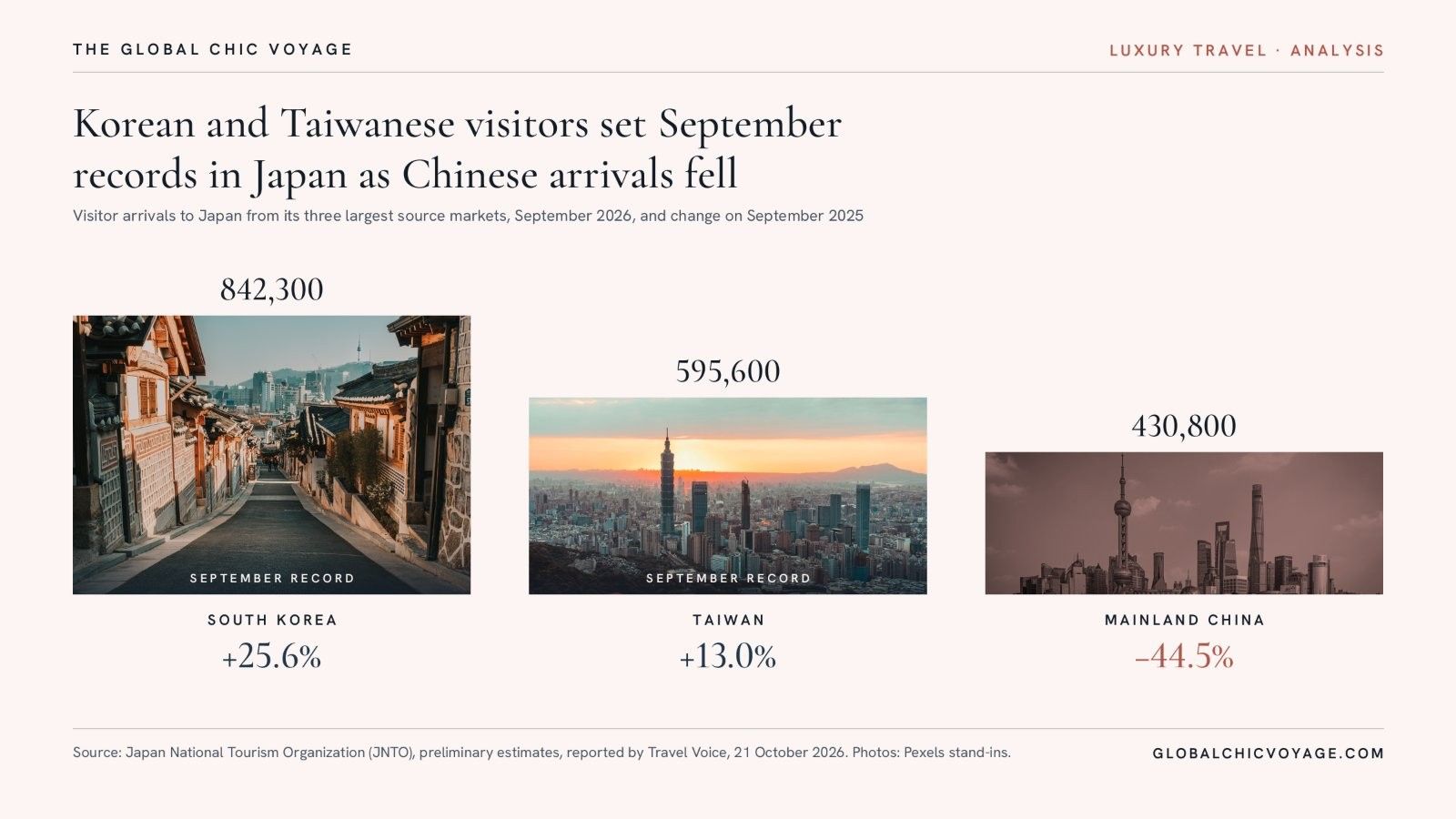
Arrivals from mainland China to Japan fell 44.5 per cent in September to 430,800, according to the Japan National Tourism Organization (JNTO). The decline followed Beijing's advice to its citizens against travel to Japan and a cut in flights, and has run at roughly half of last year's level for most of 2026. Other markets filled the gap. South Korea sent 842,300 visitors in September, up 25.6 per cent, and Taiwan 595,600, up 13 per cent. In October Japan received 3.91 million foreign visitors, its highest monthly total on record.
The shopping data moved the same way. Tax-free sales at Japanese department stores reached about ¥49.6 billion in September, up 25.3 per cent and a record for the month, according to the Japan Department Stores Association. The number of tax-free shoppers rose 5.9 per cent, while average spending per shopper climbed 18.3 per cent to about ¥101,000. Chinese shoppers fell by about 15 per cent, yet their total tax-free spending rose about 7 per cent, because those who still came spent more.
Part of that growth is recovery. Tax-free department store sales fell 12.7 per cent in 2025 to ¥566.7 billion as Chinese demand cooled, so 2026 is being compared with a weak year. The local customer has carried the rest. Hermès reported sales in Japan up 9.6 per cent at constant exchange rates in the third quarter and 11 per cent over nine months, a gain it attributed to "the loyalty of its local customer base." LVMH said in October that the United States, Europe and Japan "saw good growth" in the quarter while China was "less buoyant." Bain's study points to the same mix: rising local spending, strong department stores and jewellery, and visitors hunting for vintage pieces in Japan's pre-owned shops.
Seoul and Hong Kong picked up the Chinese traveller
Chinese travellers did not stop travelling. Mainland residents made 88.02 million outbound trips in the first half of 2026, up 10.5 per cent, according to the National Immigration Administration. They went elsewhere.
South Korea is the most visible beneficiary. The Korea Tourism Organization (KTO) counted about 563,000 Chinese visitors in May, up from 484,390 a year earlier, and their card spending rose 214 per cent year-on-year. Total card spending by foreign visitors reached a record 2.12 trillion won that month. The KTO said Chinese tourists dominated ultra-luxury shopping, lifting sales of watches, jewellery and luxury accessories. A weaker won helped: it traded at about 226 won to the yuan in June against about 209 in January, according to the Korea Culture and Tourism Institute. Hermès said growth in Asia outside Japan, 2 per cent over nine months, was "supported in particular by a solid performance in Korea," while Greater China was flat.
Hong Kong tells a similar story with gold in it. Retail sales rose 9.7 per cent to about HK$203 billion in the first half, Deloitte said, as visitor arrivals grew 13 per cent to 26.7 million, more than 20 million of them from the mainland. Deloitte linked the rise to a stronger renminbi, which made Hong Kong prices more attractive to mainland shoppers, and to demand for gold jewellery. Sales of jewellery, watches and valuable gifts rose 20.1 per cent in June. Bain lists both South Korea and Hong Kong among the Asian markets "performing well."
The hotel suite is the other destination
The second move is out of the shop altogether. Bain values luxury experiences, from hotels and fine dining to cruises and private jets, at €533 billion this year, growing 2 to 4 per cent. It says luxury hospitality is gaining ground "particularly in Asia," and that experience brands earn Net Promoter Scores 5 to 10 percentage points higher than luxury goods brands. In Southeast Asia and Japan, it notes, experiences are expanding while product spending stays polarised.
Japan's hotels show what that demand looks like in a room rate. Revenue per available room rose 13.1 per cent in Japan in the 2025 financial year, according to HotStats, and average daily rates above US$275 this year now run close to Singapore's, historically one of the region's most expensive markets. Savills ranked Tokyo's luxury hotel rates among the highest in the world in 2025, alongside London, New York and Singapore, and noted that luxury supply remains limited.
Bain has so far published only its press release and a summary chart. It gives no separate figures for Korea, Hong Kong or Southeast Asia, which is why this piece relies on national statistics and company results to trace where the money went.
China has not left the luxury market
The awkward part of the story is that China is still spending on luxury, at home and on experiences. Bain's own wording is that Asia-Pacific fell because of "China's slowdown outside of hospitality." In the second quarter, luxury hotels in Beijing, Shanghai and Hong Kong "captured robust ADR growth and pricing power," supported by returning high-spending travellers, according to JLL, and new openings in the region clustered in the upscale and luxury segments in Beijing, Shanghai and Kuala Lumpur.
Some of the mainland's apparent weakness is also spending that has moved to Chinese brands. Bain says Chinese consumers' intention to buy local luxury brands is six times higher than in 2019, and that beauty and jewellery are holding up in China while watches and fashion weaken. That shift does not appear in the results of European houses, which is where most of the China gloom is measured.
The shopping budgets have changed too. In Korea, the number of foreign shoppers at duty-free stores rose 39 per cent in August, while spending per visitor fell, the Korea Herald reported. In Hong Kong, The Economist reported in January on a rise in budget-conscious mainland visitors who favour sightseeing over shopping. More Chinese travellers are crossing borders than before. Fewer of them carry the shopping budgets that built Asia's duty-free economy a decade ago.
Why that may not matter much
- Japan's growth no longer depends on China. Korean and Taiwanese visitors set records, and Hermès credits local clients for its Japanese growth. A market that grew while losing half its largest source of visitors has a broader base than it did two years ago.
- The high spenders are still travelling. Average tax-free spending in Japan rose 18.3 per cent in September, Chinese tax-free sales there rose despite fewer shoppers, and the KTO describes Chinese visitors in Seoul buying at the top of the market.
- Luxury has always relied on a small group. Bain estimates that top customers will spend about €780 billion this year, more than half of all luxury spending. For a boutique in Ginza or a suite in Kyoto, the spending of the visitors who arrive matters more than their headcount.
The real test is whether this holds once the currency advantage narrows. Weak yen and won have made Tokyo and Seoul cheaper for regional shoppers, and that support can reverse quickly. Nobody yet publishes luxury spending by nationality on a common basis across Japan, Korea and Hong Kong, so the shift described here is assembled from separate datasets. It is consistent across them, but it cannot yet be measured as one figure.
What to watch
The evidence suggests Asia's luxury map in 2027 will have more destinations and a larger share of spending going to hotels and dining. Three things will show whether that holds.
Japan's tax-free rules. From 1 November 2026, visitors pay consumption tax at the till and claim it back on departure, according to the Japan Tourism Agency. The department store association's November figures, due in late December, will be the first read on whether the change dents spending.
Spending per visitor in Korea. The KTO's monthly card data will show whether Chinese visitor growth keeps translating into luxury purchases or settles into cheaper trips.
A mainland recovery. Bain expects personal luxury goods to grow 0 to 4 per cent in 2027 and says a recovery in China could lift that to 4 to 6 per cent. If it comes, the question for Tokyo and Seoul is how much of this year's spending returns home.
- EXCLUSIVETokyo Is the World's Most-Searched City and Japan's Arrivals Are Still Falling
- EXCLUSIVEWarmth Is Only Part of the Story: Maria Manlulu-Garcia on the Next Chapter of Philippine Hospitality
- TRENDS & INSPIRATIONSingapore Bets S$740 Million on Becoming Asia's Next Great Travel Destination
- TRENDS & INSPIRATIONWhen Television Becomes Geography: The White Lotus and the Changing Map of Desire