The Designer Who Keeps Everything in Its Place
Anya Hindmarch has built a career on giving order to chaos. Now her obsession with transit has landed in a permanent London home.
The Architecture of Movement
There is a particular kind of traveller who watches the flight map for hours, mesmerized by the slow crawl of an icon across an ocean. Anya Hindmarch is that traveller. She touches the fuselage for luck before boarding, bows three times to a new moon no matter the continent, and returns from every trip with textiles that will become her summer uniform. For the accessories designer behind one of London's most enduring fashion businesses, travel has never been about escape. It is a method of learning, a way of absorbing architecture and history and food through direct encounter rather than secondhand description.
That instinct toward firsthand experience runs parallel to another quality that has defined her work since she founded her company in 1987: the need to give everything its proper place. The two impulses met at an airport security line, where Hindmarch found herself repeatedly emptying pockets of loose currency, boarding passes, and the small debris that accumulates in transit. The solution became the Loose Pocket, a dedicated pouch that turned chaos into system. The same philosophy would later animate her Labelled collection and a catalogue of purpose-built accessories, transforming the interior of a handbag into something closer to a filing cabinet.
Now that travel fixation has its own physical address. Anya Travel, a permanent collection and standalone store at The Village on Pont Street in London, gathers what Hindmarch describes as decades of organizational ideas into one space. The shop follows a pop-up concept introduced the previous year, but this iteration is built to stay.
A Waiting Room of Her Own
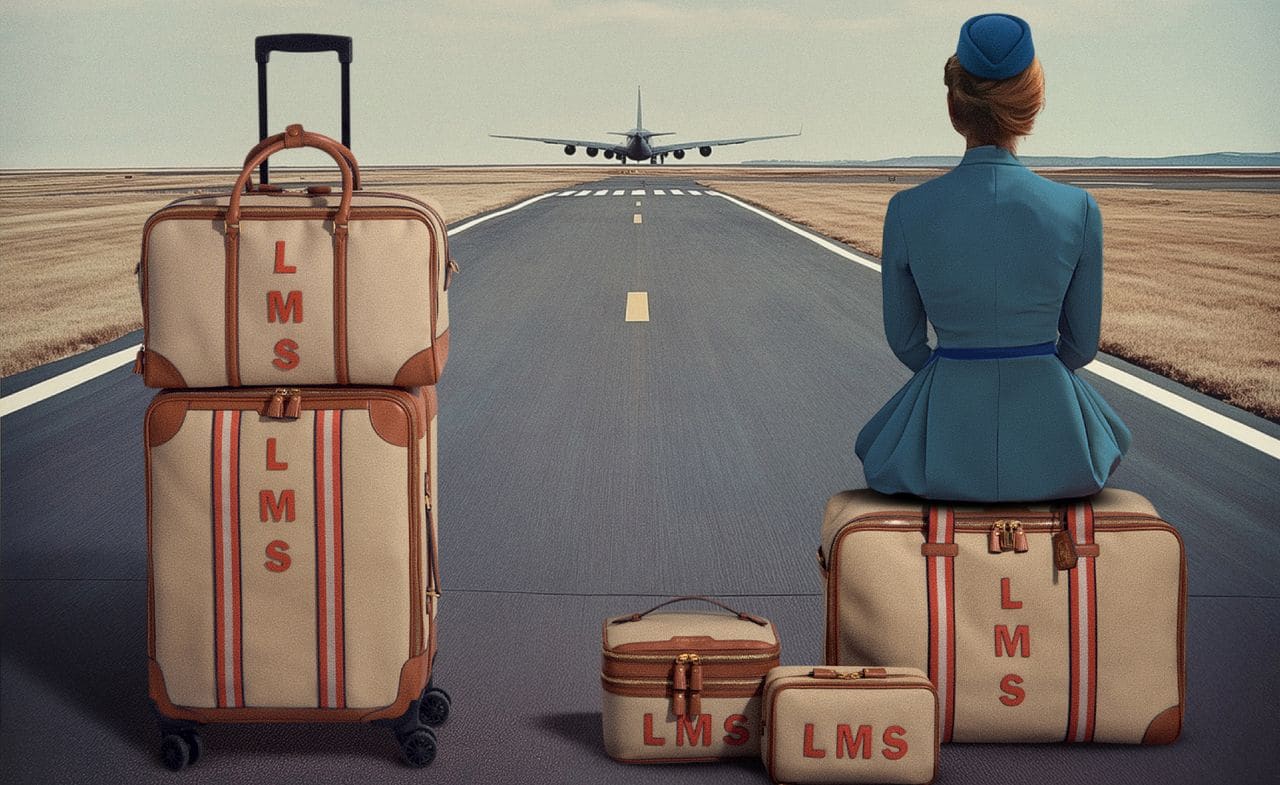
The store borrows its visual vocabulary from the places Hindmarch spends much of her life: stations, terminals, the liminal zones between departure and arrival. Thick carpet evokes waiting lounges. Moulded plastic seating and rounded windows recall the design language of mid-century travel. A travel clock anchors the space. Among the recycled-nylon suitcases and weekend bags sit passport covers, eye masks, luggage tags, and pouches for every category of in-flight necessity. A Concorde candle and tins of travel sweets add the humor that has become Hindmarch's signature.
"I spend much of my life between places," Hindmarch has noted. "It can be exhausting, but there's something about being in transit. It's the only time I allow myself to waste time and simply follow my heart."
The collection reflects a philosophy that treats travel not as disruption but as opportunity. The time spent suspended between locations becomes rare permission to let attention wander, to follow impulse rather than itinerary.
Memory as Material
Hindmarch's earliest travel memory is Marrakech at age five: strangers stroking her blond hair, oranges sold from baskets with leaves still attached, the ornate costumes of water sellers. Decades later, that same city continues to resonate. She has described Morocco as the place that feels most like her, drawn to the call to prayer, the birdsong, the contrast of cold landscapes under hot sun.
But her travels have ranged far beyond North Africa. Myanmar gave her longyis, the versatile wraps she now wears as skirts with a tucked-in shirt. A beach in the Philippines holds sand from the place her husband proposed. Petra yielded kohl applied by a local girl who insisted the whole family would photograph better with darkened eyes. She was right. Tangier provided orange blossom oil, which Hindmarch recommends buying in bulk.
These objects become more than souvenirs. They are evidence, proof of presence, small pieces of elsewhere incorporated into daily life. Her summer wardrobe has evolved into a collection of garments gathered on the road, each carrying its own story. It is an approach to travel that values accumulation not of photographs alone but of things that can be worn, used, integrated.
The Discipline of Elsewhere
Japan, Hindmarch says, is the place that has most consistently taught her something lasting. Its approach to manners, quality, and discipline offers a framework that travels back with her. The Galápagos Islands introduced her to a guide she counts among the most interesting people she has met in transit. Myanmar gave her not just textiles but a morning spent watching hot air balloons drift over temples.
She remembers places by how they looked and how they felt, but also by how they smelled. That sensory dimension is why, she insists, nothing replaces actually being there. Photographs help, and she takes thousands, savoring them after returning home. But the image is documentation, not replacement.
Her travel habits reveal a mind that thrives on ritual. The touch of the plane's exterior before boarding. The three bows to a new moon, wherever she happens to be standing. The diary she writes in every day, the one item she would never leave behind. She packs too many shoes, a recurring mistake she acknowledges but does not correct. She prefers window seats and day flights. Her playlist reliably includes Paolo Conte. Her ideal long-haul companion is either her husband or Kate, whom she calls her work wife.
Between Destination and Journey
The question of whether travel is about the journey or the destination is, for Hindmarch, a false choice. Both matter. She could watch a flight map for fourteen hours, fascinated by incremental progress, but she is equally drawn to the destination itself: the architecture, the history, the food, the culture. She plans beforehand, then adjusts on arrival. She folds rather than rolls. Her go-to travel snack is wine gums and electrolytes.
There is something methodical in her approach, a designer's instinct applied to movement itself. The same impulse that led her to create the Loose Pocket, that turned handbag interiors into organized systems, extends to how she moves through the world. Everything has its place, including the rituals that mark departure, the objects collected along the way, and the memories filed by sight, feeling, and scent.
Anya Travel is the physical expression of that philosophy. It is a store, yes, but also a kind of manifesto: that travel deserves the same attention to detail, the same thoughtful organization, the same blend of practicality and delight that Hindmarch has brought to accessories for nearly four decades. The shop is where function meets affection, where the mundane act of packing becomes an opportunity for small pleasures.
The Place She Has Not Slept
Despite all the destinations she has visited, there is one place Hindmarch names as an ambition: she wants to sleep in Pompeii. It is a curious choice, not a resort or a capital but an archaeological site, a city frozen in time. Perhaps it appeals to the same instinct that makes her watch flight maps for hours, the desire to understand not just a place but its history, its layers, the way it once moved before it stopped moving.
For now, she continues to move. Between London and wherever the next trip takes her. Between the practical need for organized luggage and the irrational comfort of touching a plane's exterior. Between the person she is when she packs and the person she becomes when she arrives. Travel, for Hindmarch, is not about leaving or arriving. It is about the space in between, where time loosens and attention can follow its own path. The designer who has spent decades creating pockets and pouches for every small thing has discovered that the most valuable space is the one where nothing is required but to be in motion, suspended between here and there, watching the map inch forward.