Above the Fairy Chimneys: A Morning in Cappadocia's Balloons
The ancient valleys of central Anatolia reveal themselves slowly from the air, stone and silence and the hiss of flame overhead.
The Landscape That Waits
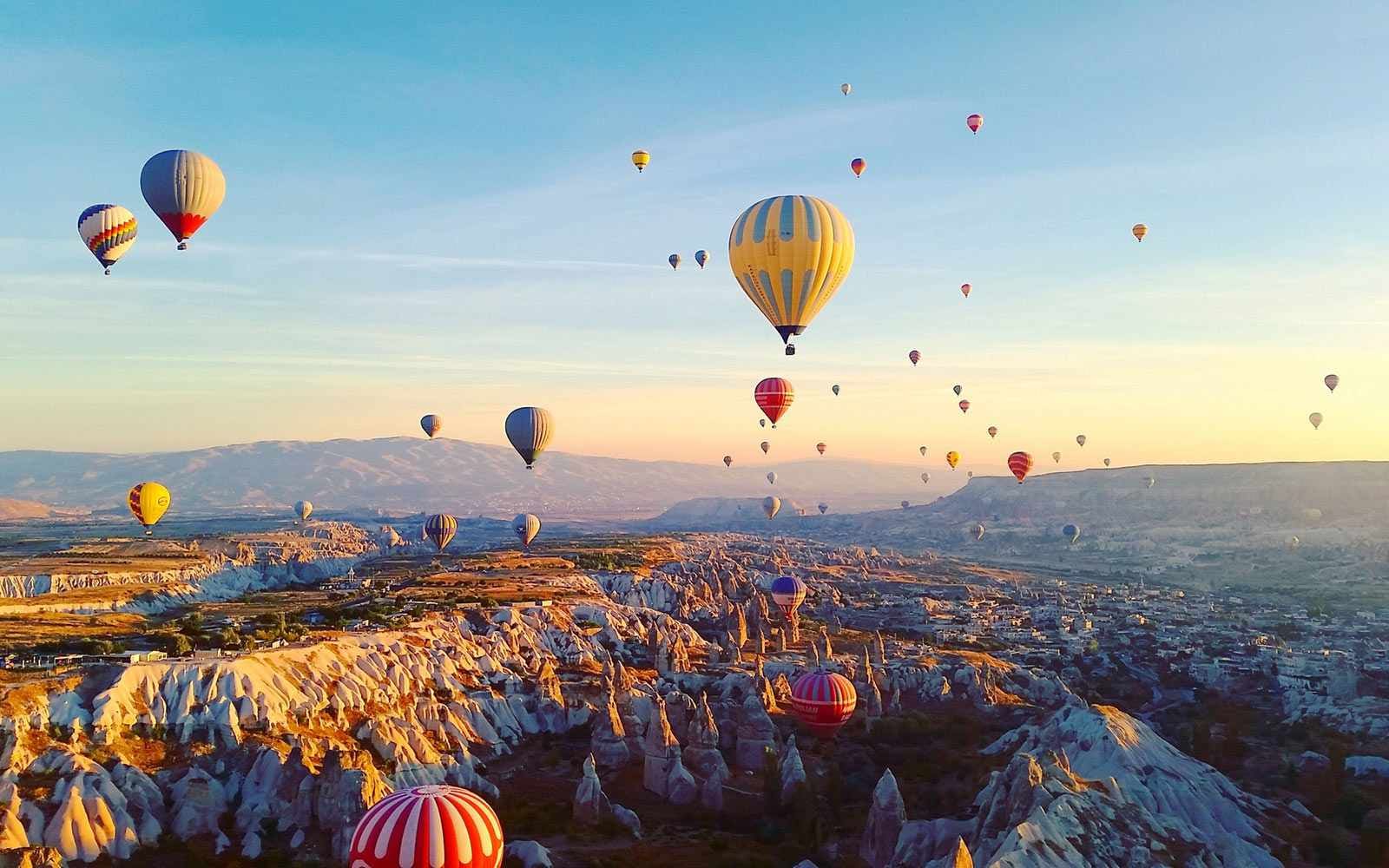
Cappadocia exists in layers. Volcanic ash from Mount Erciyes and Mount Hasan settled here millennia ago, then wind and water carved the soft tuff into valleys, cones, and pillars. The result is neither mountain nor plain but something in between: a terrain that appears sculpted by intention rather than accident. The fairy chimneys, as the tallest formations are known, rise in clusters near Göreme and Ürgüp, their caps of harder basalt protecting the softer stone beneath. Byzantine monks hollowed out churches and monasteries within these cones, painting frescoes that still cling to the rock walls. The entire Göreme National Park holds UNESCO World Heritage status, a recognition that acknowledges both the geological drama and the human history embedded within it.
To see this landscape from the ground is to walk among its details. To see it from above is to understand its scale and strangeness. Hot-air balloons began floating over Cappadocia's valleys in the 1990s, and the practice has since become one of the most recognised ways to encounter the region. On clear mornings, dozens of balloons lift into the pre-dawn sky, their envelopes glowing against the pale stone below.
When to Go, and Why It Matters
Balloon flights operate year-round in Cappadocia, but the season shapes the experience. Spring and autumn bring mild temperatures and the most stable weather, with April, May, September, and October offering the highest likelihood of clear skies and calm winds. Summer can be hot on the ground, though the early-morning departures mean passengers ascend before the heat settles in. Winter flights are less frequent, often cancelled due to wind or snow, but those that do fly offer a different kind of beauty: frost on the fairy chimneys, bare vineyards, and a stillness that summer crowds rarely permit.
Weather determines everything. Flights are subject to approval by Turkey's civil aviation authority, and operators cancel without hesitation if conditions are marginal. Wind speed, visibility, and cloud cover all factor into the decision, which is typically made a few hours before departure. This means flexibility is essential. Travellers should plan at least two or three mornings in Cappadocia to allow for cancellations and rescheduling. The disappointment of a cancelled flight is real, but the alternative, flying in unsafe conditions, is not one any reputable operator will entertain.
Choosing an Operator
Not all balloon companies in Cappadocia are equal. The region has seen rapid growth in tourism, and with it, a proliferation of operators. Standards vary. The most reliable companies hold licences from the Turkish Directorate General of Civil Aviation and maintain fleets that are regularly inspected. Pilots should have extensive experience, not just in ballooning generally but in Cappadocia's specific topography and wind patterns.
Basket size matters. Some operators pack as many as twenty-eight passengers into a single basket, divided into compartments. Others limit groups to twelve or sixteen, offering more space and better sightlines. The difference in price is often modest, but the difference in experience is not. Smaller baskets allow passengers to move slightly, to shift position as the landscape unfolds, and to avoid spending an hour wedged shoulder-to-shoulder with strangers.
Flight duration is another variable. Standard flights last around sixty minutes, though some companies offer longer excursions that extend to ninety minutes or more. The longer flights typically venture deeper into the valleys, away from the busiest corridors, and spend more time at lower altitudes where the rock formations loom close. Shorter flights are not inferior, but they do move through the landscape more briskly.
The Morning Ritual
Balloon flights begin early. Pick-up from hotels usually occurs between 4:30 and 5:30 in the morning, depending on the season and sunrise time. Passengers are driven to the operator's base, where a light breakfast is often served: tea, coffee, pastries, nothing elaborate. The balloons are already being inflated in nearby fields, their envelopes sprawled across the ground as fans blow cold air into them. Once partially filled, burners are ignited, and the hot air begins to lift the fabric. The inflation is loud, a roar of flame and rush of air, and it draws photographers and onlookers even at this hour.
Boarding happens quickly. Passengers climb into the basket, which remains tethered to the ground, and the pilot gives a brief safety talk. There are no seats; everyone stands, holding the handrails that line the compartments. Then the tethers are released, and the balloon rises.
The ascent is smooth, almost imperceptible. There is no sensation of speed, no wind in the face, because the balloon moves with the air itself. The ground falls away, and the fairy chimneys come into view, first as individual formations, then as a vast congregation stretching across the valleys. Other balloons rise nearby, their envelopes in shades of red, blue, yellow, and green. At peak season, the sky can hold more than one hundred balloons, though operators stagger their launch times and altitudes to maintain spacing.
What You See, and What You Feel
The flight path depends on the wind. Balloons cannot be steered in the conventional sense; the pilot controls altitude by adjusting the heat in the envelope, and different altitudes catch different wind currents. This means no two flights are identical. Some drift over the Rose Valley, where the rock glows pink in the early light. Others pass above Pigeon Valley, named for the thousands of dovecotes carved into the cliffs, or over the vineyards and orchards that fill the flatter stretches between the formations.
The altitude varies constantly. At times, the basket floats high enough that the entire region spreads out like a map, the villages and roads and valleys reduced to miniature. At other times, it drops low, skimming just above the tops of the fairy chimneys, close enough to see the texture of the stone and the openings where ancient dwellers carved their homes. This is when the silence becomes most striking. The burner fires intermittently, and in the pauses between blasts, there is almost no sound: no engine, no road noise, just the occasional murmur of voices from other balloons or the distant bark of a dog on the ground.
Sunrise typically occurs midway through the flight. The light changes quickly, from grey to gold to full daylight, and the shadows in the valleys shift and deepen. Photographers chase this moment, and it is worth chasing, but the experience is not only visual. There is something meditative about standing in the basket, watching the landscape scroll past, untethered from roads or trails or any fixed path.
After Landing
Landings are less predictable than take-offs. The pilot searches for a suitable field, one that is flat, accessible, and free of obstacles. The descent is gradual, and the ground crew, who have been following in vehicles, arrive to help secure the basket. Passengers are often asked to crouch and hold the handrails as the basket touches down; sometimes it drags a short distance before stopping, sometimes it settles gently without a bump.
A champagne toast follows, a tradition borrowed from the early days of ballooning in France. Some operators present passengers with certificates, small mementos of the flight. Then it is back into the vans and a return to the hotels, usually by 8:00 or 9:00 in the morning. The rest of the day lies ahead, but the flight has already coloured it.
Practical Considerations
Dress in layers. Mornings in Cappadocia can be cold, even in summer, and the temperature drops further as the balloon rises. Comfortable shoes with good grip are essential; the basket floor can be uneven, and passengers need to brace during landing. Hats should be secured or left behind; the burner's heat can singe loose fabric, and anything not tied down may blow away.
Cameras and phones are permitted, but straps are wise. Dropping a device from a balloon is both expensive and irretrievable. Some passengers bring action cameras or gimbals, but a smartphone is often sufficient; the light is forgiving, and the views are difficult to ruin.
Motion sickness is rare in balloons. The movement is gentle, and because the balloon travels with the wind, there is no sensation of turbulence. However, those with a fear of heights should consider whether standing in an open basket hundreds of metres above the ground is something they can manage. There is no option to sit down or look away; the experience is immersive by design.
Why This, and Not Something Else
Cappadocia offers other ways to see its landscape: hiking through the valleys, cycling along the backroads, or even riding horses through the vineyards. Each has its merits. But the balloon provides a perspective that cannot be replicated on foot. It reveals the patterns in the terrain, the way the valleys branch and converge, the sheer density of the rock formations. It also offers a kind of stillness, a quietness that is increasingly rare in travel.
The flight is not cheap. Prices vary by operator and season, but expect to pay between one hundred and fifty and two hundred and fifty euros per person for a standard flight. Longer flights and smaller baskets cost more. For some travellers, this is prohibitive. For others, it is the centrepiece of a visit to Cappadocia, the experience around which everything else is arranged. There is no neutral middle ground; the balloon flight is either essential or extraneous, depending on what one values in travel.
What it is not is frivolous. The landscape of Cappadocia has been shaped by geology and history, by volcanic eruptions and human habitation, by wind and time. To see it from above is to witness that process made visible, to understand the scale of what has been carved and preserved. The balloon is simply the means, the quietest and slowest and most deliberate way to rise above the fairy chimneys and see what remains.