Where Idleness Is a Virtue: Inside Kotor's Ancient Walls
In Montenegro's walled jewel, centuries of Venetian architecture and a culture that celebrates rest converge at the water's edge
A Philosophy Written in Stone
The locals have a saying about work: if the impulse strikes, sit down and wait for it to pass. At first it sounds like a joke, the kind of self-deprecating humor that small nations deploy to disarm tourists. But spend time in Kotor, the UNESCO-protected fortress city tucked into Montenegro's deepest bay, and you begin to suspect they mean it. The rhythm here moves differently. Conversations linger. Coffee stretches into afternoon. The mountains that cup the bay seem to hold time itself at a slower pace.
At Global Chic Voyage, we have watched cities chase happiness through urban planning, wellness initiatives, and Instagram-ready public spaces. Kotor offers something older and more elusive: a place where contentment appears less engineered than inherited, woven through centuries of life lived between water and stone.
The city's roots reach back to Illyrian settlements, deepened by Roman engineering and Byzantine trade. But it was nearly four hundred years under Venetian rule, standing as the maritime republic's eastern bulwark against Ottoman expansion, that shaped the face you see today. Romanesque churches nestle against Gothic merchant houses. Baroque palaces open onto squares barely wider than their facades. The defensive walls, massive and unbroken, climb the mountainside behind the town in a serpentine scramble toward the fortress of St John, as if the city itself is trying to touch the sky.
Arrival by Water
The proper approach is from the bay. Imagine the prow of a vessel cutting through morning light, the sun just clearing the ridge of Mount Lovćen, the black mountain that gave Montenegro its name. To your right, the pine-covered spine of Vrmac descends steeply to a string of stone cottages, their terracotta roofs glowing against the water. Across the inlet, the Baroque facades of Perast and the small island church of Our Lady of the Rocks slip past like illustrations from a manuscript on Adriatic splendor.
Then Kotor itself resolves from the haze: bell towers and slate roofs contained within walls so thick they seem geological rather than man-made. The fortifications continue upward, switchbacking across the limestone cliff face in a feat of military engineering that still astonishes. Even now, with cruise ships occasionally looming over the marina like steel interlopers, the first glimpse of those walls carries weight. This is a place built to endure.
Inside the Labyrinth
The farmers' market spreads beneath the city walls in a daily tableau of the surrounding land: olives glistening in their oil, watermelons split to show crimson flesh, honey from the mountain villages, cured meats dark with age, homemade rakija in recycled bottles. The abundance feels specific to this latitude, this combination of Adriatic warmth and alpine proximity. Figs perfume the morning air. Tomatoes are piled in scarlet pyramids.
Pass through the Sea Gate, surmounted by its Venetian lion, and the old town folds around you. The early seventeenth-century clock tower leans at an angle that would alarm engineers but somehow reassures visitors; if it has stood this long, it will stand longer still. Below it, an elegant stone column known as the Pillar of Shame once served as the town pillory, a public reminder that even in paradise, rules applied.
The Square of Arms bustles with cafés and tourists navigating cobblestones, but step into Cinema Square and the energy shifts. A massive black poplar, planted in the aftermath of a devastating earthquake in 1667, spreads its canopy where a Franciscan monastery once stood. Beneath its shade, locals and travelers alike nurse espresso and contemplate the day ahead. If you are fortunate, the café menu will include krempita, Kotor's signature pastry: layers of puff dough and sweet custard that dissolve on the tongue like edible architecture.
Lives Lived in Parallel
A small museum dedicated to the town's cats funds care for the descendants of mousers that Venetian sailors brought ashore centuries ago. They drape themselves across doorsteps and sun-warmed stones with the confidence of beings who know they belong. For those unmoved by feline charm, the tiny Church of St Michael houses a lapidarium: fragments of carved stone spanning Illyrian-Roman origins through the end of the eighteenth century, each piece a sentence in the city's long conversation with itself.
The streets here are narrow enough that laundry strung between upper windows creates accidental canopies. Locals pause on motorbikes to exchange news. This is not a preserved set piece but a working town that happens to occupy a masterpiece of medieval urbanism. Tourism flows through it in waves, cruise passengers and backpackers and couples on anniversary trips, but the underlying life continues. Shops sell vegetables and hardware alongside souvenirs. Children kick footballs in squares named for long-dead saints.
Climbing Toward Perspective
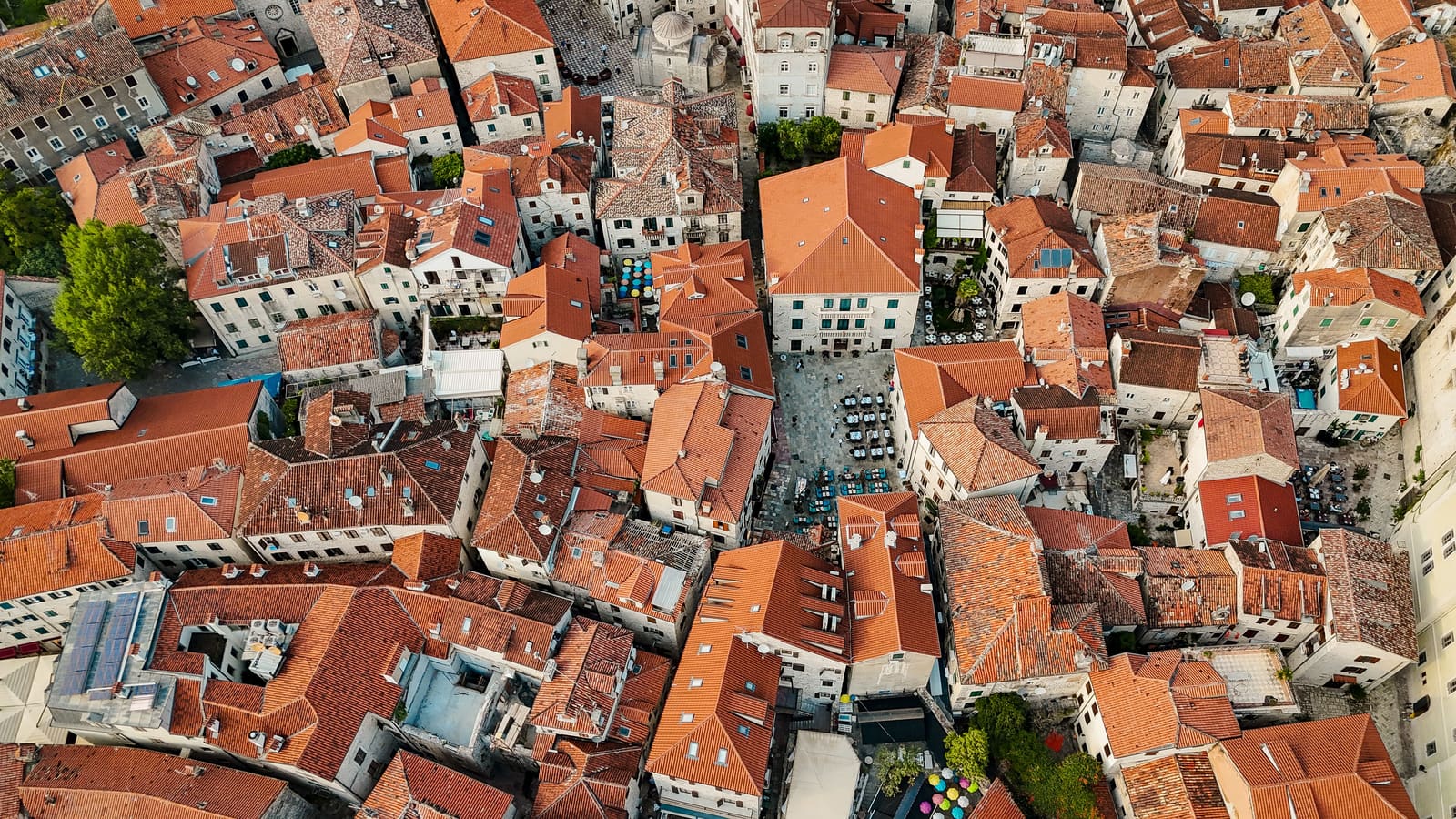
The ascent to the Castle of St John involves roughly thirteen hundred steps and more than eight hundred feet of elevation gain. The path is uneven, the sun unforgiving in summer, but the reward is a view that recalibrates your sense of the bay's scale. Halfway up, the Church of Our Lady of Remedy offers both spiritual solace and an excuse to pause. From the fortress itself, the old town spreads below in a jigsaw of terracotta and grey stone, the bay stretching westward toward the Adriatic in shades of turquoise and cobalt.
For those who prefer to keep their feet closer to sea level, the ramparts offer similar drama without the cardiovascular commitment. Either way, the interplay of human ambition and natural grandeur becomes clear. The walls were built to protect; they ended up framing one of Europe's most arresting compositions of water, stone, and sky.
The Cathedral and Its Secrets
The Cathedral of St Tryphon anchors the old town both spiritually and architecturally. Consecrated in 1166, it remains one of the Adriatic's finest Romanesque structures, its twin bell towers and striped stone facade a study in restrained elegance. Inside, a fifteenth-century gilded altarpiece glows in the dim interior. Above the main altar, a fourteenth-century ciborium rests on columns of red marble, its carvings depicting the life and martyrdom of the cathedral's patron saint.
The upper terrace, accessible via a narrow staircase, provides a vantage point over the old town's rooftops. Stand there long enough and you begin to notice the layers: Roman foundations supporting medieval walls, Baroque additions grafted onto Gothic bones, satellite dishes and solar panels negotiating with heritage protections. The city is not frozen but evolving, slowly enough that each generation recognizes itself in the stones.
The Maritime Museum, housed in the eighteenth-century Grgurina Palace, chronicles the centuries when Kotor's captains and sailors carried the city's flag across the Mediterranean and beyond. Their descendants still fish the bay, though the fleets are smaller now and the world feels both larger and more crowded.
The Bay Turns Gold
A cable car, installed recently enough that it still feels novel, climbs more than four thousand feet in eleven minutes. The gondola rises through vegetation zones like a lesson in ecology: scrub giving way to forest, forest thinning to bare limestone, until the entire bay unfurls below. From the upper station, with a cocktail in hand and the sun descending toward the Adriatic, the question is not why Kotor ranks among Europe's happiest places but how anywhere else competes.
The light at this hour is generous, gilding the water and softening the mountains into silhouettes. The cruise ships in port shrink to toys. The walls that seemed so imposing from the street become delicate tracery. It is the kind of perspective that makes you reconsider priorities, the kind of beauty that does not demand action but invites stillness.
Where Contentment Lives
Montenegro's self-proclaimed dedication to leisure might be hyperbolic, but Kotor offers evidence that the joke contains truth. This is not a city that hustles. The restaurants serve food when it is ready, not when the schedule demands. Conversations meander. Music in the old town's jazz clubs unfolds without rush, standards and blues and Balkan improvisations filling the night like smoke.
The hotels nearby understand that rest is the point. Contemporary design and Ottoman-era stone sit comfortably together in boutique properties along the waterfront. Pools overlook the bay. Gardens descend to private beaches. The message is consistent: you have arrived, now exhale.
Even the geography conspires toward calm. The bay is so sheltered that the water barely ripples. The mountains block the worst of the Adriatic's storms. The old town, pedestrian-only and small enough to cross in ten minutes, encourages wandering without destination. You might set out for the cathedral and end up in a side-street bakery, warm burek in hand, watching light move across stone that has stood for half a millennium.
The Virtue of Doing Less
We spend much of our travel energy chasing the new: the restaurant that just opened, the neighborhood on the verge of discovery, the experience no one else has documented. Kotor offers a different proposition. It has been here for centuries. It will be here for centuries more. The happiness it offers is not novelty but permission: to slow down, to sit longer, to let the afternoon dissolve into evening without guilt.
The Montenegrins who joke about avoiding work are not lazy; they are subversive. In a world that equates motion with progress and busyness with importance, they have preserved an older understanding. Time spent in a café watching the bay is not time wasted. A long lunch with friends is not indulgence but necessity. Rest is not the absence of productivity but its own kind of achievement.
Standing on Kotor's ramparts as the day softens into dusk, the bay reflecting the first stars, you begin to understand what they mean. The fortress walls were built to keep invaders out. They ended up creating a space where a different kind of life could persist, protected not just from armies but from the tyranny of hurry.
This is not a lesson you learn so much as absorb, the way stone absorbs sun during the day and releases it slowly through the night. Kotor's happiness is not a secret to be uncovered but a rhythm to be joined, a tempo set by centuries of people who understood that sometimes the most radical act is simply to stop, to look, to stay.