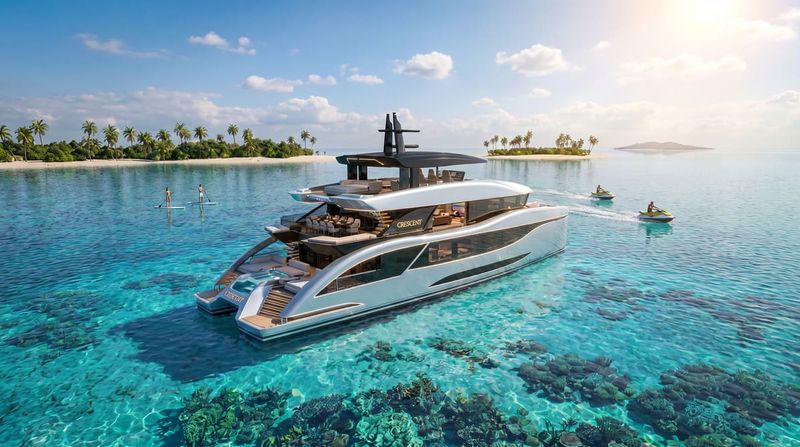
Where Distance Dissolves: An 85-Foot Catamaran Built for the Truly Unmoored
Silver Yachts and Ker Yacht Design craft a vessel that refuses to choose between speed, range, and the rare luxury of staying away longer.
The Architecture of Escape
There is a particular kind of owner who measures freedom not in days but in nautical miles. They are the ones who study weather windows the way others study stock tickers, who speak of provisioning with the precision of a quartermaster, and who understand that true luxury is not marble and gold leaf but the ability to remain, comfortably, beyond the reach of the ordinary world. For them, Silver Yachts has conceived an 85-foot catamaran that reads less like a yacht and more like a manifesto on autonomy.
The vessel is a study in contradictions that shouldn't work but do. It can cover 2,000 nautical miles at 25 knots, a pace that devours horizons, or stretch to 4,000 nautical miles at a more contemplative 11 knots, according to Silver Yachts. That latter figure places it nearly shoulder to shoulder with the yard's 128-foot flagship explorer, a vessel 40 feet longer. The route from Florida through the Straits, across the Atlantic to the Netherlands, becomes not an expedition but an itinerary.
At Global Chic Voyage, we've watched the explorer category fracture into tribes: the go-fast crowd who treat ocean crossings like sprints, and the go-far contingent who prioritize endurance over adrenaline. This catamaran refuses the binary. Guido Krass, who founded Silver Yachts, describes the project as a demonstration of the yard's capabilities with large custom multihulls, and the choice of words matters. Not a showcase, not a flagship, but a demonstration, the kind of understatement that suggests confidence earned through aluminum and sea trials rather than press releases.
The Geometry of Going Anywhere
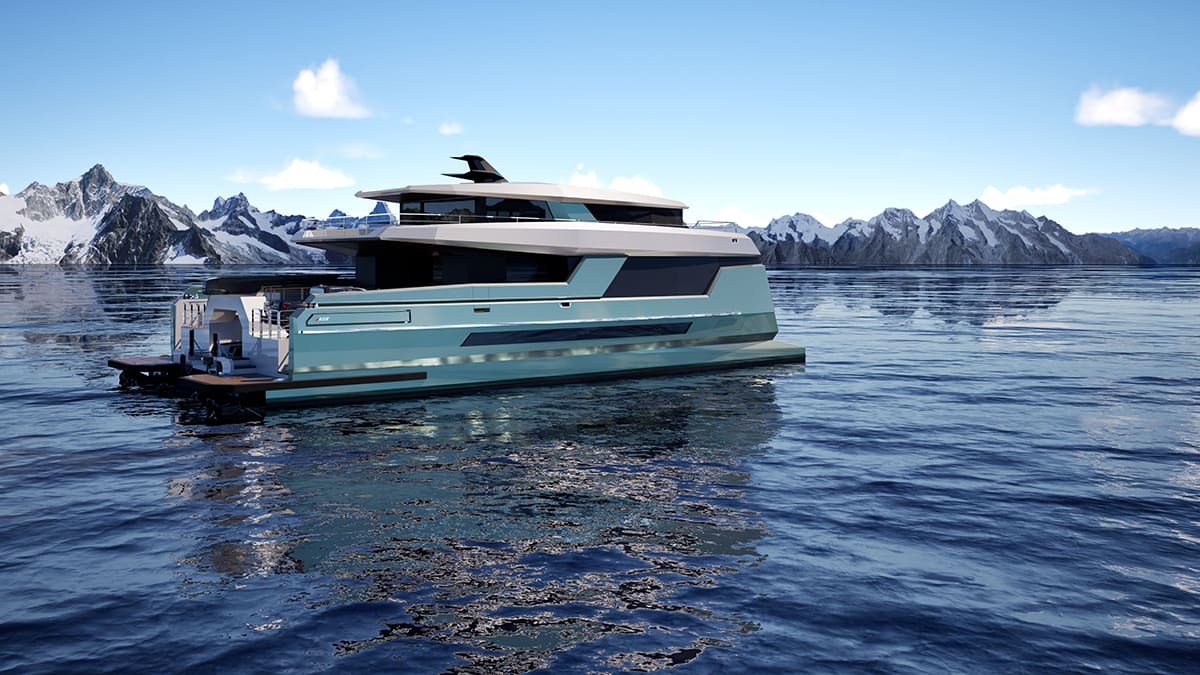
Ker Yacht Design, the British studio behind the concept, exterior lines, and naval architecture, approached the hull as a single hydrodynamic problem rather than a collection of features. Using Computational Fluid Dynamics engineering, the team developed the twin hulls, wave-piercing bows, and lifting foils as an integrated system. The result is a vessel that doesn't simply push through water but negotiates with it, slipping past resistance rather than overwhelming it with brute power.
The exterior will be rendered entirely in aluminum, a material in which Silver Yachts has built its reputation. Aluminum is unforgiving; it telegraphs every mistake, every misaligned weld, every compromise in craftsmanship. It is also light, strong, and remarkably well-suited to the kind of distances this catamaran is designed to cover. The 42-foot beam, generous even by catamaran standards, creates volume without the visual bulk that plagues so many multihulls. The proportions suggest speed even at anchor.
Jason Ker, who leads the studio, frames the vessel as a genuine explorer developed for owners who intend to cruise extensively and spend long periods away from conventional support infrastructure. The phrasing is deliberate. Not "visit remote destinations" but "spend long periods away," a distinction that separates the itinerant from the genuinely unmoored. This is a vessel for those who measure time in seasons rather than weekends, who provision for months and plan routes that avoid, rather than seek, the familiar clusters of marinas and chandleries.
The Interior Logic of Long Passages
Ker Yacht Design collaborated with Design Unlimited, another British firm, on interiors that prioritize the rhythms of extended cruising over the theater of short charters. Mark Tucker, creative director at Design Unlimited, describes the design as centered on creating a home away from home, supporting both everyday life aboard and the freedom to explore remarkable destinations. The language is careful, almost studiously neutral, but the implication is clear: this is not a floating hotel suite but a residence engineered for motion.
The exact layout remains undisclosed, though the 42-foot beam promises generous living quarters. For context, Silver's 128-foot flagship accommodates between 10 and 14 guests plus six crew, though direct comparisons are complicated by the 40-foot difference in length. What the yard does emphasize is storage, a detail that sounds mundane until you consider what it enables. The catamaran can carry a 25-foot tender in a drive-in lifting dock, a feature that transforms the mothership into a mobile base camp rather than a destination in itself. The tender becomes the instrument of exploration; the catamaran, the platform that makes exploration sustainable.
We've noted, in our own travels, that the vessels we return to are rarely the ones with the most dramatic atriums or the most ostentatious owner's suites. They are the ones that make long passages feel not like endurance tests but like a chosen way of being. The ones where storage is abundant and intelligently organized, where provisioning for three weeks feels routine rather than heroic, where the galley is designed for daily use rather than catered events. Design Unlimited's residential approach suggests an understanding of this distinction.
The Patience of Metalwork
Construction is scheduled to begin this month at Silver's Jiangmen facility in China, with delivery planned for 2028. The timeline, nearly two years from metal cutting to launch, reflects both the complexity of the build and the nature of full customization. There are no molds to pull from inventory, no standard layouts to adapt. Every frame, every bulkhead, every system is engineered for this vessel and these owners.
The choice of a Chinese yard for a European design and Australian ownership speaks to the increasingly global nature of yacht construction. Silver Yachts has built its operations in Jiangmen into a hub for aluminum expertise, a place where metalworking traditions intersect with contemporary engineering. The decision to build there is not about cost arbitrage but about access to specific skills and the infrastructure to support large custom projects.
What we find compelling about this project is not any single specification, impressive though they are, but the clarity of purpose that runs through every decision. This is a vessel conceived by owners who know precisely how they want to live aboard, designed by studios that understand the difference between touring and dwelling, and built by a yard that has staked its reputation on the kind of metalwork that makes long-range cruising possible rather than aspirational.
The Freedom to Remain
There is a particular luxury in not needing to return. Not because ports are unavailable or weather has closed in, but because the vessel itself, properly provisioned and thoughtfully designed, becomes the destination. The 4,000-nautical-mile range is not merely a technical achievement; it is an invitation to reconsider the relationship between movement and stillness, between exploring and inhabiting.
The owners who commission vessels like this are not collecting miles for the sake of a logbook. They are constructing a life that happens to unfold on water, in places where the density of other yachts thins to near zero, where provisioning requires planning rather than a quick call to a provision agent, where the nearest haul-out facility might be a week's sail away. The catamaran's combination of speed and endurance means they can reach those places without the passage itself becoming the ordeal.
At Global Chic Voyage, we've long argued that the most revealing question to ask about any vessel is not where it can go but how long it can stay. This 85-footer, with its integrated hydrodynamics, residential interiors, and exceptional storage, is designed to answer that question with a number measured not in days but in the kind of time that lets routines form, that allows the initial thrill of arrival to settle into the deeper satisfaction of inhabiting a place fully before moving on. That, more than any specification, is what sets it apart.