
Where to Stay Near Cinque Terre When You're Chasing Cliffside Villages and Silence
Five pastel towns, no cars, and a handful of intimate stays that trade Amalfi's polish for something quieter and more real.
SI
2 Jul 2026 · 5 MIN READ · UPDATED 17 AUG 2026
The Sound of Waves, Not Engines
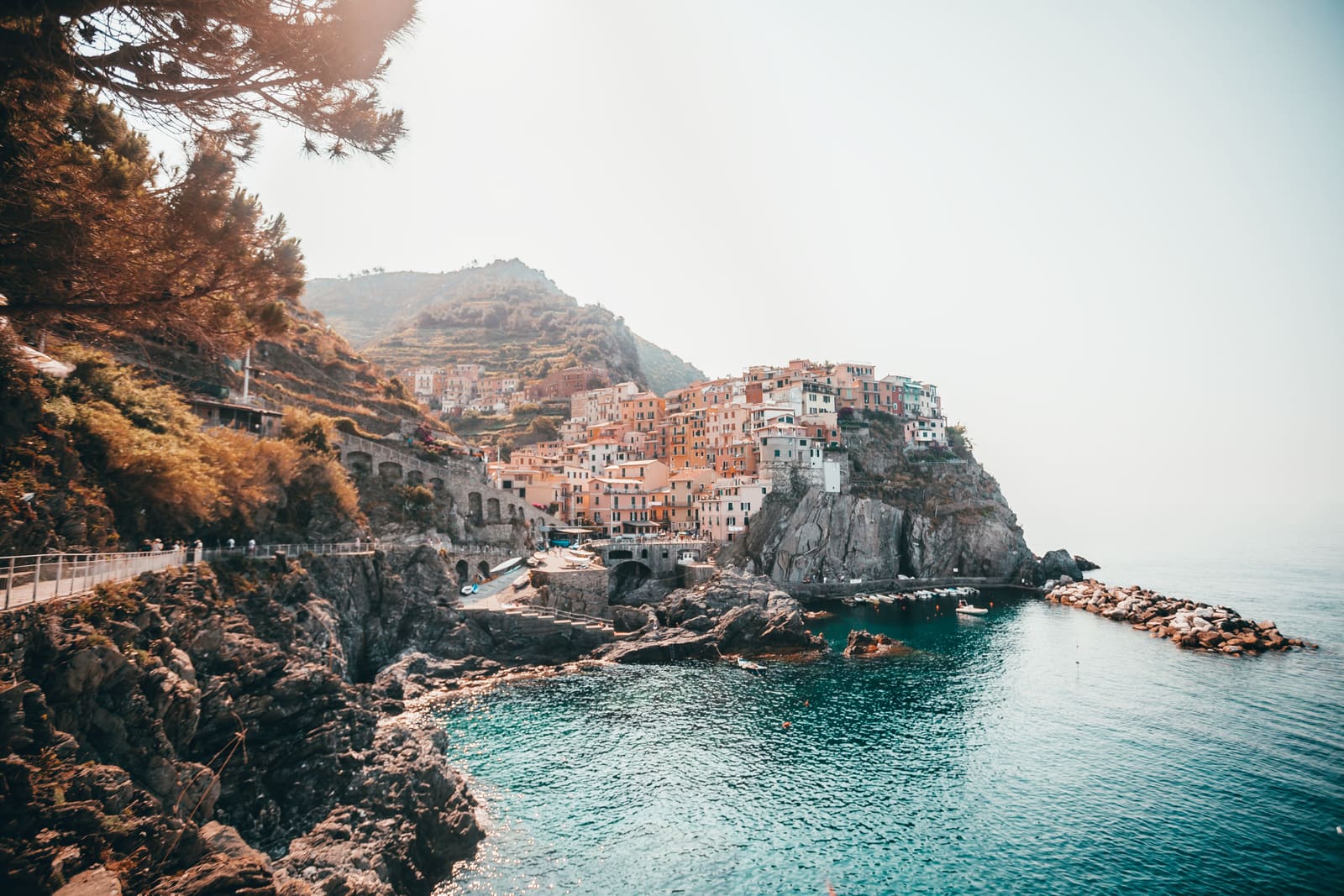
There is a particular quality to the light along Italy's northwest coast in late afternoon, when the sun slants low over the Ligurian Sea and the pastel facades of clifftop villages glow like watercolor left to dry. At Global Chic Voyage, we've watched travelers grow weary of the Amalfi Coast's relentless polish, the parade of yachts and the clamor for reservations. Cinque Terre offers something different: five villages strung along a stretch of coastline so steep and stubborn that cars have never gained a foothold, where the only routes between towns are footpaths worn smooth by centuries of use or a regional train that burrows through tunnels and emerges at intervals to face the sea.
Monterosso, Manarola, Vernazza, Corniglia, Riomaggiore. The names themselves sound like a poem. This string of settlements clings to rock faces, each one a cascade of ochre, salmon, and terracotta that seems to defy both gravity and modernity. The difficulty of reaching them is part of the appeal. From Pisa, you board one train, then another, and somewhere along the journey the world contracts to the size of a hiking trail. What you lose in convenience you gain in atmosphere: the rusticity, the silence broken only by waves and church bells, the sense that you have stepped into a landscape that still belongs more to fishermen and farmers than to travelers.
A Landscape That Resists Luxury
The absence of five-star resorts here is not an oversight but a condition of the terrain. Where the Amalfi Coast has long courted the jet set with grand hotels and infinity pools, Cinque Terre has remained stubbornly itself: small, family-run, woven into the fabric of villages too narrow for tour buses and too steep for sprawl. The accommodations reflect this. You will find boutique lodgings, guesthouses with gardens that grow lemons and olives, converted convents and ancient towers where the view is the amenity and the breakfast is made from what was picked that morning.
This is not to say that comfort is absent, only that it takes a different form. At La Torretta Lodge in Manarola, guests sleep within the walls of an old tower perched high on the cliff, where some rooms feature roll-top bathtubs and others open onto terraces with hot tubs facing the sea. The catch, as with much of Cinque Terre, is access: you arrange for your luggage to be transferred from the train station garage and you climb. The restaurant sources its ingredients locally, including wine from the terraced vineyards that stripe the hillsides like ribbing on a sweater.
For those who prefer a touch more ease, Casa di Andrea in Monterosso offers five bright bedrooms that open onto a shared garden fragrant with citrus and olive trees. Breakfast includes fruit and vegetables grown on the property, and the pace of life here is dictated by sunlight and appetite rather than schedules. It is the kind of place where you read for hours in dappled shade and lose track of time.
The Agriturismo Alternative
Further into the mountains behind Monterosso, the agriturismo tradition offers another mode of staying. Missanega, a five-bedroom farmhouse set among lemon and olive groves, has refurbished each room individually while preserving the stone walls and wooden beams that anchor the building in its history. A swimming pool overlooks the sea, a vantage point for soaking tired feet after a day spent walking the coastal paths. The restaurant cooks with what grows on the property, a practice that is both sustainable and deeply pragmatic in a landscape where every ingredient must either be grown locally or carried in.
The appeal of such places lies not in what they offer but in what they omit. There are no spas, no concierge teams trained in the art of anticipation, no orchestrated experiences. Instead, there is the garden, the view, the meal prepared by the family who owns the land. It is a form of hospitality that feels less like service and more like invitation.
When the Coast Calls for More Polish
For travelers who find the gamble of a guesthouse too uncertain, or who prefer a base with more infrastructure, the town of Portovenere serves as a gateway. The Grand Hotel Portovenere occupies a 17th-century convent that has been renovated into a five-star property with brightly colored rooms and a rooftop restaurant specializing in regional dishes. From here, ferries and private boats depart for Cinque Terre, Portofino, La Spezia, and the Gulf of Poets. It is a compromise: the comforts of a full-service hotel with proximity to the villages, though not the immersion.
Hotel Porto Roca, also in Monterosso, leans into glamour with a terrace restaurant and a swimming pool that seems to hover above the sea. Each of the 43 rooms has a private balcony, and the property sits high enough on the cliffside to offer views that stretch across the water and the vineyards below. The concierge can arrange boat trips, the most elegant way to see the villages, which reveal their full drama only when approached from the water.
For those willing to venture slightly further afield, the urban option of The Poet Hotel in La Spezia offers a different rhythm. This boutique property emphasizes convenience: sparsely decorated rooms, a late breakfast buffet, 24-hour reception, and a communal area designed for work or conversation. It is a practical base for hikers who need flexibility and a place to rest between excursions, and it welcomes pets, a rarity that makes it appealing to travelers bringing dogs along for the trails.
The Portofino Parenthesis
At the opposite end of the spectrum sits Splendido, A Belmond Hotel, perched on the hill above Portofino. Originally a Benedictine monastery, it has evolved into one of the Ligurian coast's most storied addresses, a place where Elizabeth Taylor and Ava Gardner once sought refuge in the 1960s. The hotel reopened recently after a multi-year renovation led by designer Martin Brudnizki, who brought a restrained maximalism to the interiors: lavenders, celadons, soft blues that echo the sea rather than shout over it. The saltwater pool has been retiled to match the color of the bay below, and the open-air restaurant, La Terazza, serves trofie al pesto and spritzes from a perch where the view is both postcard and theater.
Splendido is not in Cinque Terre, but it is close enough to hire a boat and visit for the day. This is, in fact, how many yacht-bound travelers experience the five villages: as a day trip, a scenic interlude between longer stays in Portofino's more manicured embrace. There is no judgment in this choice, only recognition that Cinque Terre rewards a different kind of traveler, one who values remoteness over refinement and who is willing to trade the ease of a bellhop for the satisfaction of arriving somewhere difficult.
A City Reborn as Gateway
An hour and forty minutes north of Cinque Terre, Genoa offers yet another angle. Palazzo Durazzo, a Baroque palazzo on the waterfront, has been transformed by Emanuela Brignone Cattaneo and her husband Giacomo Cattaneo Adorno, whose family has owned the building for four centuries. The project is part of a broader effort to restore Genoa to its former status as one of Europe's great capitals, a maritime and banking power that once rivaled Venice in grandeur.
The hotel comprises 12 suites furnished with museum-quality antiques, several adorned with original Baroque frescoes. To stay here is to inhabit history, to sleep in rooms that have witnessed centuries of commerce and culture. It is more than a hotel; it is an argument for Genoa itself, a city that has long been overlooked by travelers racing south to the coast. From here, Cinque Terre becomes a day trip, but Genoa becomes the story.
The Question of How to Arrive
The logistical challenges of Cinque Terre are not incidental but essential to its character. The train journey from Pisa requires patience, and once you arrive, you must reckon with the fact that your suitcase may need to be transferred separately, that the path to your lodging may involve stairs, that the schedule is dictated by train timetables and footpath conditions rather than your own preferences. This friction is what has kept the villages from becoming another Amalfi, another Santorini, another place where the infrastructure has been smoothed into frictionless tourism.
For those who approach Cinque Terre by boat, the experience is different but equally revelatory. The villages reveal themselves in vertical slices, stacked houses and terraced vineyards rising from the water's edge. This is how they were meant to be seen, how they have always been seen by fishermen and sailors. The boat removes the effort of walking but preserves the sense of arrival, the feeling that you have come to a place that does not give itself easily.
Why We Keep Returning
At Global Chic Voyage, we return to Cinque Terre not despite its inconveniences but because of them. The villages have retained their integrity precisely because they resist the kind of development that would make them easier to visit. The hotels remain small because the streets are too narrow for anything larger. The restaurants cook with local ingredients because transporting supplies is difficult. The pace is slow because there is no infrastructure to accelerate it.
This is not a destination for travelers who seek seamlessness or who measure luxury by thread count and turn-down service. It is for those who find value in difficulty, who understand that the best places are often the ones that require something of you in return. Cinque Terre asks for patience, for a willingness to walk, for an acceptance that the view from an ancient tower may come with a climb. What it offers in exchange is a landscape that still feels earned, a coastline that has not yet been polished into irrelevance.
Photo: Getty Images
Spot something wrong? Email editors@globalchicvoyage.com. We log every correction publicly.
RELATED
SEE ALL →
8 Jul 2026 / 5 min
31 Jul 2026 / 5 min
28 Jul 2026 / 5 min
28 Jul 2026 / 5 min