
A Mid-Century Motel Finds New Life Along Florida's Gold Coast
In Fort Lauderdale, a Belgian architect transforms a 1950s roadside relic into a verdant courtyard retreat that remembers what made motels magnetic in the first place.
SI
8 Jul 2026 · 5 MIN READ · UPDATED 17 AUG 2026
The Architecture of Arrival
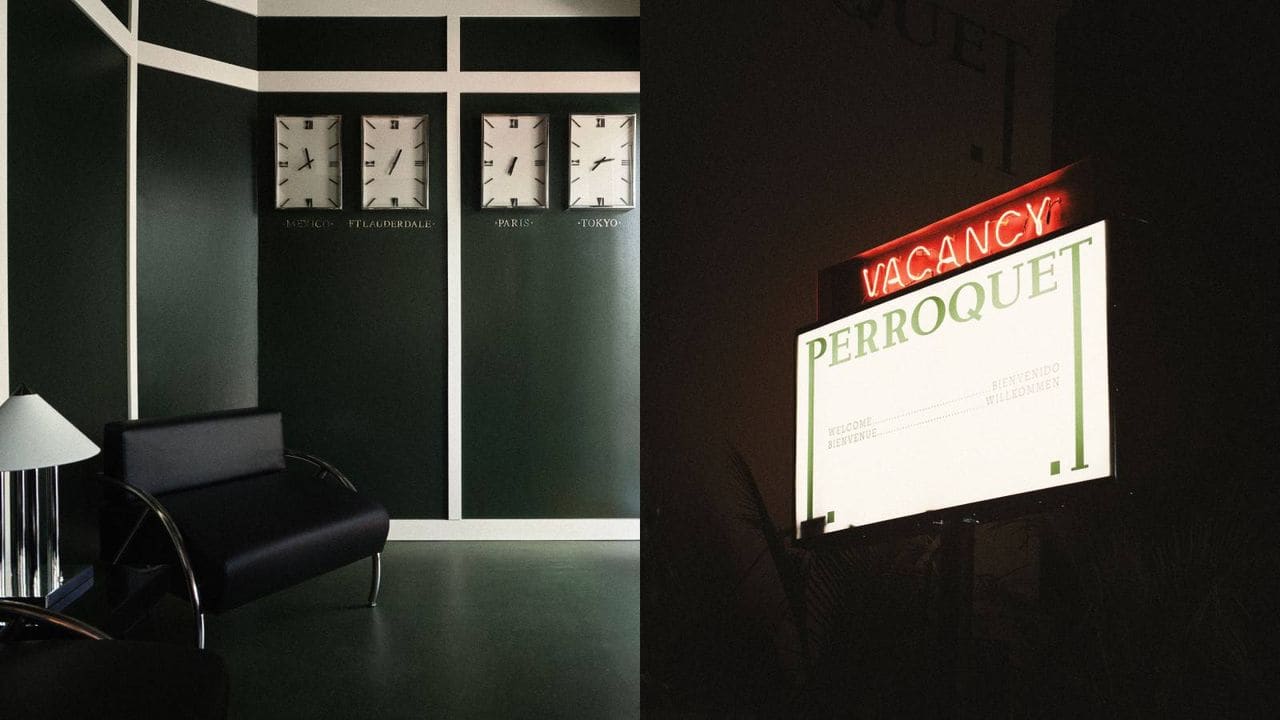
There is a particular thrill to pulling off a coastal highway and finding yourself in a courtyard where palms filter the afternoon light and the sound of traffic dissolves behind a wall of green. The American motel understood this better than most building types: arrival as theater, the pool as stage, the balcony as an invitation to linger. Perroquet, a 37-room hotel on Harbor Drive in Fort Lauderdale, remembers that language and speaks it with a Belgian accent.
At Global Chic Voyage, we have watched the motel typology cycle in and out of fashion for decades. What draws us back now is not nostalgia but a renewed interest in buildings that know their place, architecturally and geographically. Perroquet occupies a narrow strip of land between the Intracoastal Waterway and the Atlantic, a location that once made it a convenient overnight stop and now positions it as a deliberate escape. The Lane Organization enlisted Belgian architect Bernard Dubois to rework the 1950s structure, and his approach was less reinvention than clarification.
Dubois, whose recent work includes The Standard Brussels, arrived at the property before its new identity had been named or its interiors sketched. What he found was a traditional U-shaped plan wrapped around a central courtyard, a layout he described as immediately compelling. Rather than flatten that geometry into something more contemporary, he chose to amplify it. The façades were repainted in off-white and forest green, a pairing that nods to the country clubs and tennis courts that dot this stretch of Florida. Guardrails and corridor ceilings received the same treatment, creating a chromatic thread that ties the building together without overstating its presence.
A Courtyard That Breathes
The courtyard itself became the project's organizing principle. Dubois introduced red brick underfoot, green canvas overhead, and white railings that frame the pool like the edge of a painting. Custom outdoor furniture, designed by the architect, punctuates the space with sculptural intention. But the most decisive move was the planting. New trees now screen the hotel from Harbor Drive, drawing the eye inward and upward. Birds have followed the foliage, and the result is a courtyard that feels less like a hardscaped amenity and more like a verdant threshold.
From the street, Perroquet nearly vanishes behind this green curtain. The effect is not secrecy but discretion, a quality that feels increasingly rare in a hospitality landscape that often announces itself with oversized signage and valet podiums. Inside the courtyard, the view shifts. Guests in the 37 rooms, distributed across nine categories, look out onto leaves and branches rather than asphalt. The jungle Dubois speaks of is not metaphorical. It is dense, layered, and alive, softening the hard geometry of the motel's bones.
Interiors That Remember the Road
The rooms themselves extend the green palette but shift its mood. Linoleum floors, sheer curtains, and lacquered wood create a backdrop that feels both crisp and lived-in. Dubois designed the furniture, pulling references from 1970s lounge chairs, 1980s chrome-and-leather hybrids, Miami art deco geometry, and 1930s rug patterns. The result avoids the trap of period pastiche. These are not rooms that try to recreate a specific decade. They are rooms that understand how certain silhouettes and materials hold up over time.
What strikes us most is the balance Dubois achieves between polish and idiosyncrasy. Boutique hotels often lean too far in one direction, either becoming so refined they feel sterile or so quirky they exhaust the eye. Perroquet manages to be both clean-lined and eccentric, a combination that echoes the original appeal of the American roadside motel: a place where anonymity and character coexist.
Art as Punctuation
Curators Valerio Polimeno and Whitney Lane have assembled a collection that includes work by Salvatore Emblema, Giorgio Griffa, Jean Tinguely, Jean Cocteau, Lucio Fontana, Roberto Matta, Alekos Fassianos, and Jeff Koons. Pieces are distributed across the rooms rather than concentrated in public spaces, a strategy that treats art as punctuation rather than proclamation. You encounter a Fontana slash in one room, a Cocteau drawing in another. The placement feels intuitive rather than programmatic, as if each work found its way to a particular room through instinct rather than curatorial mandate.
This approach aligns with the broader ethos of the hotel, which resists the urge to over-curate the guest experience. There is a self-service breakfast bar, Sferra linens, Byredo toiletries, and deck chairs available for the beach. Check-in is designed to be swift and unobtrusive. The message is clear: the hotel provides the ingredients, but the rhythm of the stay is yours to compose.
What the Motel Knew
Dubois has spoken about the contemporary motel as a building type no longer tethered to traditional notions of luxury. The most authentic and charming places, he suggests, are not always the most conventionally opulent. This is a useful provocation in an era when luxury hospitality often equates to square footage, thread count, and the number of staff members per guest. Perroquet proposes a different calculus: a bijou scale, a strong point of view, and an environment that invites you to slow down without insisting on it.
The Florida motel, in its mid-century heyday, understood a few essential truths. It knew that a good pool could anchor an entire property. It knew that shade was not an amenity but a necessity. It knew that arrival should feel like crossing a threshold, not walking through a lobby. Perroquet takes those truths seriously and translates them into a contemporary idiom. The forest green and off-white are not just colors but a way of signaling continuity with the region's architectural past. The courtyard jungle is not just landscaping but a deliberate rewilding of a previously hardscaped site.
The Pace of the Place
We have visited enough hotels to recognize when a property is trying too hard to be something it is not. Perroquet does not suffer from that affliction. It is a motel, reimagined with care and confidence, that understands its own constraints and turns them into virtues. The 37 rooms will never compete with the sprawling resorts that line Fort Lauderdale's beachfront. The self-service breakfast bar will never be mistaken for a Michelin-starred restaurant. But that is precisely the point.
What Perroquet offers is a clarity of vision, a sense that every decision, from the chrome furniture to the choice of art, has been made with intention. It is a hotel that knows the value of a very good retro-style pool chair, a shaded courtyard, and a facade that does not shout for attention. In a hospitality landscape increasingly dominated by sameness, that kind of specificity feels like a form of luxury in itself.
For those of us who spend our time seeking out places that feel both grounded and surprising, Perroquet represents a welcome addition to the Florida coast. It is not trying to rewrite the rules of hospitality. It is simply remembering the ones that mattered all along.
Photo: Perroquet
Spot something wrong? Email editors@globalchicvoyage.com. We log every correction publicly.
RELATED
SEE ALL →
2 Jul 2026 / 5 min
31 Jul 2026 / 5 min
28 Jul 2026 / 5 min
28 Jul 2026 / 5 min