
Where Hong Kong's Modernist Heart Meets the Intimacy of Home
Inside Mandarin Oriental The Landmark, a 109-room sanctuary that bridges the city's colonial past and cosmopolitan present through the lens of Joyce Wang Studio
SI
31 Jul 2026 · 5 MIN READ · UPDATED 17 AUG 2026
A Threshold Between Two Hong Kongs
Step through the shopping concourse entrance and you cross an invisible line. Outside, Central's towers climb toward low cloud; inside, warmth radiates from crimson travertine columns that stretch toward a double-height ceiling. The contrast is deliberate. Where Hong Kong's skyline speaks in glass and altitude, this lobby speaks in stone and intimacy, drawing visual cues from the colonial mansions scattered across the New Territories rather than the contemporary towers that crowd Victoria Harbour.
At Global Chic Voyage, we've watched Hong Kong's hospitality landscape oscillate between two extremes: properties that lean heavily into heritage cliché, and those that chase international anonymity. What Joyce Wang Studio has achieved here is rarer - a spatial narrative that acknowledges the city's layered identity without flattening it into brochure copy. The undulating terracotta tiles covering the street-level facade are not mere ornament; they establish a visual vocabulary that reappears throughout the property, a thread connecting public threshold to private retreat.
This is not the grand flagship Mandarin Oriental that anchors the neighborhood. With just over a hundred rooms, the hotel positions itself as the quieter sibling, the one you visit when you want conversation rather than spectacle. The design reflects that ambition. Ice-shaped glass blocks line one wall of the foyer, their cool geometry balancing the warmth of the stone. A curved staircase in pale beige leads upward, and the mood shifts - blond wood paneling replaces soaring volume, red leather armchairs cluster in small groupings, and the residential aesthetic takes hold.
The Language of Local Craft
Every lift tells a story. Hand-painted abstractions of the Hong Kong skyline, created by Eliza Ling of Joyce Wang Studio, wrap the elevator interiors. Those same motifs reappear underfoot, translated into hand-tufted corridor carpets that echo the city's silhouette in thread. It's a subtle choreography, one that builds continuity without announcing itself.
Step into the hallway and small ceramic vessels punctuate console tables - works by Julie & Jessie, local ceramicists whose pieces appear wrapped in torn "paper" glazes that reveal flashes of vivid color beneath. These are not commissioned installations meant to impress; they are objects chosen to inhabit the space the way art inhabits a well-curated home. The distinction matters. Too many luxury properties treat art as branding. Here, it functions as punctuation, moments of visual intrigue that reward attention without demanding it.
The decision to foreground Hong Kong-based makers is more than gesture. It signals an editorial stance: this hotel exists for people who live in the city as much as those passing through. That duality shapes everything from the discreet entrance - tucked into the shopping concourse, easy to miss if you don't know where to look - to the seventh-floor dining venues designed to draw neighborhood regulars as much as overnight guests.
Suites That Understand Proportion
The L600 Junior Suite occupies a corner position, and that geometry unlocks something rare in hotel bathrooms: natural light from two directions. The circular bathtub sits at the room's center, a freestanding sculptural element that doubles as spatial divider. Behind it, shower and toilet occupy a discreet alcove, creating a sense of enclosure without walls. The effect is one of considered openness, where privacy and flow coexist.
Light greens and dark brown wood establish the palette, materials that soften rather than announce. The aesthetic leans closer to a well-appointed Central apartment than a conventional hotel suite, which is precisely the intent. Larger L900 accommodations expand the vocabulary - wraparound polished wooden headboards, more generous living areas - but maintain the same tonal restraint. There is no gilding here, no reflexive luxury signaling. The rooms trust their proportions and materials to convey value, a confidence that reads as maturity.
We've stayed in enough Hong Kong properties to recognize when design is performing for Instagram versus when it's calibrated for inhabitation. These rooms fall into the latter category. The bathtub's placement invites lingering; the desk positioning acknowledges how light moves through the space at different hours. Small considerations, cumulatively significant.
Coffee, Champagne, and the Seventh Floor
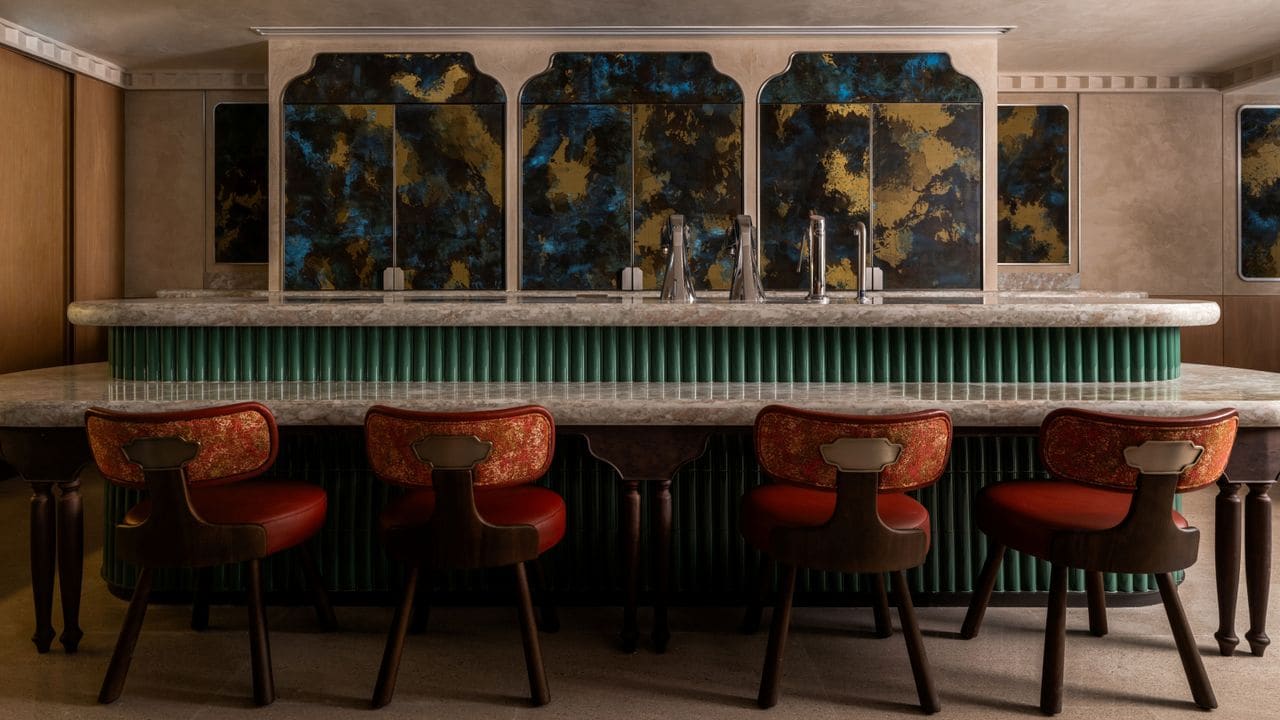
Most of the hotel's dining venues remained operational during renovation, a logistical feat that speaks to the property's integration within the larger Landmark complex. The Communal, an artisan coffee shop just off the lobby, functions as both guest amenity and neighborhood draw. Bamboo-shaped tiles in dark lustrous green line the marble-topped bar; plush booth seating faces the preparation area where baristas work with beans from nearby roastery Hazel & Hershey, roasted daily.
The space reads as genuinely welcoming rather than performatively casual, a balance many hotel coffee concepts fail to strike. Morning light floods the room, and the service carries none of the stiffness that can plague luxury properties attempting to code-switch for a local audience. It succeeds because it doesn't try too hard - good coffee, comfortable seating, efficient service. The fundamentals, executed well.
The seventh floor is where the property's dining identity crystallizes. Blanc de Noires, a champagne-focused bar created as part of the renovation, seats approximately twenty-five guests in a space designed to evoke intimacy bordering on secrecy. White marble floors catch and scatter low ambient light; black wood paneling absorbs it, creating pockets of shadow. The bar team wears white dinner jackets, a detail that tips the aesthetic toward 1980s postmodernism reinterpreting 1920s speakeasy glamour.
Twenty-five champagnes are available by the glass, each expertly paired by the sommelier to selections from what the bar calls its "Ham Library" - an extensive collection of cured meats sliced to order based on individual preference. The concept sounds gimmicky in description but lands with precision in execution. The pairings work, the space holds its mood without feeling contrived, and the experience avoids both stuffiness and forced whimsy. In a city dense with exceptional drinking venues, Blanc de Noires earns its place through specificity of vision rather than breadth of offering.
Context and Cosmopolitanism
Central is in flux. The Landmark complex itself is undergoing phased renovation; closer to the waterfront, construction continues on Central Yards, a project designed to introduce more green space into a district dominated by vertical glass. These transformations are not background - they are the story. Hong Kong has always rebuilt itself, layering new infrastructure over old foundations, and this hotel's reopening arrives as one chapter in that ongoing narrative.
The property sits within walking distance of the Victoria Peak Tram, the Star Ferry Terminal, Man Mo Temple, and the Tai Kwun Cultural Centre. An almost entirely covered route connects to the Central MTR station, placing the rest of Hong Kong Island and Kowloon within easy reach. But proximity to transit is not the same as invitation to leave. The concentration of dining, shopping, and cultural sites within Central itself - The Anthology, Prologue, and the sprawling international boutiques that occupy the Landmark's retail levels - creates gravitational pull. You could spend days within a few blocks and feel no lack.
What the hotel offers, beyond comfort and craft, is a lens through which to understand contemporary Hong Kong. Not the postcard version, not the heritage nostalgia, but the cosmopolitan city that functions as both regional hub and deeply local ecosystem. The design choices reflect that duality: colonial-era references rendered in modern materials, international luxury sensibility grounded in neighborhood-scale hospitality, art that speaks to place without performing it.
The Measure of a Stay
We return to cities for many reasons - work, family, curiosity - but we return to hotels because they have earned our trust. Trust that the room will be as we remembered, that the service will anticipate rather than intrude, that the property understands its role as facilitator rather than destination. Mandarin Oriental The Landmark operates with that understanding. It does not compete with the city; it orients you within it.
The hotels we've returned to this year share a quality difficult to quantify but unmistakable in experience: they feel inhabited rather than staged. This property achieves that through accumulation of detail - the hand-painted elevators, the ceramics in the corridors, the bamboo tiles behind the coffee bar, the sommelier who remembers your preference. Individually small, collectively they construct an atmosphere of care that extends beyond professional courtesy into something closer to genuine hospitality.
Hong Kong rewards familiarity. The city reveals itself slowly, in layers, to those willing to look past the obvious. A hotel that understands this - that positions itself as a place for locals to gather and visitors to observe that gathering - serves a function beyond accommodation. It becomes a point of entry, a space where the cosmopolitan and the intimate overlap, where the city's past and present exist not in tension but in dialogue. In a district rebuilding itself around new green spaces and renovated modernist landmarks, that kind of bridging feels not just welcome but necessary.
Credit: Common Studio / Joyce Wang Studio
Spot something wrong? Email editors@globalchicvoyage.com. We log every correction publicly.
RELATED
SEE ALL →
27 Jul 2026 / 5 min
28 Jul 2026 / 5 min
28 Jul 2026 / 5 min
14 Jul 2026 / 5 min