
Where Olive Groves Meet Longevity: A Return to Crete's Table
On Greece's largest island, food is communion, medicine, and memory all at once. A journey through biodynamic farms and village feasts reveals what nourishment really means.
SI
2 Jul 2026 · 5 MIN READ · UPDATED 17 AUG 2026
The Weight of a Clay Pot
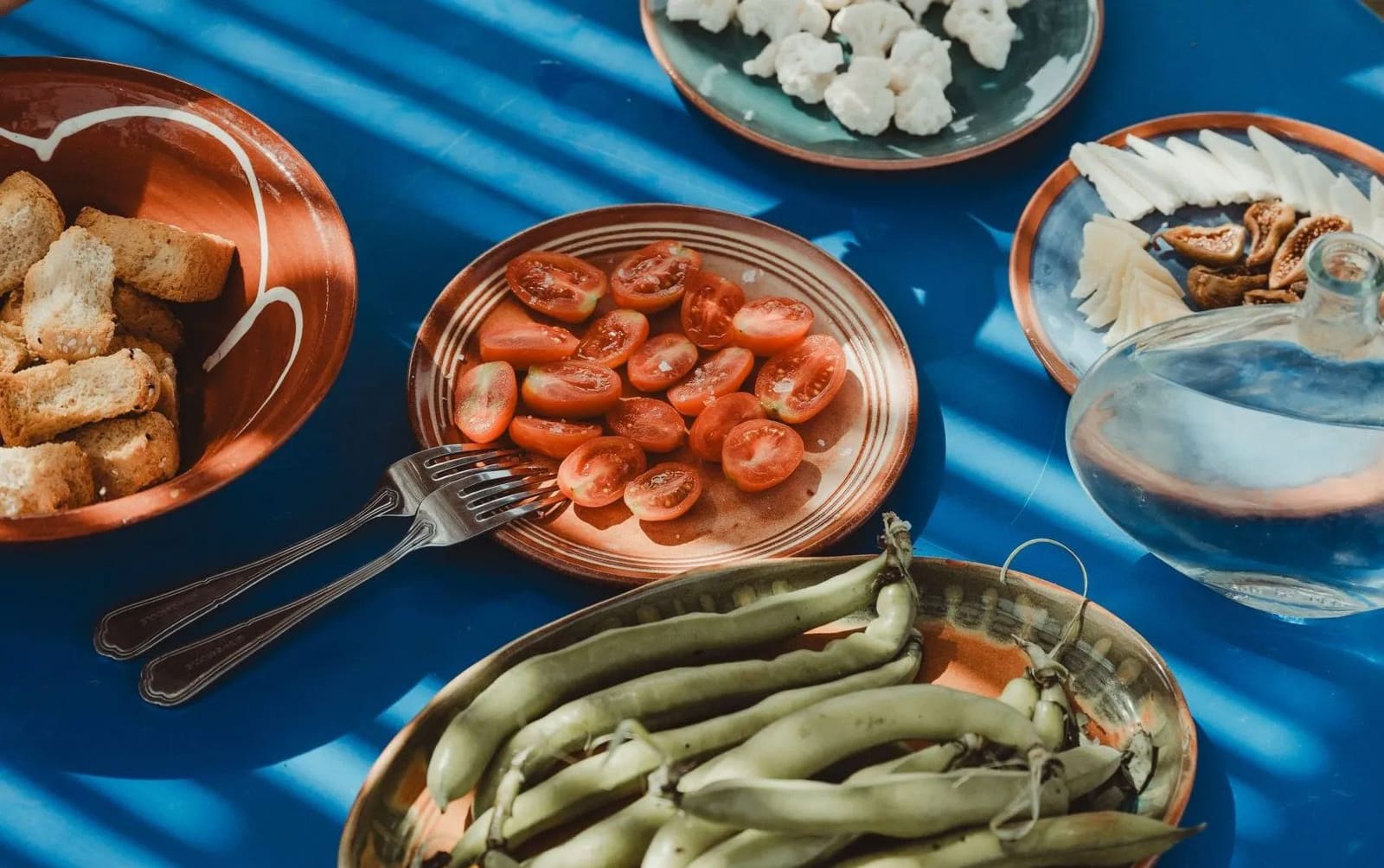
The cicadas were deafening at noon in Charaso, a mountain village where stone walls hold centuries of heat and the sea glimmers in the distance like a mirage. I had already eaten what I thought was lunch: bread dense with carob flour, cheese that tasted of wild herbs, pork from animals I'd seen rooting in compost an hour earlier, tomatoes that seemed to carry the entire summer in their flesh. My driver sat somewhere in the shade, patient or resigned. I was trying to leave when Agelos looked up from his fire and shook his head.
"When you are in Kreta, we're going to feed you," he said, spooning eggplant and lamb from a terracotta pot, the kind that has cooked over open flame for longer than anyone can remember. "No matter what."
At Global Chic Voyage, we've watched wellness travel evolve into something often unrecognizable: juice fasts in sterile clinics, meal plans that read like penance. But here, at Peskesi Organic Farm, nourishment looks different. It looks like Agelos drizzling golden olive oil over braised vegetables until the plate shines. It sounds like roosters and conversation in equal measure. It tastes like abundance, not abstinence.
This is the food culture of Crete, where health has never required an apology.
Farming by Moonlight
Peskesi operates on principles most modern agriculture abandoned decades ago. The farm follows biodynamic methods, a system developed in the early twentieth century that treats the land as a living organism rather than a factory floor. Planting, pruning, and harvest all follow lunar cycles; the moon's gravitational pull influences moisture and energy in the soil, optimizing water use in a climate that offers little mercy during summer.
Standing in the farm's herb-drying shed, watching bundles of oregano and thyme hang from wooden beams, I thought about the word "sustainable." It has been drained of meaning by overuse, reduced to marketing copy. But here, sustainability is not a brand position. It is a clay pot that has cooked the same dish for generations. It is compost made from restaurant scraps, returned to fields that grow next season's tomatoes. It is pigs that live in mud with a view of the Cretan Sea, their future as lunch neither hidden nor sentimentalized.
Yorgos, who guided me through the 24-acre estate, introduced me to Melpo, the farm's mule. "Very smart creatures," he said, scratching her ears. "She remembers faces." The goats bleated from their stone enclosure. Chickens scattered as we passed. Everything here serves a purpose, and nothing is wasted.
The farm supplies Peskesi's restaurant in Heraklion, which feeds approximately 600 people daily with dishes rooted in Cretan tradition: dakos, the barley-rusk salad that tastes of stone and salt; ladera, stews cooked slowly in olive oil until vegetables collapse into silk. The restaurant's waste returns to the farm as compost, closing a loop that most food systems have forgotten how to draw.
The Liquid Gold Standard
Crete is home to roughly 30 million olive trees, a quarter of Greece's total, and nearly all of them produce extra virgin oil high in phenolics, the compounds researchers associate with cardiovascular health and longevity. The island has been Greece's agricultural heart for four millennia, since the Minoans planted the first groves during the Bronze Age. Peskesi's own oil, labeled Talos, has earned gold recognition at the New York International Olive Oil Competition.
But numbers and accolades don't capture what olive oil means here. It is poured with the generosity of someone who knows there will always be more. It finishes every dish, not as garnish but as ingredient, as medicine, as gesture. I watched Agelos add a final glug to my plate and understood: this is not restraint. This is trust in the land to provide.
Crete was named the European Region of Gastronomy for 2026, an acknowledgment of what the island has always known. Every July, thousands gather in Rethymno's Municipal Garden for the Cretan Diet Festival, where food, music, and folk dancing merge into a celebration that feels less like a wellness retreat and more like a village wedding. The lyra and laouto, traditional Cretan instruments, play late into the night. Locals and visitors alike eat from shared plates, dance in circles, drink unfiltered wine that tastes faintly of earth and fermentation.
"In Crete, food is never just sustenance; it is an act of communion," explains Martha Papadomichelaki, tourism development manager for the Municipality of Rethymno. The festival replicates a traditional panigiri, the village feasts that punctuate Greek life, where the act of gathering matters as much as the meal itself.
This is the part of Cretan food culture that cannot be bottled or exported: the warmth, the insistence, the refusal to let anyone leave hungry or alone.
What the Blue Zone Forgot to Mention
Health experts have long praised the Cretan diet as a cornerstone of Blue Zone living, citing its emphasis on vegetables, olive oil, fish, and whole grains. The fermented grain trahanas, tangy and rich with tomato, appears in kitchens across the island. Wild mountain tea, raw honey, fresh dairy, and natural wine consumed in moderation all contribute to the region's reputation for longevity.
But the Cretan approach to food is not a list of restrictions. It is not about what you eliminate. It is about what you include, and how, and with whom.
I grew up attending lamb-roast block parties on Long Island, my Greek mother's way of keeping culture alive far from its source. Those summer panagiri taught me that food is a language, one spoken loudest in generosity and repetition. After eight months caring for infant twins through a Boston winter, recovering from a postpartum hemorrhage that left me pale and depleted, I came to Crete not for a detox but for the opposite: for abundance, for flavor, for the kind of nourishment that restores rather than restricts.
The island delivered. At Apiri Greek Eatery in Heraklion, a restaurant where booking a table requires strategy and luck, I ate sea bass over wild greens swimming in a lemon sauce that tasted startlingly like avgolemono, the egg-and-lemon soup my mother and sister made for me weekly during my recovery. Sitting alone in the restaurant's hum, I felt the ache of recognition. This is what food does when it is made with care: it becomes memory, medicine, and communion all at once.
Apiri draws both visitors and locals with inventive takes on Greek tradition: crudos accented with tzatziki and seaweed, dishes that honor the past while refusing to be bound by it. The restaurant recently expanded with Ferment Artisan Lab next door, a wine-tasting space where oenophiles can explore the island's indigenous grapes without needing a car. Moschofilero whites and rosés, Mavrotaganos reds, Vidianos skin-contact orange wines, all shaped by Crete's limestone-rich elevations and Mediterranean sun.
The Natural Wine Rebellion
The wine culture here mirrors the farming: low-intervention, regenerative, unfiltered. The bottles lining Apiri's shelves are funky and alive, made by producers scattered across Crete's southwest near Chania, where a wine trail winds through medieval tasting rooms and sprawling vineyard estates. These winemakers reject industrial methods in favor of practices that restore rather than deplete the land.
Greece's Bank of Monetary Policy recently urged the country to foster cultural tourism, wellness travel, rural tourism, and gastronomy-based experiences beyond the small islands, an effort to soften overtourism's strain on water supplies and public health systems. Crete's regenerative farms and natural wineries offer a model: tourism that nourishes the land rather than exhausting it.
But the island's food culture resists being packaged as wellness in the contemporary sense. At Acro Wellness Suites in Agia Pelagia, breakfast includes green juice alongside galaktoboureko, the custard pie soaked in syrup and dusted with cinnamon. Dessert arrives whether you ask for it or not. If you decline, your server will appear with a shot of raki, the grape-must brandy that is Crete's unofficial digestif, and a story about their grandmother who drank it every morning with mountain tea before heading to the olive grove.
"Several shots," one server clarified. "She was strong as an ox." She lived to be 100.
The Wisdom of Moderation, Moderately Applied
Crete taught me something I had forgotten in the haze of early motherhood, when my body felt foreign and my energy finite: nourishment is not about denial. It is about trust. Trust in the food, trust in the body's ability to process richness and rest, trust in the people who insist on feeding you even when you think you've had enough.
Everything in moderation, including moderation itself. It is a principle many nutrition experts endorse, and one every Cretan seems to live by as they pour you another glass of wine, spoon more stew onto your plate, refuse to let you leave without dessert.
The island is distinct from the rest of Greece in ways both geographic and cultural. Cretans will tell you they are from Kreta, not Greece, the same way a Sicilian distinguishes their island from Italy. This pride runs through every meal, every farm, every conversation over raki and olives. It is a pride rooted in land, in continuity, in the knowledge that their way of eating has sustained life for four thousand years.
At Peskesi, watching Agelos tend his fire and stir his pots, I understood why I had come. Not for a reset or a cleanse, but for a reminder: food is meant to be enjoyed. Health is not a restriction but a practice, one that includes pleasure, company, and the occasional shot of brandy in the afternoon.
When I finally left the farm, full beyond belief and slightly dizzy from the wine, Agelos waved from the patio. The clay pots still simmered. The cicadas still buzzed. The island continued its work of feeding whoever arrived, no matter what.
Notes for the Table
Crete remains accessible yet unhurried, a rare combination in Mediterranean travel. The International Airport of Heraklion offers the most direct access to the island's northern coast, where village-style resorts dot the shoreline near Agia Pelagia. Venturing inland to places like Charaso requires a car or hired driver; roads narrow and turn to dust as they climb into the mountains, but the journey is part of the experience. Most hotels can arrange drivers for half-day excursions, a service that costs little more than a rental car and spares you the anxiety of navigating switchbacks in the heat.
The island's wine trail near Chania rewards exploration, particularly for those drawn to natural and biodynamic producers. Tasting rooms range from rustic to refined, but all share a commitment to the land and a skepticism of industrial shortcuts.
Crete does not ask you to choose between pleasure and health. It offers both, in equal measure, on the same plate. At Global Chic Voyage, we believe that is the future of wellness travel: not deprivation dressed as virtue, but abundance rooted in care. The island has been proving it for millennia.
Spot something wrong? Email editors@globalchicvoyage.com. We log every correction publicly.
RELATED
SEE ALL →
7 Aug 2026 / 5 min
30 Jul 2026 / 5 min
30 Jul 2026 / 5 min
29 Jul 2026 / 5 min