
Where Hospitality Meets Ambition: Charleston's New Culinary Language
In a Southern port city opening fifty restaurants a year, the table has become a stage for reinvention - and the old rules no longer apply.
SI
29 Jul 2026 · 5 MIN READ · UPDATED 17 AUG 2026
A City That Eats Its Own History
There is a moment, late on a Thursday evening in Charleston's French Quarter, when you realize you are not simply eating dinner. You are watching twelve strangers lean forward in unison, elbows on a sushi counter, as chefs in the center of the room orchestrate seventeen courses with the precision of a symphony. Gold leaf catches the light. Caviar appears on rice you did not know could taste like this. Someone laughs. The music shifts. You understand, suddenly, that this port city - sleepy no longer - has learned to speak in a new culinary language, one that honors its past while refusing to be confined by it.
At Global Chic Voyage, we have watched Charleston evolve over the past decade from a place where shrimp and grits defined the dining conversation to a metropolis opening forty-five to fifty new restaurants each year. That is not a trend. That is a transformation. And the establishments earning staying power are those that treat hospitality not as a service model but as an art form - a way of making strangers feel like regulars before the first course arrives.
The French Interruption
On Upper King Street, where tourists spill out of bars and bachelorette parties clog the sidewalks, there is a stucco-walled refuge that feels like stepping through a portal into the French countryside. La Cave occupies a block you might walk past, dismissing it as too loud, too crowded, too obvious. You would be wrong.
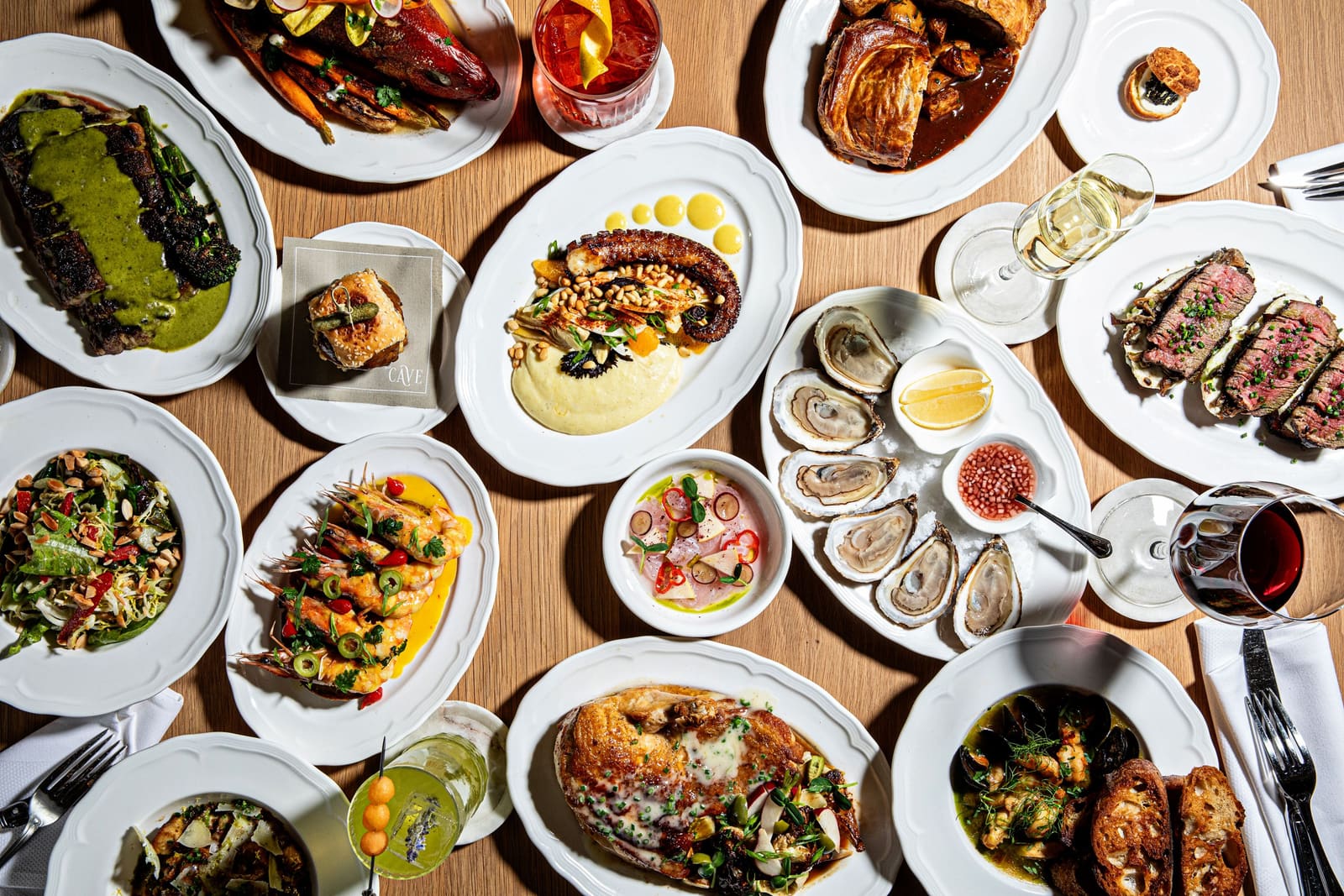
Inside, the noise of the street dissolves. Chef Alex Eaton, who honed her craft in some of Charleston's most respected kitchens, brings a deft hand to crudo - a dish the city has adopted as its own - and pairs it with a salad dressed in Roquefort vinaigrette that tastes like summer in Provence. Local fish appears whole, plated with the kind of reverence that makes you remember why you came to the Lowcountry in the first place. Oysters and caviar arrive as preludes to steak, or whatever Eaton has decided to feature that evening. The menu shifts, but the philosophy remains constant: local ingredients filtered through the lens of French technique, served in a room that makes you want to linger over a second bottle of Champagne.
This is not fusion. This is translation - a chef fluent in both languages, moving between them with ease.
The Suburbs Have Something to Say
Charleston's metro area has stretched eastward, and with it, the culinary map has expanded. In Mount Pleasant, near a Costco and just off Highway 17, Lola Rose sits in a location that might read as compromise. It is anything but.
Chef Kevin Johnson, whose downtown restaurant The Grocery has long been a fixture on best-of lists, has opened a second act here, and it resists easy categorization. Yes, there are wood-fired pizzas and hummus, the Mediterranean staples that have become his signature. But Chef de Cuisine Isabel Picus has left her mark, too - roasted scallops with fennel and orange that taste like the coast, pastas with ragu and bolognese that layer flavor until you forget you are eating in a strip mall. The interior, designed by David Thompson, is clean and buzzing, filled with locals who know this is not a lesser version of something downtown. It is its own argument, made with conviction.
The message is clear: great food no longer requires a historic district address. It requires intention.
When Elegance Becomes the Point
For too long, Indian cuisine in the American South has been relegated to lunch buffets - an accessible entry point, perhaps, but one that flattens a culinary tradition as varied as the subcontinent itself. Rivayat, in the Cannonborough neighborhood, offers a counterpoint.
The space itself is a statement. Indian murals and golden yellow walls meet indigo blue accents, and the bar glows with activity. The plating is sculptural: lamb chops stacked with precision, naan soft and fragrant with garlic, oysters pulled from local waters and prepared with spices that make you reconsider everything you thought you knew about raw shellfish. This is Indian food as fine dining, a cuisine treated with the same reverence Charleston typically reserves for French or Italian traditions.
The Cochin scallops arrive as a revelation - local seafood meeting South Indian technique in a dish that feels both rooted and inventive. Rivayat does not simplify or apologize. It invites you to meet the food on its own terms, and the invitation is worth accepting.
The Theater of Omakase
Sushi Bar, tucked into the French Quarter, operates less like a restaurant and more like a backstage pass. You wait in an anteroom with Champagne until the doors open, revealing a twelve-seat counter surrounding chefs who work with the focus of surgeons and the flair of performers. This is dinner as spectacle, and under Chef Anthony Martin - who holds two Michelin stars - it is a spectacle worth the price of admission.
The seventeen-course omakase experience unfolds in waves. Foie gras. Gold leaf. Caviar. Nigiri that redefines what you thought sushi could be. Each bite builds on the last, a crescendo that mirrors the music playing overhead. This is not the place for a casual Tuesday. This is the place for the promotion, the proposal, the night you want to remember because you earned it.
The Evolution of a Beer Hall
Edmund's Original - formerly Edmund's Oast - changed names and ownership recently, but the soul of the place remains intact. The space is divided: an outdoor bower for casual drinks and snacks, and an interior dining room that stretches the length of a beer hall, anchored by dark wood, substantial chairs, and a wall of rotating taps.
Chef Bob Cook has been a fixture in Charleston kitchens for nearly twenty years, and his menu reads like a autobiography. There is a burger that revives a cult favorite from his Artisan Meat Share days. There are frog legs and escargot, macaroni with peas, a ginger salad with cucumbers that tastes like summer. His Midwestern roots show up alongside his love for Asian flavors and his mastery of butchery. The result is a menu that feels personal rather than calculated, the kind of place where you can order anything and trust the instinct.
On weekends, the encrusted prime rib becomes the draw, and locals know to arrive early.
The Spanish Lens on Lowcountry Bounty
Estadio, in Cannonborough, has evolved steadily since Max Kuller opened it in 2019. Each chef who has passed through the kitchen has brought a new interpretation of the same mandate: local ingredients, Spanish technique, and a commitment to using every part of the animal.
Chef Jeremy Gozlan took over last year, bringing baking skills - his Basque cheesecake has become legendary - and a nose-to-tail philosophy that results in beef heart skewers sharing menu space with tortilla española and patty pan squash dressed with jamón. This is a restaurant for regulars, the kind of place where the menu shifts subtly with the seasons and the staff remembers your name. You can stop in for pintxos and a drink, or you can settle in for the evening. Either way, you will leave satisfied.
Tasting Menus as Clockwork
Zero George is a property that resists easy description. A cluster of antebellum buildings connected by a serene courtyard houses one of Charleston's highest-rated boutique hotels and a two-story restaurant with an open kitchen. You can dine in the courtyard, in the main dining room, or in an upstairs drawing room that feels like a private salon.
Chef Vinson Petrillo has returned to the kitchen here, and his tasting menu runs with the kind of pacing that makes three hours feel effortless. The evening begins playfully - a bite that looks like a cigar but tastes like beef and pastry - and builds through caviar courses to a wagyu beef main that justifies every dollar spent. This is fine dining as it should be: ambitious, precise, and aware that timing matters as much as flavor.
The Dressing Room Intimacy of Merci
Merci, in Harleston Village, occupies a nineteenth-century building that designer Helen Rice has transformed into something that feels like a secret. The space is intimate, luxurious, and lit at golden hour with the kind of care that makes you want to photograph your wine glass. Regulars move through the room with quiet confidence, and they have earned it - this is one of the most coveted reservations in the city.
The menu is seasonally driven and European in spirit, with pasta that achieves toothsome perfection and slow-cooked chicken that tastes like it has been simmering for days. Lowcountry vegetables appear at their peak, treated with a restraint that allows their flavor to speak. The beef Wellington arrives as both classic and revelation, a dish that has been prepared thousands of times but rarely this well.
What Fifty Restaurants a Year Means
Charleston is not simply opening restaurants. It is rewriting the rules of Southern dining, one kitchen at a time. The city has learned that hospitality is not about charm - it is about making people feel seen. That innovation does not require abandoning tradition - it requires understanding which traditions are worth keeping and which are ready to evolve.
The best tables in Charleston today are not defined by their proximity to historic sites or their adherence to Lowcountry orthodoxy. They are defined by chefs who know how to listen - to the season, to the ingredient, to the diner sitting across the counter - and respond with generosity and skill.
At Global Chic Voyage, we return to Charleston because it is a city that eats its own history and transforms it into something new. Because a port city that once defined itself by what arrived on ships now defines itself by what happens in its kitchens. Because hospitality, when practiced with ambition, becomes its own form of luxury.
And because sometimes, late on a Thursday evening, you need to sit at a counter and watch strangers lean forward in unison, tasting the future.
Credit: Andrew Cebulka
Spot something wrong? Email editors@globalchicvoyage.com. We log every correction publicly.
RELATED
SEE ALL →
22 May 2026 / 5 min
13 May 2026 / 5 min
4 May 2026 / 5 min
20 Apr 2026 / 5 min