
The Looms and Silk Makers Shaping Lake Como's Quiet Luxury
Beyond the celebrity villas and grand hotels, northern Italy's most famous lake is sustained by weavers, woodworkers, and artisans whose centuries-old workshops define what true luxury means.
SI
18 Aug 2026 · 6 MIN READ · UPDATED 18 AUG 2026
A Year for Six Meters
The afternoon light filtering through the workshop arrives already transformed, softened by silk before it reaches the loom. Lorita Bellocco sits at an 18th-century weaving frame, her hands moving between 800 individual spools with the deliberate precision of someone performing surgery on thread. The loom itself is a workhorse, all wood and iron and accumulated memory, and when she pushes the pedal it responds with a low, mechanical grunt that sounds less like machinery and more like breathing.
It will take her twelve months to complete six meters of fabric. The finished textile will eventually dress an interior at Tiffany & Co. or hang in the boxes at La Scala, or perhaps upholster a chair in one of the grand hotels that line the lake's perimeter. But for now, it exists only as possibility, as tension held between warp and weft, as the physical manifestation of what Bellocco describes as mental endurance. The work is not simply manual. It requires a kind of meditative focus that few possess and fewer still can sustain.
This is Rubelli, a textile house whose archive spans thousands of patterns and whose collaborations have included everyone from mid-century designer Gio Ponti to contemporary artist Ai Weiwei. And this room, tucked just off the shores of Lake Como, is where the house's most prized pieces begin.
What the Mulberry Bushes Started
At Global Chic Voyage, we have always believed that the most compelling destinations are those where landscape and livelihood are inseparable. Lake Como is famous for its Riva speedboats and its star-studded real estate, for the way light plays across water and how the mountains rise like theater curtains on either side. But the lake's proximity to Milan made it something else entirely: a production center for the materials that defined Italian luxury for centuries.
The story begins, as so many Italian craft stories do, with a duke and a good idea. In the 15th century, a Milanese nobleman ordered mulberry bushes planted along the lake's fertile shores. The decision was strategic. Milan's appetite for silk was insatiable, and the microclimate around Como, temperate and protected, proved ideal for sericulture. Over the following centuries, the region became synonymous with textile production, its workshops supplying the upholsterers, dressmakers, and decorators whose work filled the palazzos and opera houses of northern Italy.
Today, Como remains one of Europe's most important centers for silk. Maisons like Mantero, whose delicate printed scarves are commissioned by houses including Chanel, operate with a scale and archive that feels less like a business and more like a living museum. The company employs more than 500 people and maintains a collection of 75,000 fabric prints and 80,000 silk scarves, stored in a meditative, climate-controlled archive that few outsiders ever see.
Woodworking, too, has deep roots here. Towns like Bellagio became known for their inlay work, their ability to coax pattern and image from contrasting grains. The tradition continues in workshops like Castiglioni, where craftspeople restore antique floorboards and create new pieces that honor historical techniques.
The Hotels as Canvas
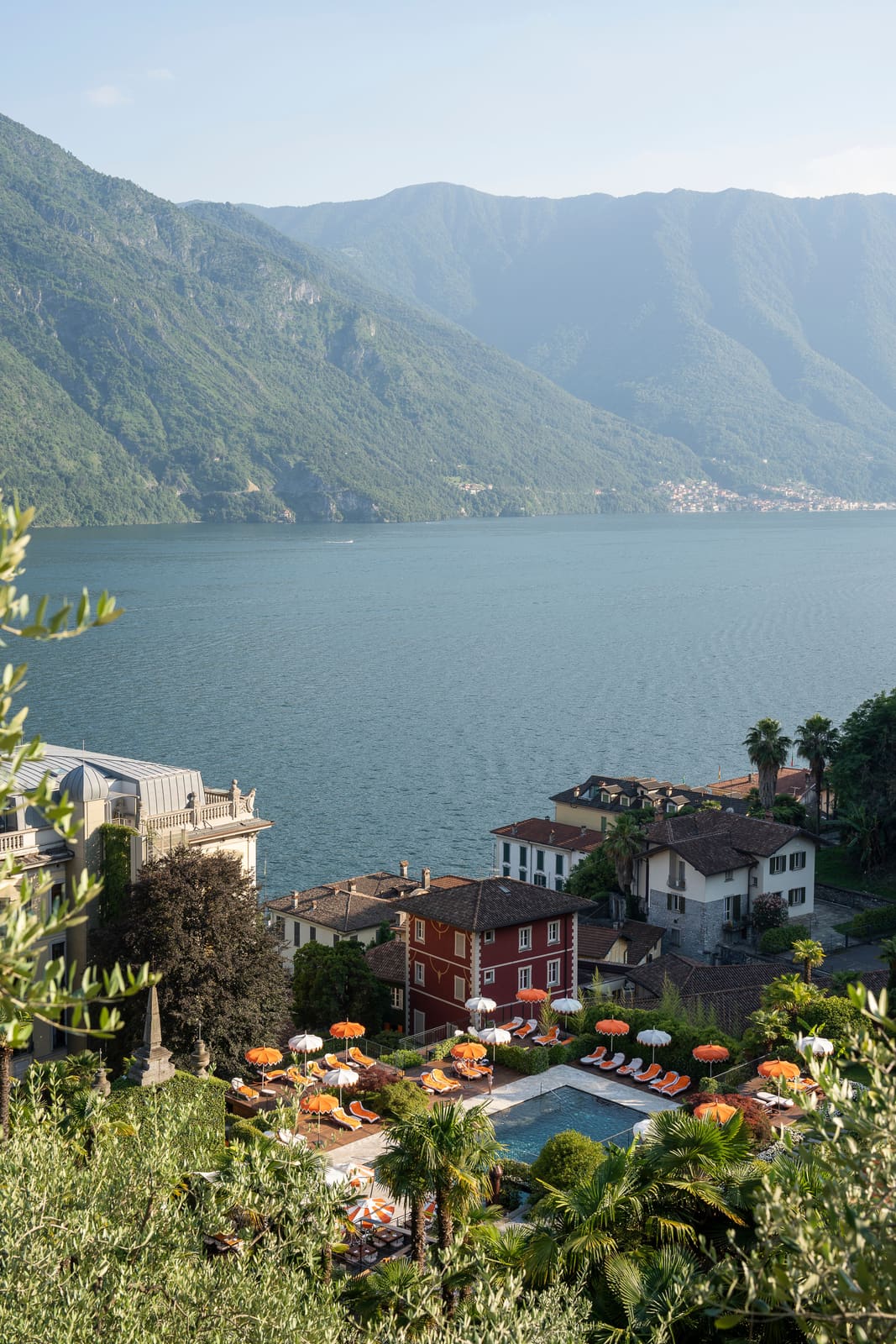
Valentina De Santis grew up in a crib upholstered with Como silk. Her family, rooted in the region for three generations, has built a hospitality empire that functions as both showcase and patron for the artisans who work along the lake. At Grand Hotel Tremezzo, the couches, pillows, and drapery all carry the mark of Rubelli. The hotel itself, palatial and unapologetically grand, serves as a kind of showroom for local craft.
De Santis speaks about her partnerships with a conviction that borders on the philosophical. Heritage and authenticity are not marketing language for her; they are the architecture of identity. She describes the artisans as custodians, as people whose hands carry forward not just technique but a way of understanding material, beauty, and time. Regional pride, she says, is inseparable from the definition of luxury her properties pursue.
Passalacqua, the family's second hotel, opened in 2022 inside an 18th-century villa that seems to have been designed specifically to overwhelm the senses. Frescoes climb the walls, Murano glass catches the light, marble floors reflect the shadows of centuries. The property worked closely with Mantero to create a series of custom-printed scarves, available for purchase, that depict scenes from the villa's history: the roosters that once entertained nobility, the gardens that slope down to the water, the architectural details that have survived wars and changing tastes.
Grand Hotel Tremezzo offers guests the opportunity to visit the Rubelli factory, to stand in the same room where Bellocco works her loom and to understand, perhaps for the first time, what it means when someone says a fabric is handmade. The tours are not performances. They are glimpses into the reality of craft, into the unglamorous patience required to make something beautiful.
A New Space for the Old Work
Como town itself has historically played a quieter role in the lake's tourism narrative, a functional hub overshadowed by the resort villages that dot the shoreline. But this year brought the opening of Casabianca, a project that blurs the line between gallery, restaurant, and guesthouse in a way that feels both considered and inevitable.
The space houses a private art collection assembled by Paolo and Antonella De Santis, Valentina's parents, with works from the 1960s through the 1980s. Pieces by artists including Anselm Kiefer and Marina Abramović hang in rooms where well-dressed locals gather for Negronis and precisely composed plates of pasta. The restaurant is an outpost of Milan's historic Cova, and the atmosphere is one of easy sophistication, the kind that comes from confidence rather than effort.
The building itself is a study in Como craft. Castiglioni, the noted local woodworking atelier, restored all the floorboards, honoring the original materials while ensuring structural integrity. Paolo De Santis describes the intention as creating the feeling of entering a family home, and the effect is surprisingly intimate despite the high ceilings and the art that commands attention from every wall.
Above the gallery, three suites offer perhaps the most design-focused accommodations on the lake. Gio Ponti taps in the bathrooms, Rubelli wallpaper, Milan-designed Azucena chairs, and views that stretch across the water toward the mountains. The rooms are not large, but they are meticulously considered, each detail chosen to reflect the intersection of Como's artisan tradition and Italy's modernist design legacy.
The Endurance Required
What strikes us most, returning to Como year after year, is not the beauty of the lake itself, though that remains undeniable. It is the persistence of the people who work just behind the scenery, in the workshops and mills and restoration studios where the pace is slow and the standards are uncompromising. Lorita Bellocco will spend a year on six meters of silk because that is what the work requires. Castiglioni will restore a floor one plank at a time because there is no other way to do it properly.
This is the luxury that does not announce itself, that cannot be photographed from a speedboat or captured in a sunset panorama. It is the luxury of time, of knowledge passed down, of hands that know how thread behaves and wood responds. It is, in the end, what makes Como more than a postcard, more than a backdrop for wealth. It is what makes it a place where making still matters.
Spot something wrong? Email editors@globalchicvoyage.com. We log every correction publicly.
RELATED
SEE ALL →
8 Aug 2026 / 5 min

7 Aug 2026 / 5 min

31 Jul 2026 / 5 min

27 Jul 2026 / 5 min