
The Pilgrimage Japan Forgot: Hokuriku's Mountain Valleys and Quiet Temples
While Kyoto buckles under the weight of mass tourism, the forested prefectures of Ishikawa and Fukui offer a quieter, older Japan - cypress baths beneath full moons, sake breweries in farming villages, and monastic silences unbroken for seven centuries.
SI
18 Aug 2026 · 8 MIN READ · UPDATED 18 AUG 2026
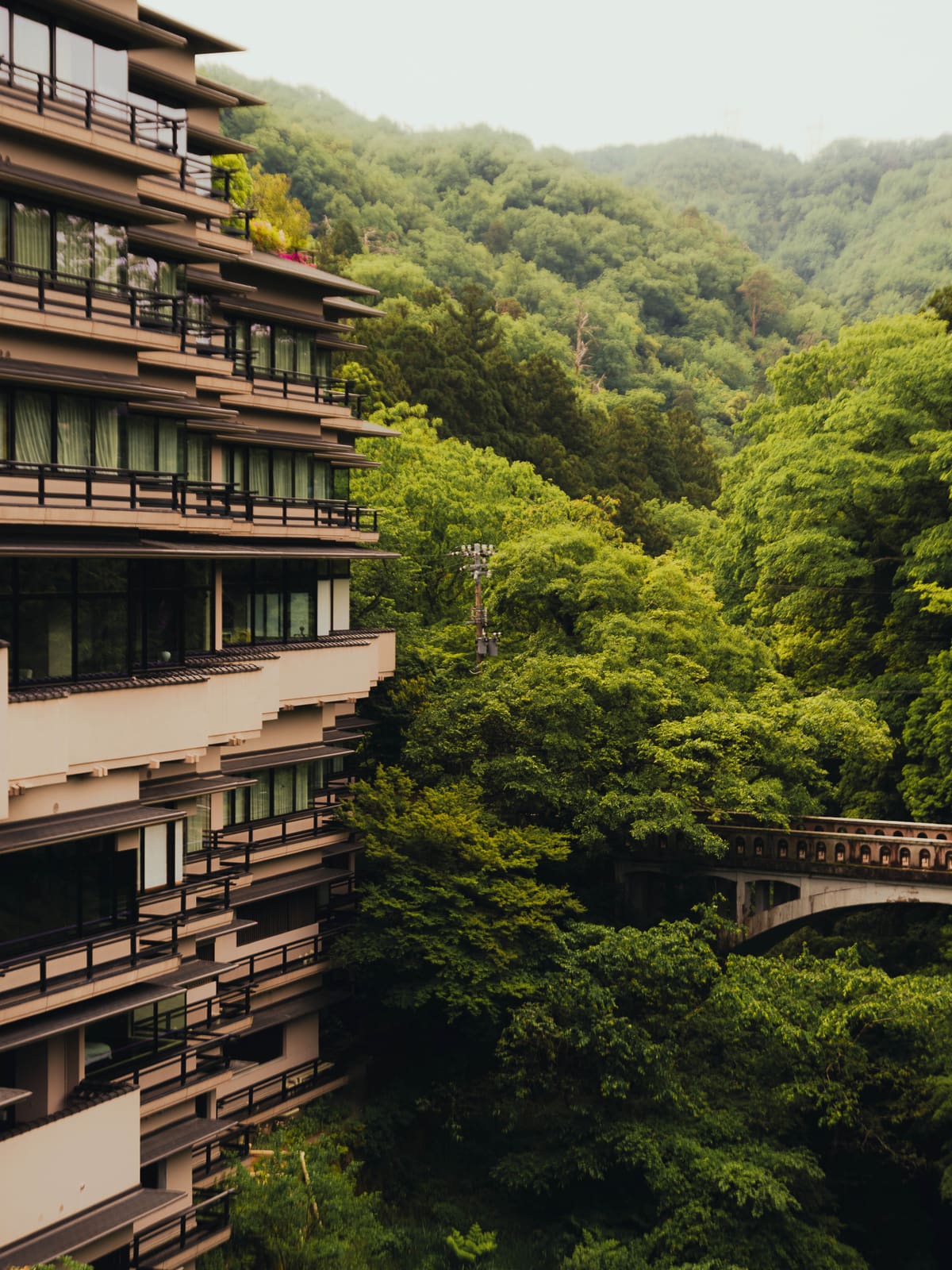
A Bath Under the Full Moon
The cypress tub was deep enough to sit in comfortably, hot enough to ease the tension from shoulders and neck, and the moon had just cleared the ridge of forested hills across the valley. No roofline interrupted the view, no power line cut the sky. Only the sound of the Daishoji River, urgent and cold, moving over stones far below the terrace. Two days earlier, the streets of Kyoto had been thick with demonstration placards and the crush of bodies funnelling through narrow alleys. Now, after a nine-course meal that included sweet potato infused with Earl Grey and rice grown on a farm where ducklings patrol the paddies instead of pesticides, the stars were beginning to appear overhead.
At Global Chic Voyage, we have watched Kyoto's transformation with a mixture of admiration and unease. The city received more than 75 million visitors in 2023 alone, and the quiet lanes we once walked at dawn are now impassable by midday. Friends write asking where they might find something closer to the Japan they imagined - something older, slower, less choreographed for the lens. And so we turned northwest, toward the prefectures of Ishikawa and Fukui in the Hokuriku region, where the mountains rise steep and green, where foreign visitors remain rare enough to prompt smiles, and where the old arts are not museum pieces but living practice.
The Inn That Owns the Mountain
Kayotei, a ryokan tucked into one corner of Yamanaka Onsen, feels less like accommodation and more like residence inside a private collection. The corridors are narrow, lined with treasure chests and scrolls and rows of ceramic pots whose provenance the staff can recite from memory. The furniture was assembled without nails, using joinery techniques refined over centuries. Nearly fifty years ago, Masanori Kamiguchi closed his father's multistory hotel and built something smaller, more intimate - ten suites, each designed to showcase the region's traditional crafts. Now in his nineties, Kamiguchi still appears in the incense-scented reception, greeting guests with the quiet authority of someone who has spent a lifetime curating beauty.
The inn maintains relationships with some thirty artisans across Ishikawa and Fukui, and guests are invited to visit their workshops. There is a kombu sommelier, a sake brewery, and a master of maki-e lacquerware who works with a brush made from mouse hair, rubbing gold powder into intricate designs until the surface gleams like water under lamplight. When the general manager served tea on our arrival, he mentioned, almost in passing, that the leaves came from the mountain behind the inn. Then he added, with characteristic understatement, that the ryokan owns the mountain.
Yamanaka Onsen has been a pilgrimage site for more than thirteen centuries, but in 2023 it welcomed fewer than forty foreign visitors per day. The name translates simply as "in the mountain," and the geography explains much of the obscurity. It lies an hour south of Kanazawa, two hours from Kyoto by train, three from Tokyo - close enough to reach easily, remote enough to have escaped the circuits.
Where Geisha Walk Alone at Dusk
A young American writer arrived in Yamanaka several years ago, intending to spend two months working at a sake bar. She ended up buying a house. Her book about the experience describes learning wood turning, making sake with her neighbors, and watching the autumn ritual in which a Buddhist monk leads prayers beside a large tombstone erected for the ducks caught in Y-shaped nets along the river. When we walked together along Kakusenkei Gorge, which runs behind the village, a woman managing a red-parasol cafe set on rocks beside the water called out her name. Everywhere, locals greeted her as one of their own.
The village operates on a different scale. One shop stocks goods that cost nothing. Old women offer coffee for free at the weekend market. At Kayotei, the staff explained that guests sometimes request keys, but the inn rarely needs them. A young woman in a kimono walked alone through the empty streets at dusk, on her way to perform at an eel restaurant - one of the local geisha, still practicing an art that in larger cities has become almost entirely transactional.
Across the street from Kayotei, another ryokan is redefining what tradition can look like in the present tense. Hanamurasaki is run by a couple in their thirties who lived abroad and returned to transform the family inn into something sleeker, more contemporary. The automatic doors open onto black lacquer furnishings and a restaurant that feels airlifted from a design capital. The welcome tea arrived in a wine glass, part of a three-tier afternoon tea featuring vegetable sushi and meringues made from roasted twig tea. If Kayotei is all hush, Hanamurasaki is all buzz - proof that the next generation is finding ways to honor the past without embalming it.
The Pop Star Who Carves Knife Handles
An hour west into Fukui prefecture, the landscape opens into rice paddies and wooden farmhouses. The roads narrow to single lanes. There are no concrete towers, no chain convenience stores lit like operating theaters. Domestic tourists come in winter for snow crabs and the picturesque drifts, but foreign visitors remain scarce enough to be a novelty.
At a workshop that produces high-quality knife handles, a young woman with an infectious smile led us through the compound and then carved a name in Japanese characters onto the blade of a vegetable knife. Her energy was remarkable, and only later did she admit, shyly, that she also works as a pop star - singing, dancing, the full repertoire. Two days later, at a paper mill where visitors are guided through the delicate process of making washi, a photo behind the cash register showed the same face. She serves as an instructor here when she is not working on lacquerware or performing onstage.
It was a reminder of how many young people return to these rural prefectures after time in the cities, drawn by the slower pace and the blessings of community. One woman who moved to Fukui from elsewhere told us that people here are committed to tradition but determined to make it new and fresh. It takes progressive thinking, she said, to keep old ways relevant.
The Monastery Where Monks Do Not Speak
For decades, we had wanted to visit Eiheiji, the great Zen training center founded in 1244 by Dogen Zenji. It is the largest Soto Zen monastery in Japan, the birthplace of a practice that now has people across the globe sitting in silence, eyes closed, facing a wall. The approach was gradual, designed to build anticipation. First, a stop at Heisenji Hakusan Shrine, a sacred site that once housed six thousand buildings before being burned to the ground in the sixteenth century. Old women climbed the steep slope on canes - many make the pilgrimage daily - until we reached the small main shrine, where a woman in elaborate robes was speaking to a group of visitors. She turned to us and explained, in clear English, that her husband, the chief priest, had passed away, and her son was still completing his studies. So she had become a priest herself, one of the small minority of Shinto clergy who are women. Then she waved a white whisk above two small boys and sat down to tell them how to get on at school.
Next came a deserted car park and a monk who greeted us in English, leading us on a breathless twenty-minute hike to Kippoji, a hilltop temple with historical ties to Eiheiji. The young monks in training served a monastic vegetarian meal - spiced tofu, mushroom rice, pancakes made without milk or eggs - and then our host, who had been working in Tokyo television until his family temple needed a priest, began pounding on a three-hundred-fifty-year-old drum from a samurai castle.
Nothing prepared us for the scale of Eiheiji itself. The complex is monumental, a collection of large wooden buildings set against the hills, tall pines all around, another rushing river alongside. Its seven principal structures are said to resemble the seated Buddha - head, heart, waist, arms, knees. In three of them, the training monks are not allowed to speak. Our guide, a reverend who had once toured the world as an opera singer before his family temple required a priest, opened a door to a large, dark space not usually seen by outsiders: the meditation hall where eighty monks meditate, eat, and sleep, each on a single tatami mat.
At four in the morning, we followed a faint trail of lanterns under an indigo sky, past the dragon entrance and up into the dark buildings. The reverend appeared to give an introduction, in Japanese and English, to a day in the life of a training monk. Then he led us up to the dharma hall, which stands high above the other structures, and we sat in silence as the first light began to touch the mountains.
Why Obscurity Is a Gift
Fukui ranks forty-sixth among Japan's forty-seven prefectures for international arrivals. In 2023, it received fewer than one foreign visitor for every six hundred pouring into Tokyo. For those of us who have watched beloved places bend and break under the weight of tourism, this obscurity feels less like neglect and more like grace. The villages of Hokuriku are not undiscovered - they have been cherished by the Japanese for centuries. They are simply overlooked by the circuits that move millions of visitors along the same narrow tracks.
What we found in Ishikawa and Fukui was not a Japan frozen in amber but a Japan still in motion - artisans returning from the cities to revive family workshops, young priests taking on robes after careers in television and opera, innkeepers reimagining tradition without severing its roots. The cypress bath, the full moon, the sound of the river - these were not staged for us. They were simply there, as they have been for thirteen centuries, waiting for anyone willing to take the slower train.
Spot something wrong? Email editors@globalchicvoyage.com. We log every correction publicly.
RELATED
SEE ALL →
13 Jun 2026 / 5 min
27 Jul 2026 / 5 min
27 Jul 2026 / 5 min

18 Aug 2026 / 4 min