
The Island Where Kelp Forests Rise Like Cathedrals
Off the Southern California coast, Catalina Island offers underwater landscapes that rival the world's best diving destinations.
SI
18 Aug 2026 · 4 MIN READ · UPDATED 18 AUG 2026
Where the Pacific Reveals Its Secrets
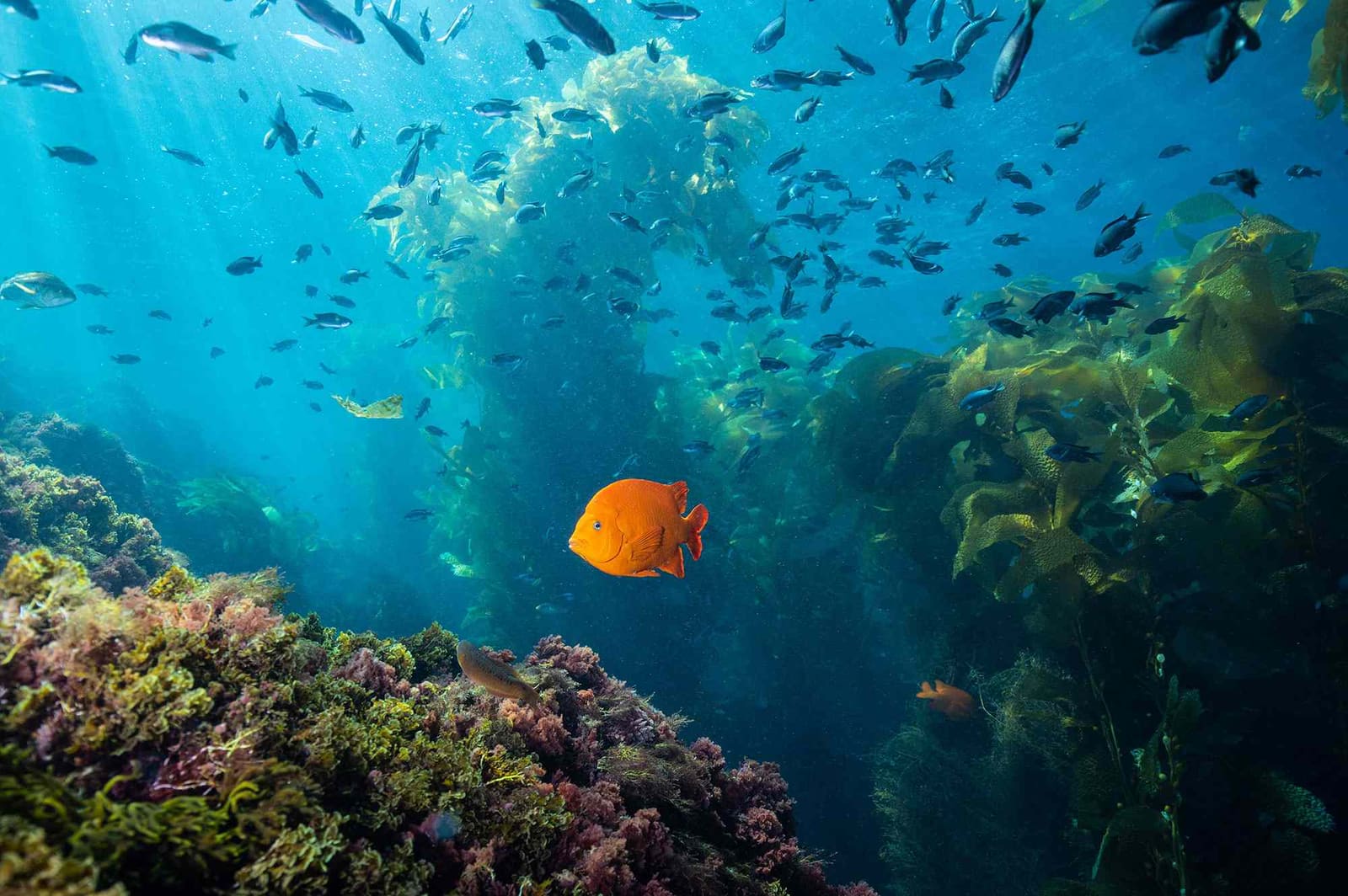
There is a moment, perhaps twenty feet below the surface, when the light begins to change. The sun filters through kelp fronds in shafts of amber and green, and the water takes on the quality of stained glass. You are swimming through architecture - living columns that stretch toward the surface, swaying in the current, creating corridors and chambers that shift with the tide. This is Catalina Island's underwater signature, and it is unlike anything else along the California coast.
At Global Chic Voyage, we've watched diving destinations cycle through trends and accolades, but certain places earn their reputations not through marketing but through the quiet authority of their natural drama. Catalina, lying just twenty-two miles off the Southern California mainland, has long been known to the diving community as a site of exceptional richness. According to PADI, the island now holds the distinction of being named the top scuba diving destination in the United States, a recognition that speaks to both the diversity of its marine ecosystems and the accessibility of its waters.
The Architecture of Kelp
The kelp forests here can rise nearly one hundred feet from the ocean floor, creating vertical landscapes that divers navigate like explorers in a flooded cathedral. Giant kelp, Macrocystis pyrifera, grows faster than almost any plant on earth, capable of adding two feet to its length in a single day under ideal conditions. The result is a forest that is never static, always regenerating, always in motion.
Swimming through these groves requires a different kind of awareness. You move not just forward but upward and downward, following channels that open and close depending on the swell. The kelp itself becomes a reference point, a living anchor that orients you in three-dimensional space. Small fish dart between the fronds. Garibaldi, California's state marine fish, flash their improbable orange against the green. Seals occasionally drift past, curious and unhurried.
The ecosystem here is not merely picturesque; it functions as a nursery and hunting ground for species ranging from the microscopic to the massive. The kelp provides both shelter and food, and its presence supports a food web that includes everything from tiny amphipods to the apex predators that patrol the deeper waters.
Encounters With the Giants
Among the most compelling reasons to dive Catalina is the possibility of encountering the giant sea bass, a fish that can exceed six feet in length and weigh more than five hundred pounds. These creatures, once hunted nearly to extinction, have made a slow recovery along the Southern California coast, and Catalina's waters offer some of the most reliable sightings.
To see one is to understand scale in a new way. They move with a kind of slow deliberation, their bulk rendering them nearly weightless in the water. There is no aggression in their presence, only a kind of ancient patience. They regard divers with mild curiosity, sometimes allowing close approaches, sometimes drifting away into the blue with a single sweep of their broad tails.
The return of the giant sea bass is a conservation success story, one that reflects decades of protection and habitat restoration. Diving here becomes not just recreation but a form of witness - a chance to see what the ocean looks like when given the opportunity to heal.
Practicalities and Access
Catalina's diving infrastructure is well developed without being overdeveloped. The island offers a range of entry points, from shore dives accessible to beginners to boat dives that take experienced divers to offshore pinnacles and deeper walls. Water temperatures hover in the mid-fifties to mid-sixties Fahrenheit, requiring wetsuits or drysuits depending on the season and personal tolerance.
Visibility varies with the seasons and the currents, ranging from twenty feet on cloudier days to more than one hundred feet when conditions align. Late summer and early fall tend to offer the clearest water, though the kelp forests are at their most robust in late spring and early summer.
The island itself is reached by ferry from San Pedro, Long Beach, or Dana Point, with crossings taking roughly an hour. Avalon and Two Harbors serve as the primary bases for diving operations, each offering a different character - Avalon with its Mediterranean-inflected charm, Two Harbors with its quieter, more rustic appeal.
Why Catalina Endures
In an era when divers routinely travel to the far corners of the Indo-Pacific or the Caribbean in search of coral reefs and warm water, Catalina offers a different proposition: a cold-water ecosystem of remarkable complexity, accessible within an hour of one of the world's largest metropolitan areas. The kelp forests here rival the biodiversity of tropical reefs, and the experience of diving them carries a particular quality - temperate, shadowy, layered.
The island's designation as a premier diving destination is not a revelation to those who have been exploring its waters for decades, but it serves as a useful reminder that extraordinary marine environments exist not only in remote atolls but also within reach of urban centers. Catalina's underwater landscapes are a product of nutrient-rich upwelling, rocky substrates, and protection policies that have allowed ecosystems to recover and thrive.
For those of us who measure travel not in stamps collected but in moments of genuine encounter, Catalina offers something increasingly rare: proximity without compromise, accessibility without diminishment. The kelp forests rise and sway, the giant sea bass glide through the green light, and the island continues to hold its secrets just beneath the surface, waiting for those willing to descend.
Spot something wrong? Email editors@globalchicvoyage.com. We log every correction publicly.
RELATED
SEE ALL →
6 Jul 2026 / 5 min
24 Jul 2026 / 5 min
14 Jun 2026 / 5 min
7 Aug 2026 / 5 min