Philippe Starck Plants a Village in the Portuguese Hills
In the cork forests and ochre cliffs of Alentejo, the industrial designer is building A Serra, a 25-suite hotel and villa enclave shaped by the landscape and by absence.
The Story Begins With a Note
Philippe Starck imagined two people first: a writer and a musician, living somewhere in the Serra de Grândola hills. Their dwellings would be geometric, almost sculptural, sitting among cork forests the colour of rust. Inside, evidence of their lives - books, musical scores, instruments - but no inhabitants. Only a note left on a desk: "Join me in the village, down below."
That fiction became the organising principle for A Serra, a hospitality project near Melides in Portugal's Alentejo region. Developed by Larfa Properties, the estate comprises 25 hotel suites, 22 private villas, restaurants, wellness facilities, and creative studios spread across 200 hectares. The hotel is scheduled to open in the second quarter of 2028, with residences available now from six million dollars. Owners receive access to concierge services, housekeeping, restaurants, spa facilities, and a year-round creative programme.
Starck has maintained a home in Alentejo for years, drawn to the region's lagoons, sunsets, and a coastline he describes as catching fire at dusk. That attachment shaped the brief: A Serra should feel as though it had always been there, embedded in the terrain rather than imposed upon it.
A Village, Not a Resort
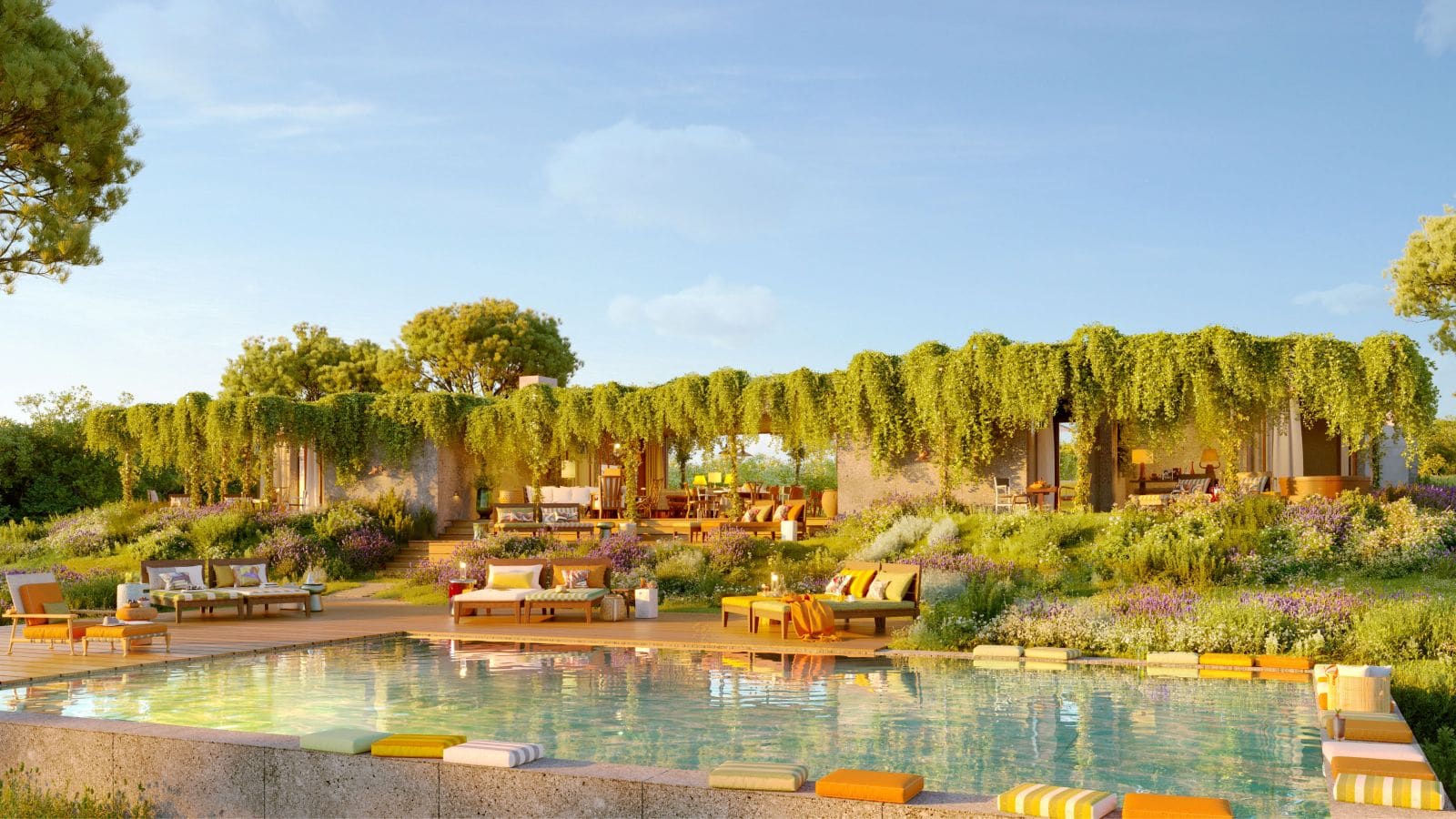
The layout follows the narrative Starck wrote. Mineral structures sit uphill; timber buildings gather at the foot of the slope, forming what he calls an aldeia - a Portuguese village. A raised main street connects a farm-to-table restaurant and vegetable garden, a café with a market-style shop, an art studio, and a swimming pool.
Stéphane Delplancq of Larfa Properties set the tone early: nothing superfluous, nothing competing with the site's hills, vegetation, or Atlantic horizon. Lisbon-based Atelier AAVV, led by Miguel Passos de Almeida, handled planning and construction. Landscape architect Filipa Cardoso de Menezes of FC Arquitectura Paisagista designed the grounds, layering native planting across the estate.
Each of the 25 hotel suites offers 70 square metres of interior space and a 90-square-metre terrace; 12 include private pools. A central pool and indoor-outdoor bar anchor the communal areas, alongside a restaurant intended for gathering rather than formality. The 22 villas take similar visual cues - concrete shells softened by terracotta, red-toned woods, natural leather, and touches of gold. Starck likens them to ship cabins emerging from the earth: intimate interiors held within protective exteriors, warmed by vegetation.
Craft Without Costume
Local artists and craftspeople will contribute to the interiors, though Starck has resisted literal renderings of regional style. The materials - cork, terracotta, timber - are rooted in Alentejo, but the aesthetic avoids pastiche. Instead, A Serra is intended to absorb the talents and personalities of those who pass through it, a setting where cultures meet without flattening into decoration.
At the village, workshops for painting, pottery, sculpture, drawing, and cooking sit alongside a spa, yoga shala, children's garden, and courts for tennis, padel, and pétanque. The programming is designed to sustain activity throughout the year, countering the seasonal rhythms of many coastal retreats.
Starck has described the project as a refuge of living art, a phrase that gestures toward the role he envisions for the estate: not a static luxury product but a site of ongoing creativity and exchange. The residences are fully serviced, bridging the privacy of a home with the infrastructure of a hotel. Delplancq calls it a living destination, a model that collapses the boundary between hospitality and habitation.
Why It Answers a Shift
A Serra arrives at a moment when luxury hospitality is recalibrating. The appetite for highly designed but impersonal resorts has cooled; in its place, a preference for projects rooted in place, shaped by local materials, and sustained by year-round programming rather than transient tourism. Starck's involvement signals credibility - his work on projects such as Brach Madrid and Maison Heler Metz established a signature blend of narrative, craft, and spatial intimacy - but A Serra's success will hinge on execution, not pedigree.
The Alentejo region has become a magnet for this kind of development, its relative seclusion and unspoiled coastline attracting investors and designers seeking alternatives to the Algarve's overdevelopment. A Serra positions itself within that trend, though its scale and price point place it firmly in the rarefied segment of the market.
The residences, starting at six million dollars, are being sold off-plan, a model that requires buyers to trust not only the design but the developer's ability to deliver on the vision. Larfa Properties' prior work includes Nhà Estate, also designed by Starck, in Vietnam. That project offers a precedent, though A Serra's ambition - to function as a village rather than a resort - represents a more complex proposition.
The Absence at the Centre
Starck's narrative device - the absent couple, the note on the desk - becomes more than a branding exercise. It suggests that A Serra is built around a kind of longing, a search for connection and place that the estate promises to fulfil. The writer and musician are proxies for the residents and guests, figures who arrive seeking refuge, creativity, and a life lived at a slower tempo.
Whether that vision holds depends on the community that forms. The shared spaces, the workshops, the farm-to-table restaurant - all are designed to foster interaction, but forced conviviality is the pitfall of many such projects. A Serra's success will be measured not by its architecture or interiors but by whether it becomes what Starck imagined: a place where people gather, create, and feel at home.
The cork forests, the lagoons, the sunsets - these remain constant. What A Serra adds is infrastructure for living within them, a village built around the possibility of staying.