Where Couture Lives Forever: Eight Museums That Rewrite Fashion History
From Parisian salons frozen in silk to archives that hold the blueprint of modern dress, these institutions prove that fashion is memory made wearable.
The Salon Where Time Stopped
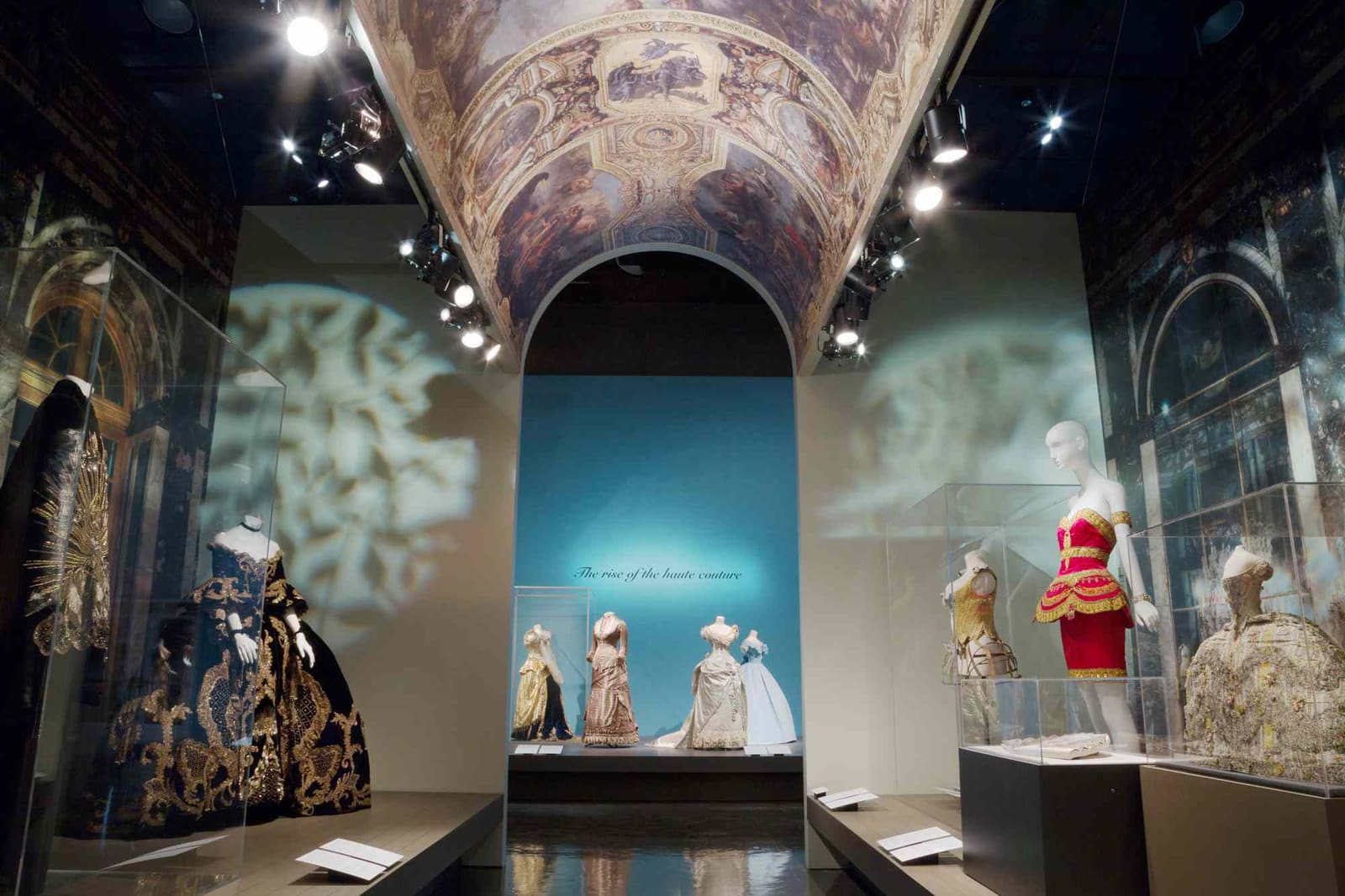
In a hushed gallery where the light falls at precisely the angle needed to protect silk from decay, a 1947 Bar jacket hangs as if waiting for its wearer to return from lunch. The waist is impossibly narrow, the peplum a study in geometry, the shoulders soft as a whisper. It is not fashion in the sense of what one might wear today. It is fashion as architecture, as philosophy, as a moment when the world exhaled after war and women wanted their bodies back.
This is what the best fashion museums understand: that clothing is never just clothing. It is the skin we choose, the story we tell before we speak, the archive of how we have moved through the world. And in certain institutions scattered across continents, that understanding is curated into something close to reverence.
Paris: The Cathedral of Couture
The Palais Galliera stands in the 16th arrondissement like a temple to the religion of French dressmaking. Its permanent collection spans three centuries, but it is the temporary exhibitions that draw pilgrims: retrospectives of Balenciaga's sculptural precision, Dior's New Look as cultural earthquake, Yves Saint Laurent's radical femininity. Here, the garments are displayed not on mannequins but on forms that mimic the bodies they were made for, so that a 1920s Poiret coat drapes with the same languor it would have had on the shoulders of a woman stepping into a Montparnasse café.
What sets Galliera apart is its refusal to separate fashion from its social context. A 1968 minidress is shown alongside photographs of student protests. A Worth gown from the Second Empire is paired with documents detailing the economic structure of the atelier system. The message is clear: fashion does not float above history. It is woven into it.
London: The Democracy of Dress
The Victoria and Albert Museum holds one of the world's most comprehensive fashion collections, and its approach is deliberately inclusive. Next to a Vivienne Westwood punk ensemble, you might find a 17th-century embroidered waistcoat, a Savile Row suit from the 1930s, a Zandra Rhodes gown that looks like a sunset trapped in chiffon. The V&A treats fashion as vernacular culture, as something made by hands for bodies, regardless of whether those hands belonged to a Mayfair tailor or a Birmingham seamstress.
The museum's recent exhibitions have traced the evolution of undergarments, the politics of the T-shirt, the global influence of African textiles on European design. There is no hierarchy here, no insistence that haute couture is inherently more worthy of study than workwear or streetwear. It is fashion as anthropology, and the result is endlessly illuminating.
New York: The Spectacle Machine
The Costume Institute at the Metropolitan Museum of Art has become, in the 21st century, something closer to a cultural phenomenon than a museum department. The annual Met Gala, which funds the Institute's operations, has transformed fashion exhibition into mass spectacle, and the shows themselves have grown accordingly ambitious. "Heavenly Bodies," which explored fashion's engagement with Catholicism, drew 1.7 million visitors, according to the Met, making it the museum's most attended exhibition ever.
But beneath the celebrity and the Instagram moments, the Costume Institute does serious scholarly work. Its archives hold more than 33,000 objects, from 15th-century European court dress to contemporary avant-garde pieces. The conservation labs are where damaged textiles are brought back from the edge of disintegration, where the chemistry of dye and the physics of fabric are studied with the same rigor applied to Old Master paintings.
Florence: The Medici Legacy
The Museo della Moda e del Costume, housed in the Pitti Palace, occupies rooms that once belonged to the family that bankrolled the Renaissance. The collection spans from the 18th century to the present, but it is the early pieces that stop breath: gowns of such intricate construction that they seem less sewn than grown, embroidery so dense it becomes a second fabric, silks that have survived centuries and still hold their color.
Here, fashion is presented as a continuum with the decorative arts that Florence has always excelled at: ceramics, metalwork, tapestry. A 1780s court dress is displayed near a contemporaneous piece of Florentine marquetry, and the visual rhyme is intentional. Both are objects made by artisans working at the highest level of their craft, both are products of a culture that understood luxury as a form of civic identity.
Antwerp: The Laboratory
MoMu, the fashion museum in Antwerp, occupies a different philosophical space. This is a city that produced the Antwerp Six, the generation of designers who in the 1980s dismantled and reassembled the language of fashion, and the museum reflects that spirit. Exhibitions here are often conceptual, exploratory, willing to ask uncomfortable questions about consumption, identity, the environmental cost of the industry.
A recent show examined the archive itself as a form of power: who decides what gets saved, what gets shown, whose stories are told and whose are erased. Another traced the influence of Japanese design on European fashion, not as appropriation but as conversation. MoMu is less interested in fashion as object than in fashion as system, as ideology, as a set of choices that ripple outward into the world.
Kyoto: The Kimono as Philosophy
The Kyoto Costume Institute, known as KCI, holds one of the world's foremost collections of Western fashion, which might seem paradoxical until you consider the Japanese approach to craft and preservation. Here, an 18th-century robe à la française is treated with the same care that might be given to a centuries-old kimono: the humidity controlled to the degree, the light measured in lux, the handling ritualized.
But KCI also maintains a significant collection of Japanese dress, and it is in the dialogue between these traditions that the museum finds its deepest insights. A Comme des Garçons piece from the 1980s, with its radical deconstruction of Western tailoring, is shown in the context of kimono construction, where the garment is a series of rectangles, where negative space is as important as fabric. The exhibition argues, without saying it outright, that fashion is not a Western invention exported to the rest of the world, but a language with many grammars.
Copenhagen: Sustainability as Aesthetic
The Designmuseum Danmark has in recent years turned its attention to fashion's future as much as its past. Exhibitions here grapple with the industry's environmental crisis, showcasing designers who work with deadstock fabric, who engineer biodegradable textiles, who rethink the very idea of seasonal collections. There is a Nordic pragmatism at work: beauty is not separate from ethics, and a garment that destroys the world in its making cannot be truly beautiful, no matter how exquisite the cut.
The museum's permanent collection includes pieces by Danish designers whose work has always carried that double commitment to form and function: the clean lines, the attention to materiality, the insistence that design serves life rather than the other way around. It is fashion as applied philosophy, and in an era of overproduction and waste, the argument feels urgent.
The Museum as Memory
What all these institutions share is an understanding that fashion is a form of collective memory. Every garment is a record of the technology available to make it, the labor that constructed it, the body it was intended for, the occasion it was meant to mark. A wedding dress from 1890 tells you about textile production, about the economics of marriage, about ideals of femininity, about the hands that sewed each tiny button. A Chanel suit from 1965 tells you about women entering the workforce, about the simplification of dress, about the idea that elegance could be comfortable.
In an age when fashion is increasingly fast, disposable, digital, these museums perform a crucial act of resistance. They insist that clothing matters, that it is worth preserving, studying, arguing about. They create a space where you can stand in front of a dress that is two hundred years old and feel the shock of recognition: someone made this with their hands, someone wore this on their body, someone looked in a mirror and saw themselves transformed.
Why Pilgrimage Matters
To visit these museums is to enter into a different relationship with dress. You cannot walk through galleries of centuries-old garments and then look at your own closet the same way. You cannot see the labor embedded in a hand-embroidered 18th-century waistcoat and not think about the hands that made your own clothes, and where those hands are, and what they are paid.
The best fashion museums do not simply display beautiful objects. They ask you to think about what it means to cover your body, to present yourself to the world, to participate in the vast, complex, often troubling system that is the global fashion industry. They remind you that every choice you make about dress is a choice embedded in history, in culture, in economics, in politics.
And they offer, in the careful preservation of these fragile objects, a kind of hope: that what we make with care can outlast us, that beauty need not be disposable, that the conversation between past and present is ongoing and necessary. In a gallery in Paris or London or Kyoto, standing before a garment that has survived longer than most buildings, you are part of that conversation. You are a witness to the fact that fashion, at its best, is a form of human continuity, a thread that connects us across time.