Where Ancient Myth Meets Summer Tranquility Along Italy's Forgotten Coast
Between Rome and Naples, a stretch of shore that once hosted emperors and inspired Homer's epics remains blissfully unhurried.
The Cyclops Still Watches
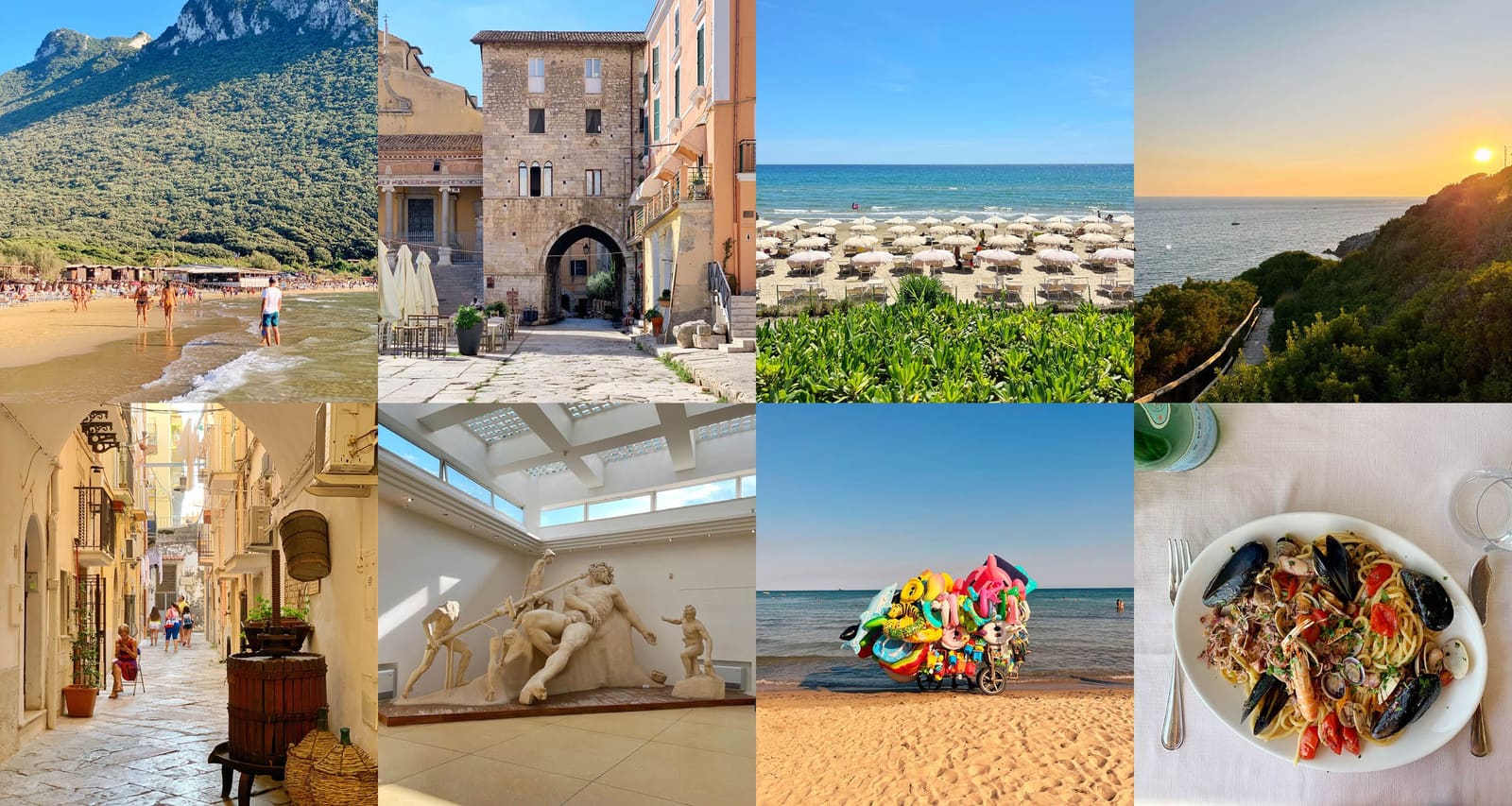
The statue looms overhead, a single eye carved into stone. Polyphemus, the cyclops who trapped Odysseus and his men in his cave, once presided over the grotto where an emperor entertained. The archaeological museum attached to the Villa of Tiberius holds this hulking figure, and standing beneath it, you can almost hear the echo of Roman banquets reverberating off cave walls. Just outside, teenage boys kick a football across compact sand, their bare feet leaving prints that the tide will erase. The hilltop town of Sperlonga rises white in the distance, its buildings stacked like sugar cubes against the blue.
This is the Riviera di Ulisse, the Ulysses Riviera, stretching some seventy-five kilometers from Monte Circeo to Gaeta. The name alone announces its pedigree: Homer's hero sailed these waters, or so the legends claim, and the Romans who followed believed it fervently enough to build their summer retreats here. At Global Chic Voyage, we've watched travelers chase glamour to Positano and Capri, yet this quieter coastline between Rome and Naples continues to hold a different kind of appeal. It offers beauty without the breathless Instagram energy, myth without the museum crowds, and a rhythm that feels decidedly, stubbornly unhurried.
Where Emperors Once Feasted
The ruins of Tiberius's villa cling to the mountainside, discovered in 1957 when road builders carved the Via Flacca to link the coastal towns. The grotto where the emperor hosted his guests sits carved into rock, overlooking water that shifts from turquoise to cobalt depending on the light. Among the villa's excavated treasures: sculptures depicting Scylla, Charybdis, and other figures from The Odyssey, tangible proof that these shores have been entwined with myth for millennia.
Local tradition places Circe's island, Aeaea, either on Ponza, the small island visible from shore, or at Monte Circeo itself. The mountain rises dramatically above the towns of Sabaudia and San Felice Circeo, and in ancient times, surrounded by marshland, it may well have appeared as an island from the sea. The sorceress who transformed Odysseus's men into swine has lent her name to the peak, and to the mystique that still clings to this coast.
A Roman Summer Ritual
For generations of Romans, summer and this coastline have been inseparable. Families return year after year, renting the same apartments, claiming the same stretch of beach, ordering the same dishes at the same family-run trattorias. There is a loyalty here that transcends fashion. While international travelers flock to Puglia or Sicily, Romans drive south from the capital for weekends that unfold with comforting predictability: morning swims, long lunches under umbrellas, evening strolls through narrow lanes where laundry hangs from iron balconies.
Ponza, the island just offshore, captures this spirit perfectly. Rocky outcrops serve as natural diving platforms. Families spread their towels on stone warmed by the sun. Little restaurants serve spaghetti with clams, the pasta perfectly al dente, the shellfish sweet and briny. Pastel buildings ring the port, their shutters faded to soft shades of pink and yellow. It feels like the Amalfi Coast must have felt sixty years ago, before the luxury hotels arrived and the day-trippers descended in waves.
The Taste of Place
In Gaeta, the medieval quarter winds upward from the port, its alleys so narrow that neighbors can pass dishes from balcony to balcony. Small shrines to the Virgin Mary are tucked into walls, decorated with fresh flowers and flickering candles. The town's signature dish is tiella, a savory pie that comes filled with either stewed octopus and tomato or escarole and olives, the pastry flaky and golden, the filling rich and deeply flavored. Beach clubs serve it in thick slices, perfect for sharing under an umbrella as the afternoon stretches long and lazy.
The descent from the Via Flacca to the beach is steep, a switchback path that delivers you to soft golden sand and water in shades of aquamarine so vivid they seem unreal. Rows of umbrellas in orange and yellow dot the shore. This is where Romans with season passes spend their days, reading paperbacks, playing cards, taking occasional swims in water so clear you can count the pebbles on the bottom.
At the outdoor market, vendors sell Gaeta olives, small and wrinkled, cured in brine until they develop a complex, almost wine-like flavor. Hole-in-the-wall bakeries turn out more tiella, which locals buy to eat by the marina, watching the fishing boats rock gently in their moorings. There is a rhythm to days here, unhurried and repetitive in the best possible way.
Layers of History Underfoot
In Terracina, a section of the Appia Antica runs through town, the ancient stones worn smooth by two thousand years of footsteps. The road once connected Rome to Brindisi, and walking it now, you follow in the path of legionaries, merchants, pilgrims. The Temple of Jupiter Anxur sits high on a promontory above the town, its ruined columns framing views that stretch the entire length of the coast. From here, you can see the curve of the shore, the way the land bends and the water glitters.
Restaurants like Da Mario l'Ostricaro occupy retro buildings overlooking the sea, their interiors unchanged since the 1960s. The seafood arrives impossibly fresh: oysters on ice, grilled fish with lemon, octopus braised until tender. Gelaterias on the main square serve sorbetto made with local strawberries, tiny and intensely sweet, their flavor concentrated by the coastal sun.
In San Felice Circeo, the town on the slopes of Monte Circeo, boutiques sell linen shirts and canvas espadrilles, the kind of uncomplicated summer clothes that never quite go out of style. The Hotel Punta Rossa exudes a particular kind of old-school glamour: whitewashed walls, tile floors, tables set with crisp linens. At sunset, aperitivo hour brings out Romans in their summer best, perched at bar tables, debating the merits of this year's vintage or that chef's interpretation of a classic dish.
The Ritual of Sabaudia
Saporetti, a wood-paneled beach shack in Sabaudia, draws affluent Romans for fritto misto and spaghetti with clams. The interior looks frozen in the 1960s, all dark paneling and simple tables. Outside, businessmen and politicians who spend their working lives in suits walk the beach in swim trunks, their usual preoccupations set aside. Conversations revolve around food, family, the quality of this year's tomatoes. The beach stretches in both directions, Monte Circeo rising to one side, a constant landmark.
This is where you see Italy's version of democratic summer: the same beach serves families from modest apartments and executives from Roman villas. Everyone claims a patch of sand, plants an umbrella, settles in. There are stretches of spiaggia libera, free beach, where you can bring your own umbrella and towels, and pay nothing for the privilege of swimming in water that belongs to everyone and no one.
Resisting the Tide of Change
Things are shifting, inevitably. Ponza's prices have climbed. A beloved fisherman's cooperative in Terracina expanded and, in the process, lost some of its original character. Yet compared to the dramatic transformation of Positano or Capri, of Puglia's once-sleepy towns or Taormina's crowded streets, this coastline remains comfortingly behind the curve. The absence of international luxury resorts has preserved a certain authenticity, a sense that summer here still belongs primarily to Italians.
Between the 1950s and 1970s, the coast attracted its share of celebrities. Alberto Sordi, Gina Lollobrigida, Pino Daniele, and Cy Twombly all kept houses here. But their presence never transformed the towns into playgrounds for the international jet set. The beaches remained accessible. The restaurants stayed family-run. The rhythm of summer continued, generation after generation, largely unchanged.
The Murals of Sperlonga
This past summer, an artist painted murals throughout Sperlonga's whitewashed hilltop town, scenes from The Odyssey blooming across walls and archways. Ulysses's ship appears perfectly framed by an arch, the golden beach visible below, the crystalline water stretching to the horizon. The murals add a new layer to the town's mythology, connecting the ancient stories to the present in vivid color.
Standing beneath that arch, looking down at the beach where children build sandcastles and couples wade into the shallows, you understand the appeal that has drawn people to these shores for thousands of years. It is not just the beauty of the water or the quality of the light, though both are considerable. It is a feeling of well-being, a sense that time moves differently here, that summer can still unfold at its own pace.
At Global Chic Voyage, we've traced the trajectories of Italy's coastal destinations, watching some transform almost beyond recognition while others hold fast to older rhythms. The Ulysses Riviera falls firmly in the latter category. It remains a place where myth and history layer together, where Romans return summer after summer, where change arrives slowly and the essential character endures. For travelers seeking Italy's coast as it once was, before the luxury boom and the social media frenzy, this stretch between Rome and Naples offers something increasingly rare: beauty paired with tranquility, and the time to appreciate both.