Where Altitude Meets Attitude: Ten Places That Reimagine the Yoga Retreat
From desert silence to Himalayan vantage points, a new geography of practice emerges at the edge of land, water, and sky.
Where the Mat Ends
There is a moment, just before dawn breaks over Ladakh's Nubra Valley, when the Siachen River runs silver beneath the Karakoram peaks and the air holds a chill that feels ancient. At The Kyagar, a boutique property built along the old Silk Route, that moment is when practice begins - not in a climate-controlled room but on a river trail bordered by wildflowers and sea buckthorn, where the altitude itself becomes part of the breath. Owner Rinchen Kalon has designed seasonal retreats here, believing the stark beauty of this landscape deepens awareness in ways no enclosed space can replicate. The outdoor sessions, held when weather allows, run thirty to ninety minutes and are complimentary for guests.
This is yoga reimagined: not as escape from the world but as immersion into it. Across continents, a handful of properties have begun to treat the practice less as an amenity and more as a dialogue with place - moving it out of pavilions and onto platforms, sandbanks, and cliffsides where the setting itself instructs.
On Water, On Sand
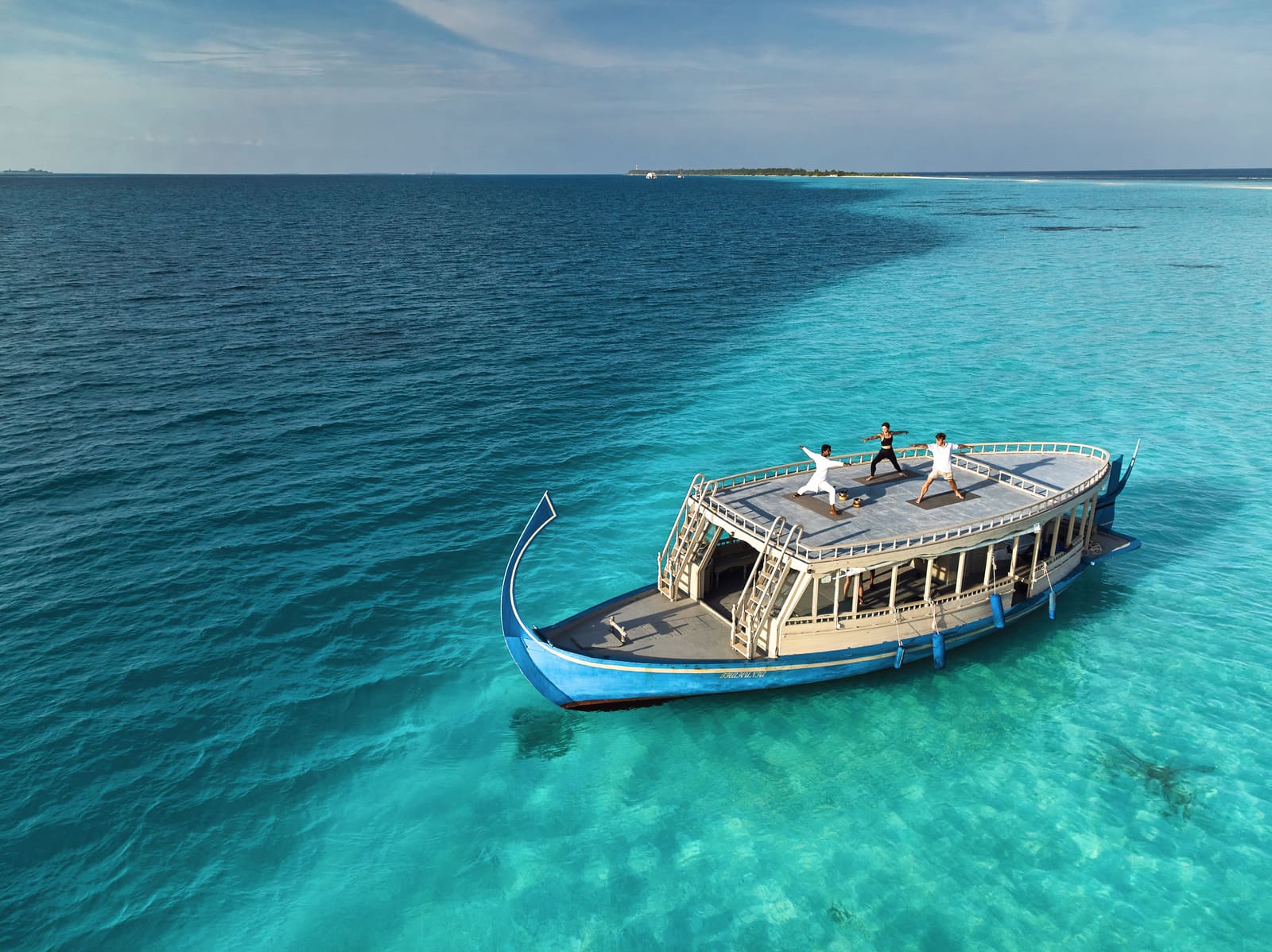
In the Maldives, Lux* South Ari Atoll has turned a traditional wooden dhow into a floating studio. During golden hour, guests sail across the Indian Ocean while an instructor leads them through asanas, Tibetan Sound Bowl therapy, and breathwork. The experience layers ritual with motion: mood-enhancing oils, chilled drinks, the gentle pitch of waves underfoot. It is yoga as voyage, the body moving in concert with a vessel that has carried fishermen for centuries.
Jumeirah Olhahali Island takes the concept further, transporting participants by speedboat to a private sandbank at sunrise or sunset. The Oceanic Balance Retreat unfolds here, tailored to the time of day - energizing sequences at dawn, grounding poses as light fades. With horizons unbroken in every direction and only the sound of surf, the sandbank becomes a study in seclusion, a temporary island where nothing distracts from the work of returning to center.
Vertical Practice
Height changes perspective, and several properties have claimed altitude as an asset. At Anantara Al Jabal Al Akhdar Resort in Oman, Diana's Point - a platform named for the Princess of Wales, who stood there in 1986 - juts over a canyon with views of the Green Mountain far below. The resort offers hatha, sarvanga, meditation, and monthly full-moon sessions on this deck, weather permitting. It is not a space for beginners nervous about edges; the drop-off is steep, the exposure total. Visit between March and May, and the valley erupts with Damask roses, their scent rising on thermals.
The Kumaon, perched in a remote corner of the Indian Himalayas, reserves its rooftop terrace - the highest point on the property - for practice. On one side, the Kosi River valley unfolds; on the other, the Binsar Forest climbs toward peaks that include Nanda Devi, considered divine. The floor is reclaimed Himalayan slate, cool underfoot, and the air carries pine and birdsong. Traditional hatha yoga and pranayama are offered here, and guests consistently describe the sessions as restorative in ways that extend well beyond the physical.
Beneath Canopy and Stars
In Phuket, Keemala Resort and Spa has positioned one of its two outdoor yoga spaces beneath a three-hundred-year-old Takian tree, a species considered sacred in Thai culture. The forest setting encourages barefoot practice, grounding participants directly to earth. No mats, just soil and roots and the rustle of leaves overhead. The resort also maintains a meditation cave beside a waterfall, designed to amplify focus through sound and negative ions. Group classes are complimentary; private instruction is available.
Sri Lanka's Haritha Villas and Spa offers a similar philosophy in Hikkaduwa, where an open-air pavilion sits within a canopy of tropical greenery. Hour-long Hatha sessions, suitable for beginners, unfold to a soundtrack of birdsong and wind through branches. Guests routinely cite the setting as a highlight, the kind of memory that outlasts tan lines and souvenir purchases.
The Desert as Teacher
In Abu Dhabi, Qasr Al Sarab by Anantara has built its wellness center at the edge of the Liwa Desert, where sand dunes stretch uninterrupted to the horizon. Sessions take place at sunrise or twilight - the former bathing the landscape in pink and gold, the latter revealing stars that feel close enough to disturb. From October to April, the resort collaborates with visiting instructors who specialize in yin yoga, sound healing, and yoga nidra. The desert offers something cities cannot: silence deep enough to hear your own pulse, stillness that forces you to confront what you bring with you.
Alpine Clarity
At the southern end of the world, Aro Hā Wellness Retreat sits on the shore of Lake Wakatipu in New Zealand's Southern Alps, forty minutes from Queenstown. The retreat's yoga room is known less for its design than for what lies beyond its windows: the alpine lake, mountains that seem to rise without end. Classes span a range of hatha styles, accommodating all skill levels, and are woven into a broader wellness program that includes subalpine hikes, daily massage, and workshops. Here, yoga is not the centerpiece but one thread in a larger tapestry of restoration.
The Aegean Edge
On the cliffs of Crete, Acro Suites has constructed its wellness studios from bamboo and local stone, angled toward the Aegean Sea and the dramatic geology of Mononaftis Bay. The property offers hatha, vinyasa, yin, and yoga nidra, all led by certified instructors. Beyond the complimentary daily sessions, guests can book couples practices, healing circles, and sound journeys. The studios face the water intentionally - every window a reminder that practice is never separate from the world, only a different way of being present within it.
Why Place Matters
There is a theory, increasingly supported by practitioners and neuroscientists alike, that environment shapes consciousness as much as technique does. The body in motion against a backdrop of geological time, biological abundance, or elemental simplicity does not merely perform poses - it recalibrates. Breath synchronizes with wind or wave. Attention sharpens when distraction is replaced by vastness or intimacy with the non-human world.
These properties have understood something fundamental: yoga, at its root, is about union - not just of body and mind but of self and surroundings. By moving practice into landscapes that demand presence, they return the discipline to its origins, when asanas were not performed in studios but in forests, on riverbanks, in caves. The settings listed here are not backdrops. They are collaborators.
What Comes After
Long after a session ends - after the mat is rolled, the dhow docked, the desert cooled - what remains is not muscle memory but a kind of spatial recall. The way light fell across a valley. The temperature of slate underfoot. The particular quality of silence at altitude or the weight of humid air beneath a jungle canopy. These are not incidental to practice; they are its architecture, the scaffolding on which transformation is built.
Travel has always been a vehicle for change, but rarely does it offer change that can be felt in real time, breath by breath. These ten places do. They ask nothing more than that you arrive, unfold a mat or stand barefoot on sand, and allow the world to teach what no instructor can. In doing so, they redefine what a retreat can be - not withdrawal, but deeper engagement with the only moment that ever exists.